One Day in Sagano: A Walking Itinerary Beyond the Bamboo Grove
The bamboo grove is where almost everyone’s Arashiyama trip starts, and for a lot of people, it’s also where it ends — a quick walk through the path, a photo, and back to the station. That’s a shame, because the real reward in this part of Kyoto is what’s just beyond the crowds: a string of small shrines and temples scattered across the lower slopes of Mount Ogura that most day-trippers never reach. This is a route for stitching those together into a single morning or afternoon, starting at the grove everyone knows and finishing somewhere much quieter.
None of this requires special planning. It’s a single continuous walk along one main road with a handful of side paths, no reservations needed anywhere along the way, and enough bus stops and train stations near the far end that you’re never more than a short ride from civilization if you want to cut the day short. What it does reward is starting early and not rushing — this is the kind of route that gets better the slower you go.
The Essentials at a Glance
| What | Details |
|---|---|
| Total walking distance | Roughly 4–5km one way if you go all the way to Otagi Nenbutsu-ji; plan on half a day |
| Start / end points | Start at Togetsukyo Bridge (JR Saga-Arashiyama or Keifuku Arashiyama Station); the far end near Otagi Nenbutsu-ji is served by Kyoto City Bus back to Arashiyama or Saga-Arashiyama Station |
| Combined admission | Roughly ¥2,000–3,000 per person if you enter every temple along the way (several, including Nonomiya Shrine, are free) |
| Best time to start | Early morning, ideally before 9:30am, to see the bamboo grove before the tour groups arrive |
| Best season | Year-round, but especially rewarding in mid-to-late autumn for the maples around Jojakko-ji and Gio-ji |
| Who it suits | Visitors who’ve already done a quick bamboo grove visit and want to see the quieter side of Arashiyama without renting a car |
Starting Point: Togetsukyo Bridge and the Bamboo Grove
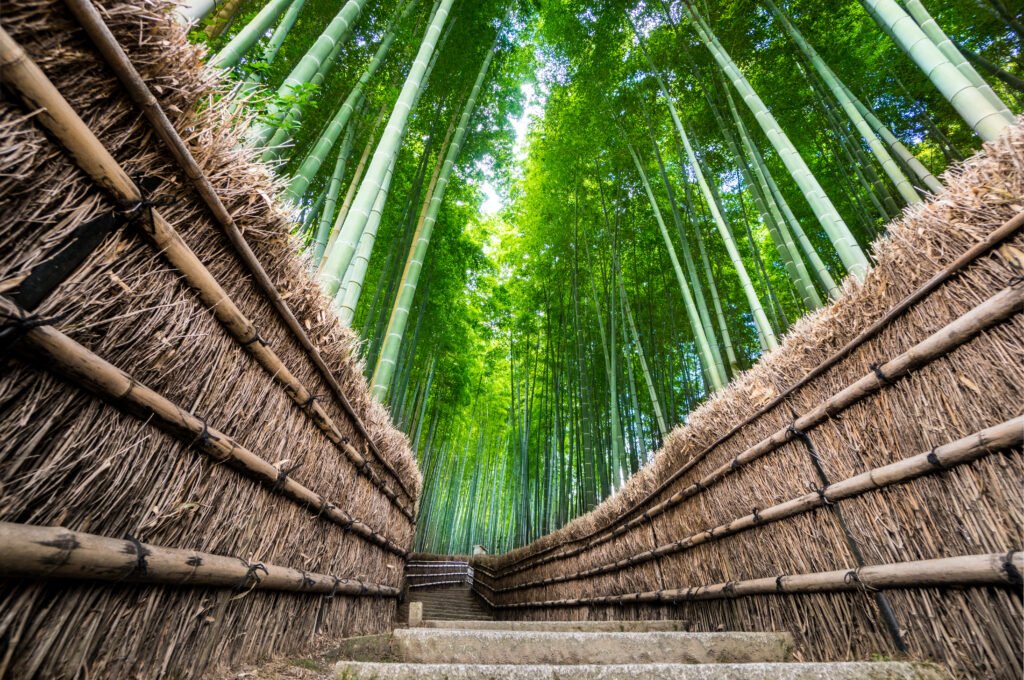
Begin at Togetsukyo Bridge over the Katsura River, the usual landmark for orienting yourself in Arashiyama, then head north into the bamboo grove and Tenryu-ji. Going early matters here more than almost anywhere else in Kyoto — the grove is a narrow path, and it fills in fast once the first tour buses arrive. If you want to add an hour, the entrance to Okochi Sanso Villa sits right at the top of the grove, and its garden view over the city is worth the detour before you continue on.

Nonomiya Shrine: A Quick Stop With a Literary Past
A couple of minutes past the bamboo grove, a small shrine with an unusual black torii gate is easy to miss if you’re not looking for it. Nonomiya Shrine was built as a purification site for the saiō, imperial women sent to serve as the emperor’s representative at Ise Shrine, who would stay here to purify themselves before making the journey east. The torii, made of unbarked wood and bordered by simple brushwood fencing, is meant to preserve that Heian-era atmosphere, and the shrine appears by name in the Sacred Tree chapter of The Tale of Genji. These days it’s known more for a turtle-shaped stone near the hall dedicated to the matchmaking deity Nonomiya Daikokuten — the custom is to touch it while making a wish. There’s no admission fee, and most people spend five or ten minutes here before moving on.
Into the Hills: Gio-ji and Jojakko-ji
From Nonomiya, the path climbs gradually toward the Mount Ogura hillside, where a cluster of small temples sit within a few minutes of each other. Gio-ji, with its thatched hut and moss garden tied to the story of a dancer abandoned by Taira no Kiyomori, is the more atmospheric of the two, while Jojakko-ji, a short walk further on, rewards the climb to its two-story pagoda with a view back over the rooftops of Saga. Both are easy to fold into the same stretch of walking, and both stay far quieter than anything you passed in the first half hour of the day.
Saga Toriimoto and the Deepest Temples
Continuing past Jojakko-ji and Nison-in, the road narrows into the Saga Toriimoto Preserved Street, a short stretch of thatched-roof houses and traditional shopfronts that leads toward a red torii gate at the edge of the old village. Beyond it are the two temples that mark the far end of this route: Adashino Nenbutsu-ji, with its field of roughly 8,000 small stone Buddhas gathered from the surrounding hillside, and Otagi Nenbutsu-ji, deeper still, where around 1,200 moss-covered rakan statues carved by amateur volunteers in the late 20th century fill the hillside with individual, slightly comic expressions. These two are genuinely the quietest stops on the whole route — by the time you reach them, you’ve usually left the day-trip crowd behind entirely.
Getting Back, or Extending the Day
Otagi Nenbutsu-ji sits far enough out that most people don’t walk back the way they came. The easiest option is the Kyoto City Bus stop nearby, which runs back toward Saga-Arashiyama Station or Arashiyama Station — check our guide to getting around Kyoto if IC cards and bus routes are new to you. If you’d rather not retrace your steps at all, it’s also possible to treat this walk as a one-way route and loop back via a different mode of transport the next time you’re in the area, pairing it with a ride on the Sagano Scenic Railway through the Hozugawa gorge on a separate outing.
What to Bring
Comfortable, broken-in shoes matter more on this route than on most Kyoto sightseeing days, since you’re covering real distance on uneven stone paths rather than moving between single sights by train. Carry some cash in small bills, since several of the temples along the way are old enough that card readers aren’t a given, and a bottle of water is worth packing since there are only a handful of vending machines once you’re past the bamboo grove. In summer, bring sun protection for the open stretches near the river; in winter, the hillside temples can feel noticeably colder than the station area, so an extra layer helps.
When to Walk This Route
This route works in any season, but it’s at its best from late autumn into early winter, when the maples around Jojakko-ji and Gio-ji turn and the whole walk slows down naturally — see our guide to Kyoto’s koyo season for the citywide timing. Our season-by-season guide has more on how this compares to spring and summer, both of which are workable here too, if quieter on color and busier on heat.
Bottom Line
Most of what makes Arashiyama worth a full day, rather than a quick photo stop, is on the far side of the bamboo grove. Give yourself three to four unhurried hours, start early, and this stretch of Sagano turns from a ten-minute selfie spot into one of the better half-day walks in Kyoto.