A Day Trip to Nagaokakyo: Komyo-ji’s Maple Tunnel and the Birthplace of the Nembutsu Teaching
Nagaokakyo doesn’t come up often in Kyoto trip planning, which is exactly why it’s worth a mention here. It’s a small city a short train ride south of Kyoto Station, and for most of the year its best-known temple, Komyo-ji, draws a modest, local crowd. For about three weeks in autumn, that changes: a 200-meter stone path lined with maples turns a quiet Pure Land temple into one of the region’s better-known foliage spots, minus the shoulder-to-shoulder crowds of Tofuku-ji or Eikando.
The Essentials at a Glance
| What | Details |
|---|---|
| Location | Nagaokakyo City, Kyoto Prefecture |
| Founded | 1198, by Kumagai Naozane (the monk Rensei) |
| Sect | Head temple of the Seizan branch of Jodo (Pure Land) Buddhism |
| Known for | The Momiji Sando, a roughly 200-meter maple-lined stone approach |
| Hours | Daily, 9:00am–4:00pm |
| Admission | Free most of the year; around ¥500 during autumn foliage season |
| Access | JR Kyoto Line to Nagaokakyo Station, then a Hankyu bus to Asahigaoka Homemae (about 2 min walk from there) |
Where Honen First Preached
The temple’s founder, Kumagai Naozane, was a samurai commander in the Genpei War of the late twelfth century, remembered today chiefly for killing the young Taira nobleman Atsumori at the Battle of Ichi-no-Tani in 1184 — an episode retold in the Tale of the Heike and later Noh drama as one of the war’s most tragic moments. By most temple accounts, the weight of that killing, among others from his years as a soldier, pushed Naozane toward Honen’s teaching; he gave up his sword for the robes of a monk under the name Rensei, also recorded as Renshobo. He is said to have built Komyo-ji on the spot where he first heard Honen — the founder of Japan’s Pure Land school — preach the nembutsu, the practice of chanting the Buddha Amida’s name that Honen taught as a path to rebirth in the Pure Land open to anyone, not only the ordained. The temple’s name is said to come from a light that reportedly appeared from Honen’s remains after his death, and the temple has remained a Honen pilgrimage site ever since, distinct from the better-known Chion-in but tied to a direct piece of his teaching history rather than a later dedication to it.
Inside the Mie Hall, the main hall housing Honen’s memorial image, a long-standing temple legend holds that the hall’s principal statue was made from papier-mâché built up from a letter written by Honen’s mother, soaked in water and worked into shape — the kind of origin story that’s impossible to verify but is told at the temple as a point of pride rather than a footnote.
The Momiji Sando
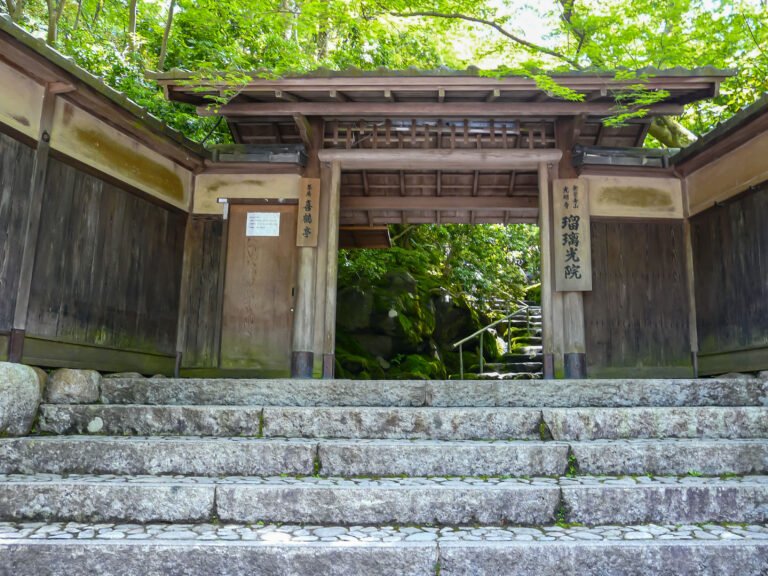
The main draw for most visitors today is the Momiji Sando, the maple approach running from the Chokushimon Gate down to the Somon Gate. It’s about 200 meters of stone steps flanked on both sides by maples old enough to form a near-continuous canopy overhead by late autumn, and when the color peaks — typically in the back half of November, a few weeks after the city’s famous Arashiyama and Higashiyama spots — the path turns into one long tunnel of red and gold. A second, gentler route beside the main slope is traditionally known as the “women’s slope,” built with an easier grade for visitors who preferred not to climb the steeper stone stairs, and it’s still there as a quieter, flatter alternative if you’d rather skip the steps.

What Else Is There
Komyo-ji is a working temple complex rather than a single photo stop, and the grounds reward a slower look beyond the maple path. The main hall and surrounding halls hold a collection of Buddhist statuary and artwork connected to the Seizan sect’s history, and the open grounds — more than thirty buildings spread across a genuinely large property — give the place a scale that’s easy to underestimate from photos of the maple path alone. Because the temple functions as the head temple of its own branch of Pure Land Buddhism rather than a single tourist attraction, there’s a working rhythm to the place: monks and staff go about ordinary temple business around visitors rather than treating the grounds purely as a sightseeing stop, and there’s rarely a sense of being rushed through, even during the busier autumn weeks. Beyond the Mie Hall and its Honen memorial image, several smaller halls and garden corners are scattered around the property for anyone willing to wander past the main maple path rather than heading straight back out the gate.

Pairing It With the Rest of Your Trip
Komyo-ji works best as a dedicated half-day out of the city rather than a stop squeezed between central Kyoto sights, given the train and bus connection involved. If autumn color is the main goal, it’s worth reading Kyoto Autumn Foliage first to see how Komyo-ji’s typically later peak fits around the timing of more central spots, and Kyoto in November for a broader sense of what else is worth scheduling around the same visit. Getting Around Kyoto is useful background on IC cards and bus fares before you head out this far from the usual sightseeing core, and if you enjoy a quieter, less-visited temple circuit, A Day Trip to Takao is a similar kind of outing — maples, a bus ride out of the city center, and noticeably thinner crowds than the headline sights.
Getting There
From Kyoto Station, take the JR Kyoto Line to Nagaokakyo Station, a ride of around ten minutes. From there, catch a Hankyu bus (routes 6, 7, 20, or 22 typically serve the stop) to Asahigaoka Homemae, then walk about two minutes to the temple. An alternative route runs via the Hankyu Kyoto Line to Nagaoka-Tenjin Station, followed by the same bus connection. Either way, allow a bit under an hour door to door from central Kyoto, and expect the bus to run slower and more crowded than usual during peak foliage weeks.
Bottom Line
Komyo-ji isn’t a must-see on a first, three-day Kyoto trip, and that’s part of its appeal. It’s the kind of stop that makes sense once you’ve already covered the major temples and want a foliage spot that doesn’t come with a wait to get in — a genuine maple tunnel, a temple with a direct line to Honen’s own teaching, and a half-day out of the city that feels like a small discovery rather than one more item checked off a list.