Gio-ji: A Practical Guide to Kyoto’s Moss Garden of a Forgotten Dancer
Past the last souvenir stand on the Adashino side of Arashiyama’s bamboo path, the crowds thin out and the road narrows into something closer to a country lane than a sightseeing route. That is where Gio-ji sits: a small, thatched hermitage wrapped in a moss garden that most first-time visitors to Kyoto never reach, mostly because it takes a deliberate walk rather than sitting on the way to somewhere else. The temple takes its name from a twelfth-century dancer, Gio, said to have retreated here after being cast aside by one of the most powerful men in Japan, and the quiet, almost domestic scale of the place still carries a bit of that story’s melancholy.
The Essentials at a Glance
| What | Details |
|---|---|
| Hours | 9:00 a.m.–5:00 p.m. daily |
| Admission | ¥300 adults, ¥100 students; a discounted combined ticket with nearby Daikaku-ji is sometimes available at the gate |
| Access | Kyoto City Bus 28 or 91 to Sagashakado-mae, then about a 15-minute walk; or JR Saga-Arashiyama Station, roughly 20 minutes on foot |
| Visit length | 30–45 minutes |
| Best time | Mid-November to early December for moss against turning maples; early summer for the moss at its most vivid green |
| Known for | A moss garden with around seventeen species, a thatched hermitage, and the Tale of the Heike story of Gio |
The Dancer Kiyomori Left Behind
Gio-ji was originally founded under a different name, Ojo-in, as a temple of the Jodo-shu Pure Land school. It picked up its present name from Gio, a shirabyoshi dancer who, according to the Tale of the Heike, became a favorite of the military leader Taira no Kiyomori in the twelfth century, only to be dropped without ceremony once Kiyomori’s attention turned to a younger performer named Hotoke Gozen. The story goes that Gio retreated here with her mother and her sister Ginyo to live out their lives as Buddhist nuns, and that Hotoke Gozen herself later joined them after falling out of favor in turn. How much of that is verified history and how much is a few centuries of storytelling smoothing out the details is genuinely hard to say, but the temple leans into the tale rather than downplaying it: the main hall holds wooden statues of all four women alongside one of Kiyomori, plus a separate image of Dainichi Nyorai, the Buddha of Light, so the human side of the story sits right next to the religious one.
Seventeen Kinds of Moss Under the Maples
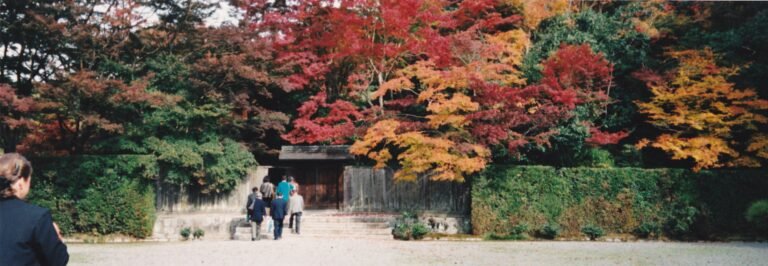
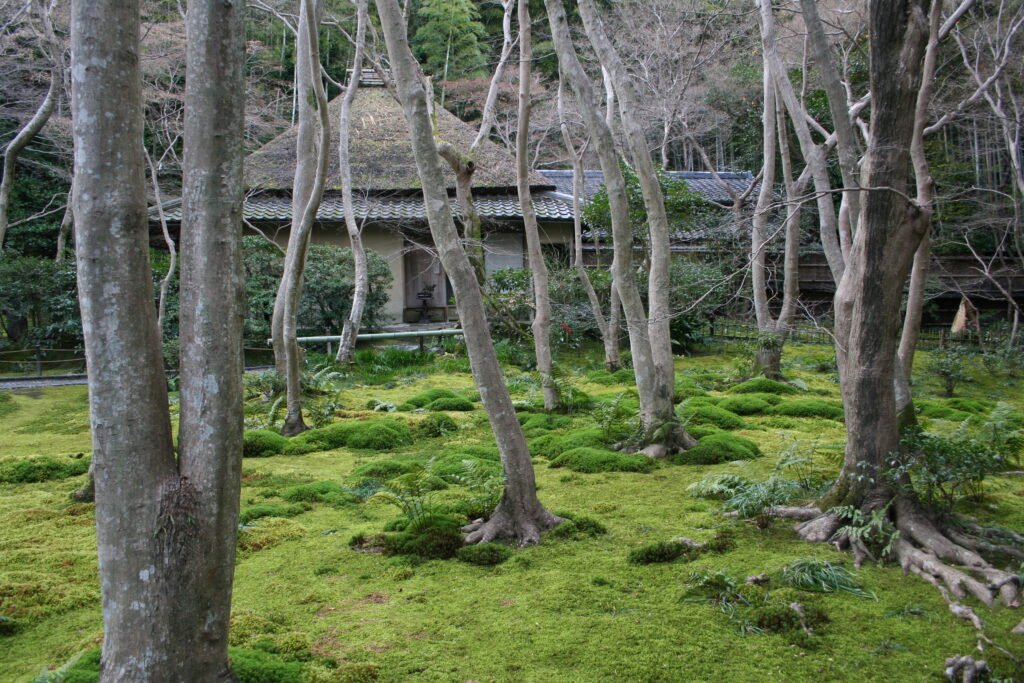
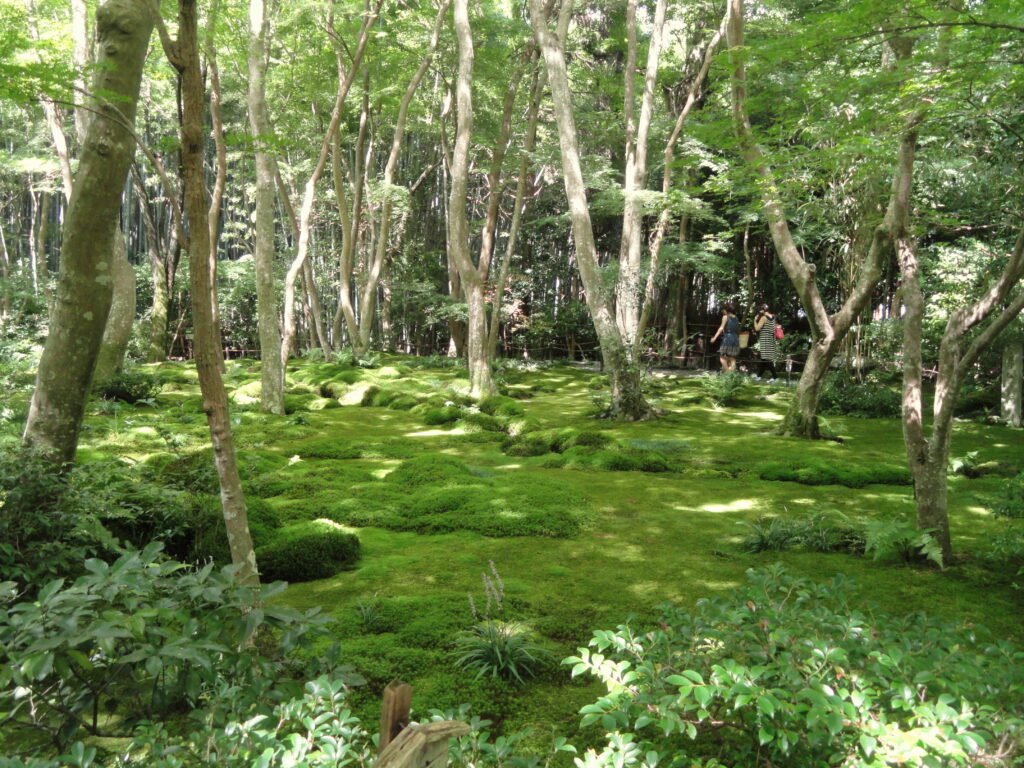
The reason people make the walk out here is the garden, not the history. Gio-ji’s grounds are covered in a dense carpet said to include around seventeen different species of moss, spreading under a canopy of maples and a stand of bamboo that shades the whole plot even at midday. In autumn the moss stays a deep, saturated green while the maples above it turn yellow, orange, and red, which is the contrast most photographs of the temple are chasing, but the garden is arguably just as striking in early summer, right after the rainy season, when the moss is at its thickest and the crowds are close to nonexistent. A small thatched pavilion sits at the center of the grounds, its roof built in the traditional kayabuki style, where visitors can sit on tatami mats and look out at the moss for a while; photography is not allowed inside the pavilion itself, so it is one of the few spots left in central Kyoto tourism where you are more or less obligated to just look at something instead of photographing it.
Part of a Quieter Sagano Walk
Gio-ji sits in the Toriimoto neighborhood, the same northern stretch of Sagano that holds Otagi Nenbutsu-ji and its field of individually carved stone rakan, and Adashino Nenbutsu-ji with its roughly eight thousand weathered stone Buddhas. All three are a genuine walk from the main Arashiyama Bamboo Grove and Tenryu-ji area, twenty to thirty minutes on foot depending on your pace, which is exactly why this side of Sagano stays so much calmer than the bamboo grove itself. If you are willing to make that walk, a natural order is bamboo grove and Tenryu-ji first, then north to Gio-ji, then Adashino Nenbutsu-ji a little further along, with Otagi Nenbutsu-ji as the final, furthest stop. Doing all four in one go is a half-day commitment, but you end up seeing a side of Arashiyama that the tour buses mostly skip.
Planning Your Visit
Bring shoes you can slip off easily, since you will need to remove them before stepping up into the thatched pavilion, and the floor there is tatami like most temple interiors in Kyoto. The paths through the moss garden are narrow gravel, roped off from the moss itself, so there is no real risk of accidentally stepping on centuries of careful cultivation, but they do get slick after rain, which is worth knowing if you are visiting during a wet spell. Umbrellas are provided at the gate on rainy days, and the moss itself only looks better for the extra moisture, so a drizzly morning is not a reason to skip the trip; it is arguably when the garden is at its most photogenic, with the greens deepened and the gravel paths quieter than usual. Because Gio-ji is small, thirty minutes is enough time for most visitors, which makes it easy to pair with a stop at nearby Daikaku-ji, and the discounted combined ticket sometimes offered at the gate is worth asking about if you plan to see both on the same day. If you are timing a trip around the leaves, our Kyoto Autumn Foliage guide covers how the citywide koyo season tends to unfold, which is useful context since a temple this dependent on moss-and-maple contrast is very much a peak-season destination.
Bottom Line
Gio-ji is not a temple you stumble into on a first visit to Kyoto, and that is more or less the point. It rewards the extra twenty minutes of walking with a genuinely quiet moss garden, a small human story to go with it, and none of the crowd management that comes with Arashiyama’s bigger draws. If you already have a free afternoon planned around the bamboo grove and its northern neighbors, this is an easy and worthwhile detour to add to the list.