Okochi Sanso Villa: A Practical Guide to the Film Star’s Garden Above Arashiyama’s Bamboo Grove
Almost everyone who walks Arashiyama’s bamboo grove reaches the top of the path, takes one last photo, and turns around. Right at that turning point there’s a ticket window that most of them ignore, and behind it is the place I’d send you if you asked where the crowds thin out: Okochi Sanso, the hillside villa and garden that a silent-film star spent roughly thirty years building for himself. The entry fee is higher than most temples in the area, which is exactly why it stays quiet, and it includes a bowl of matcha and a sweet at the end of the walk.
The Essentials at a Glance
| What | Details |
|---|---|
| Admission | Around 1,000 yen for adults and around 500 yen for children, with matcha and a small Japanese sweet included — prices can change, so treat this as a guide |
| Hours | Generally 9:00am–5:00pm daily; no reservation needed |
| Visit length | 45–60 minutes including the tea |
| Size | Roughly 20,000 square meters on the slope of Mount Ogura |
| Access | At the upper end of the bamboo grove path; about 15 minutes on foot from Keifuku Arashiyama Station or JR Saga-Arashiyama Station, and a few minutes from Torokko Arashiyama Station |
| Good to know | The route is one-way with stone steps and uneven paths, so it isn’t suited to strollers or wheelchairs |
Who Was Okochi Denjiro?
Okochi Denjiro (1898–1962) was one of the biggest names in Japanese period film from the silent era onward, best remembered for playing Tange Sazen, a one-eyed, one-armed swordsman who became a fixture of prewar cinema. Kyoto was the center of samurai filmmaking at the time, and the studios clustered in the Uzumasa area just east of Arashiyama, so living out here made sense for a working actor. What makes his story unusual is what he did with the money. Starting in the early 1930s, when he was in his mid-thirties, he began buying land on Mount Ogura and shaping it into a private garden, and he kept adding to it, by most accounts pouring a large share of his film earnings into the project, until his death three decades later. The estate opened to the public after he died and is still privately run.
Walking the Route
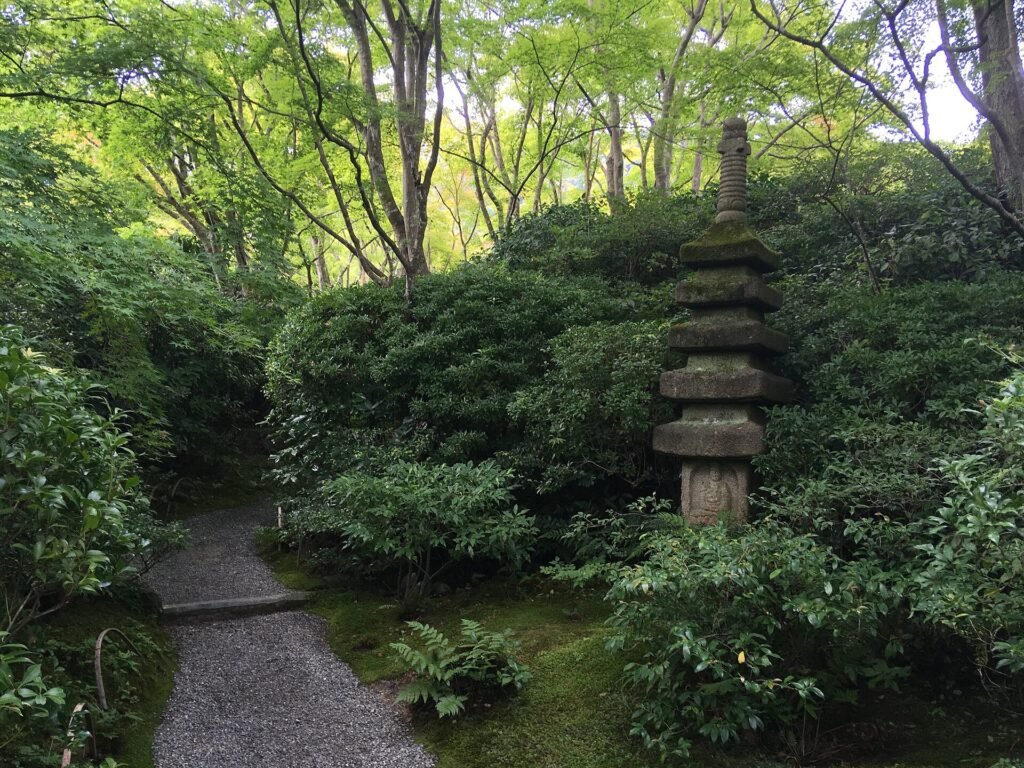
The visit follows a single marked path with arrows, so there’s no way to get lost and no need to plan. It climbs gently from the entrance through moss, maples, and pines, and the buildings appear one at a time. The first major one is Daijokaku, the main residence, which combines several traditional Japanese architectural styles under one roof and sits on a lawn facing east toward the city. You can’t go inside, but the exterior and its setting are the point. Further on you pass Jibutsudo, a small Buddhist hall that is said to be where the whole project started and where Okochi came to meditate between shoots, and Tekisuian, a rustic tea hut tucked into the trees.
What I like most is how deliberately the views are rationed. The path keeps you enclosed in greenery and then opens suddenly at a few lookout points. On one side you see across Kyoto to the Higashiyama hills and Mount Hiei; on the other, the ground drops away toward the Hozu River gorge and the mountains behind Arashiyama. On a clear day, this is one of the better views in western Kyoto, and you’ll usually share it with a handful of people rather than a few hundred.

The Tea at the End
Your ticket includes a bowl of matcha and a small sweet, served in a tea house near the exit. It’s a simple, self-seated affair rather than a formal tea ceremony, so there’s no etiquette to worry about: hand over your ticket stub, find a seat, and drink it while looking out at the bamboo. After the push and noise of the grove below, ten minutes sitting here is a big part of what you’re paying for. There’s also a small open-air display of photographs and materials from Okochi’s film career near the end of the route, which is worth a few minutes even if you’ve never seen his films.
When to Visit
Autumn is the obvious season. The garden is planted heavily with maples, and in a typical year they color from mid to late November, in line with the rest of Arashiyama — our guide to Kyoto’s koyo season covers how the timing shifts across the city. It gets busier then, but still nothing like the temples on the valley floor. Spring brings cherry blossoms and azaleas, and early summer is when the moss is at its best. Whatever the season, come in the morning if you can. The bamboo grove is far more pleasant before 9:00am, and arriving at the villa when it opens means you get the lookouts nearly to yourself.
Is It Worth the Price?
This is the question I get asked most about Okochi Sanso, because the fee is roughly double what nearby temples charge. My answer is yes for most visitors, with two caveats. If you’re on a tight budget and have already paid for Tenryu-ji’s garden, you can skip it without missing a headline sight. And if you have limited mobility, the steps and slopes make it hard going. Otherwise, the combination of a well-kept stroll garden, wide views, a quiet seat, and a bowl of tea adds up to good value, especially since the tea alone would cost several hundred yen elsewhere in Arashiyama.
Pairing It with Nearby Sights
The natural approach is through Tenryu-ji: exit the temple’s north gate straight into the bamboo, walk uphill, and you arrive at the villa entrance. Our guide to the Arashiyama Bamboo Grove and Tenryu-ji covers that stretch in detail. From the villa’s exit you’re a few minutes from Torokko Arashiyama Station, where the Sagano Scenic Railway departs along the Hozu gorge you were just looking down on. If you’d rather keep walking, head north into the quieter Sagano lanes toward Gio-ji and its moss garden, about fifteen to twenty minutes away on foot.
Getting There
From central Kyoto, the JR Sagano Line from Kyoto Station to Saga-Arashiyama is the fastest route, and the Keifuku (Randen) tram drops you closest to Tenryu-ji and the start of the bamboo path. Hankyu Arashiyama Station is on the far side of the river and adds another ten minutes or so of walking. From any of them, follow the signs to the bamboo grove and keep going uphill until the path ends; the villa entrance is on your left at the top.
Bottom Line
Okochi Sanso is the calm that the bamboo grove promises and rarely delivers. One man’s thirty-year project gives you a garden, two big views, and a seat with a bowl of tea, all a few steps from one of the busiest paths in Kyoto. If Arashiyama is on your itinerary, set aside an extra hour for it.