Shoden-ji: A Practical Guide to the Hidden Garden That Borrows Mount Hiei
Entsu-ji‘s claim to fame is a dry garden that borrows Mount Hiei as its backdrop instead of building the whole view out of rock and gravel. Shoden-ji, tucked into the Nishigamo hills on the opposite side of the city, does roughly the same trick with a different cast of supporting characters — clipped azalea bushes standing in for rocks, trimmed into groups the gardener was clearly counting out on purpose — and gets a fraction of the visitors. It’s further out, the bus ride takes longer, and that’s more or less the whole reason it has stayed this quiet.
The Essentials at a Glance
| What | Details |
|---|---|
| Location | Nishigamo, Kita-ku, in the hills northwest of central Kyoto |
| Tradition | Rinzai Zen |
| Founded | traditionally dated to the Kamakura period; settled on its current site in 1282 |
| Known for | a borrowed-view dry garden framing Mount Hiei, and a 17th-century “blood ceiling” salvaged from Fushimi Castle |
| Hours | daily, roughly 9:00am–5:00pm |
| Admission | around ¥500 for adults, less for students; worth confirming on-site |
| Access | city bus toward Jinko-in-mae, then a steep 15-minute walk; no nearby train station |
From a Wartime Prayer Hall to a Hillside Retreat
Shoden-ji traces itself back to the Kamakura period and a Zen master named Togan Eian, who is said to have first built a hall at Ichijo Imadegawa, near what’s now the Nijo area, to pray for the country’s protection during the Mongol invasions. The temple moved to its present site in the Nishigamo hills in 1282, a relocation the records don’t explain in detail. Like a lot of Kyoto’s older temples, it didn’t survive the Onin War intact; Toyotomi Hideyoshi later had it rebuilt, and it was revived again in the early Edo period under the monk Suden, better known by his temple name Konchi-in. That’s a name worth remembering, because Suden was also behind Konchi-in, the sub-temple at Nanzen-ji whose garden is attributed to the same designer tradition as the one at Shoden-ji — the two places are connected by more than just borrowed scenery.
A Garden Grown Instead of Carved
Shoden-ji’s garden has a name, Shishi no Ko Watashi, “lion cubs crossing the river,” and a design that swaps out the rocks you’d expect in a dry garden for clipped azalea bushes, arranged in clusters counted out in threes, fives, and sevens across a bed of white gravel. The layout is traditionally attributed to the tea master and garden designer Kobori Enshu — the same name behind Konchi-in’s garden at Nanzen-ji — though what visitors see today owes a good deal to a restoration carried out in the 1930s by the garden historian Shigemori Mirei, who left his mark on gardens across the city.
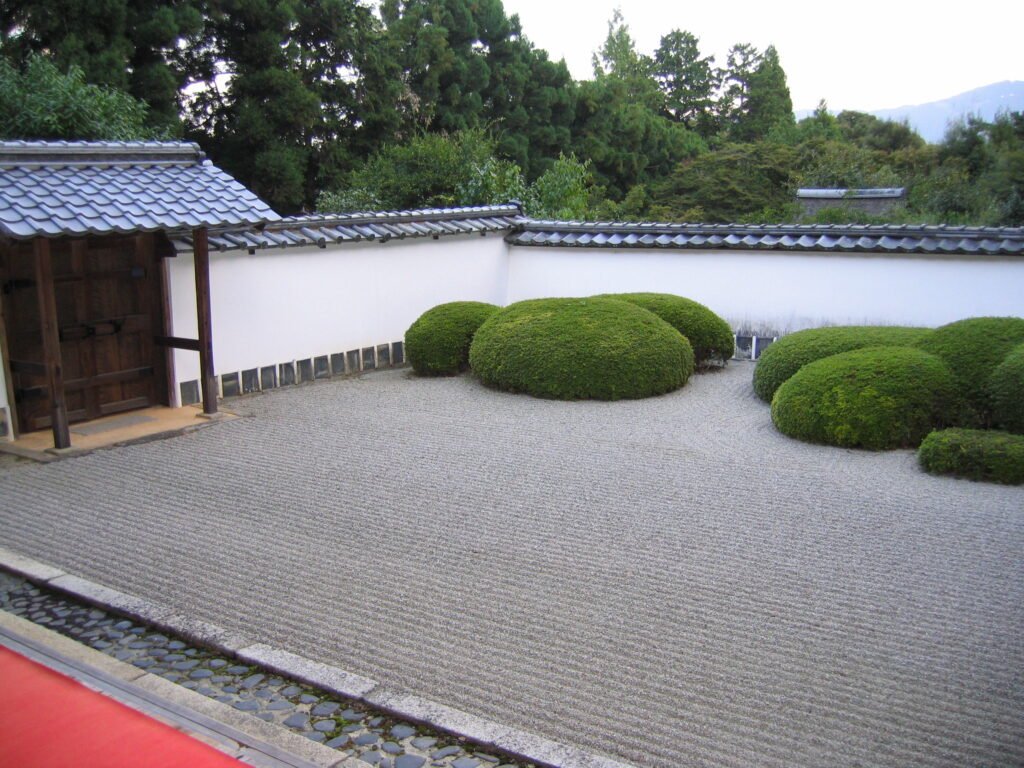
For most of the year the azaleas are just clipped green mounds, with the drama coming from the counted groupings and the view beyond rather than color; in May they bloom pink and the garden briefly looks like a different place. Either way, Mount Hiei sits framed beyond a low wall at the garden’s edge, borrowed into the composition the same way it is at Entsu-ji and, with rocks instead of rock gardens, at Ryoan-ji — three different answers to a similar question about where a garden’s walls should end.
A Ceiling With a Hard History
The Hojo, Shoden-ji’s main hall, has a quieter attraction that takes some explaining: floorboards in its ceiling, taken from Fushimi Castle after its defenders chose mass suicide over surrender ahead of the Battle of Sekigahara in 1600, installed here in 1653 to honor the dead. It’s a grim detail, but not a unique one — Shoden-ji is one of several Kyoto temples, including Hosen-in and Koshoji, that ended up with a piece of the same castle’s corridors in their ceilings after the fact.
The stains are faint enough now that it takes a guide or a sign to point them out, and most visitors spend far more time on the garden than on the ceiling above it. Photography inside the Hojo itself is generally discouraged, so save the camera for the garden and the approach; the temple’s outer grounds, including a small bamboo grove and an old graveyard, are free to wander even if you decide to skip the paid hall and garden viewing.
A Small Part in a Summer Fire Festival
Shoden-ji also has a minor role in one of Kyoto’s best-known summer traditions. Every August 16th, as part of the Gozan no Okuribi fire festival that closes out the Obon holiday by sending off the spirits of the dead, the temple helps light one of the hillside characters — a boat shape called Funayama — on the slope just behind its grounds. It’s a one-night event and not really a reason to plan a dedicated visit around, but it’s a reminder that a temple this quiet for most of the year still has a job to do a few times a season.
Getting There and Best Time to Visit
Shoden-ji is genuinely out of the way, and that’s worth planning around rather than fighting. There’s no train station nearby and no way to reach it on a JR Pass; the practical route is a city bus toward Jinko-in-mae, followed by a steep walk of around fifteen minutes up into the hills, with the bus ride alone from central Kyoto running 40 minutes or more. A taxi from the Kitaoji area cuts the time down considerably if you’d rather not deal with bus schedules on the way back down. Kamigamo Shrine sits in the same general part of the city and pairs reasonably well with a Shoden-ji visit if you’re already making the trip out this way. The garden works in any season, but the stretch from mid-November into early December — when the hillsides around Nishigamo pick up color to go with the framed view of Mount Hiei — is when the trip feels most worth the extra travel time; our Kyoto Autumn Foliage guide has more on timing that for the city as a whole.
Bottom Line
Shoden-ji asks more of you than most of the temples on this blog, in travel time if nothing else, and it gives back a dry garden that’s genuinely different from the more famous ones in town rather than a smaller version of the same idea. Go for the azalea garden and the Mount Hiei view, budget extra time for the walk up and the wait for a bus down, and treat the remoteness as the reason it’s stayed this uncrowded rather than a reason to skip it.