Randen: A Practical Guide to Kyoto’s Nostalgic Streetcar Line
Kyoto’s visitors tend to default to the subway and the JR lines, but tucked into the northwest corner of the city is a slower, smaller way to get around: the Keifuku Electric Railroad, known to basically everyone here as Randen. It’s the last surviving piece of a streetcar network that once ran across much of the city, and riding it still feels like stepping into an earlier decade — single-car trains, a flat fare paid on the way off, and a route that happens to connect several temples most visitors are already trying to reach anyway.
The Essentials at a Glance
| What | Details |
|---|---|
| Fare | Flat ¥250 for adults, ¥120 for children, paid when you get off (not by distance) |
| One-day pass | Randen 1-Day Free Ticket, roughly ¥700 adults / ¥350 children, unlimited rides on both lines; not covered by the Japan Rail Pass |
| Two lines | Arashiyama Line (Shijo-Omiya ↔ Arashiyama) and Kitano Line (Katabiranotsuji ↔ Kitano-Hakubaicho), connecting at Katabiranotsuji |
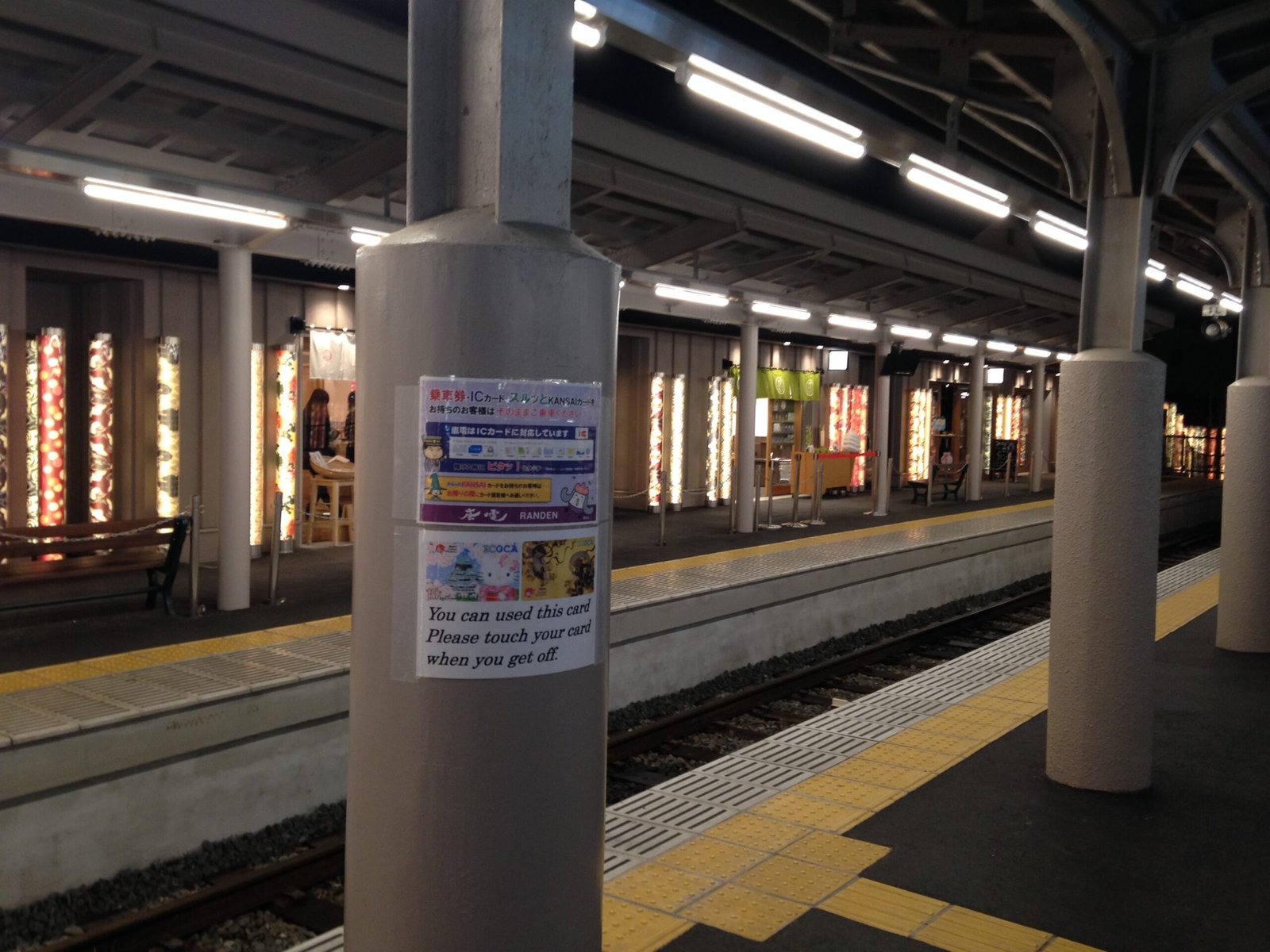
| IC cards | ICOCA, Suica, PASMO, and other nationwide cards work — tap only when you get off, not when boarding |
| Access | Shijo-Omiya connects to Hankyu Omiya Station; the Arashiyama end sits near JR Saga-Arashiyama Station |
| Best for | Stringing together several northwest Kyoto temples in one loop without bus transfers |
A Streetcar Line That Outlived the Rest of the Network
Keifuku, the company that runs Randen, also operates the Eizan Cable Car and Eizan Ropeway up Mount Hiei, so this isn’t a one-off tourist novelty — it’s a working transit operator that happens to still run trams. Kyoto once had a much larger citywide streetcar network, but the lines were shut down one by one from the 1960s into the 1970s as buses and cars took over the city’s streets. Randen is what’s left of that system, and that history is a large part of why people who grew up riding it tend to feel a soft spot for it that the subway never quite earns.
The trains themselves are part of the appeal. Most runs are single-car trams rather than multi-car sets, some of them older models still in service alongside newer, air-conditioned cars, and boarding works differently from a subway: you get on through the back or middle door without paying anything, then pay as you leave through the front, either into a fare box beside the driver or by handing your fare to a gate attendant at the four staffed stations.

Two Lines, One Transfer Point
Randen runs on two lines that meet at a single junction. The Arashiyama Line runs east-west between Shijo-Omiya, in the city center near Hankyu Omiya Station, and Arashiyama, on the far side of the Katsura River. The Kitano Line branches off the Arashiyama Line at Katabiranotsuji and heads north to Kitano-Hakubaicho. If you need to connect between the two, Katabiranotsuji is where you switch, and it’s a simple cross-platform change rather than a long walk between separate stations.
Which Randen Station Should You Use?
Most visitors only need a handful of the line’s stations. Here’s where to get off for the sights people actually ride Randen to reach, plus the stops that connect to other train lines.
| Where you’re going | Randen station | Line |
|---|---|---|
| Arashiyama Bamboo Grove & Tenryu-ji | Arashiyama (end of the line) | Arashiyama Line |
| Koryu-ji | Uzumasa Koryuji-mae | Arashiyama Line |
| Toei Kyoto Studio Park | Satsueisho-mae or Uzumasa Koryuji-mae | Arashiyama Line |
| Myoshin-ji | Myoshinji | Kitano Line |
| Ryoan-ji | Ryoanji (about a 7-minute walk) | Kitano Line |
| Ninna-ji | Omuro-Ninnaji (right at the gate) | Kitano Line |
| Kitano Tenmangu | Kitano-Hakubaicho | Kitano Line |
| Kinkaku-ji | Kitano-Hakubaicho, then about 20 minutes on foot or a short bus ride | Kitano Line |
| Hankyu Kyoto Line | Shijo-Omiya (Hankyu Omiya Station) | Arashiyama Line |
| Tozai subway line | Randen Tenjingawa (Uzumasa Tenjingawa Station) | Arashiyama Line |
| JR Sagano Line | Satsueisho-mae (a few minutes’ walk from JR Uzumasa) | Arashiyama Line |
The Arashiyama Line: Bamboo Grove to the City Center
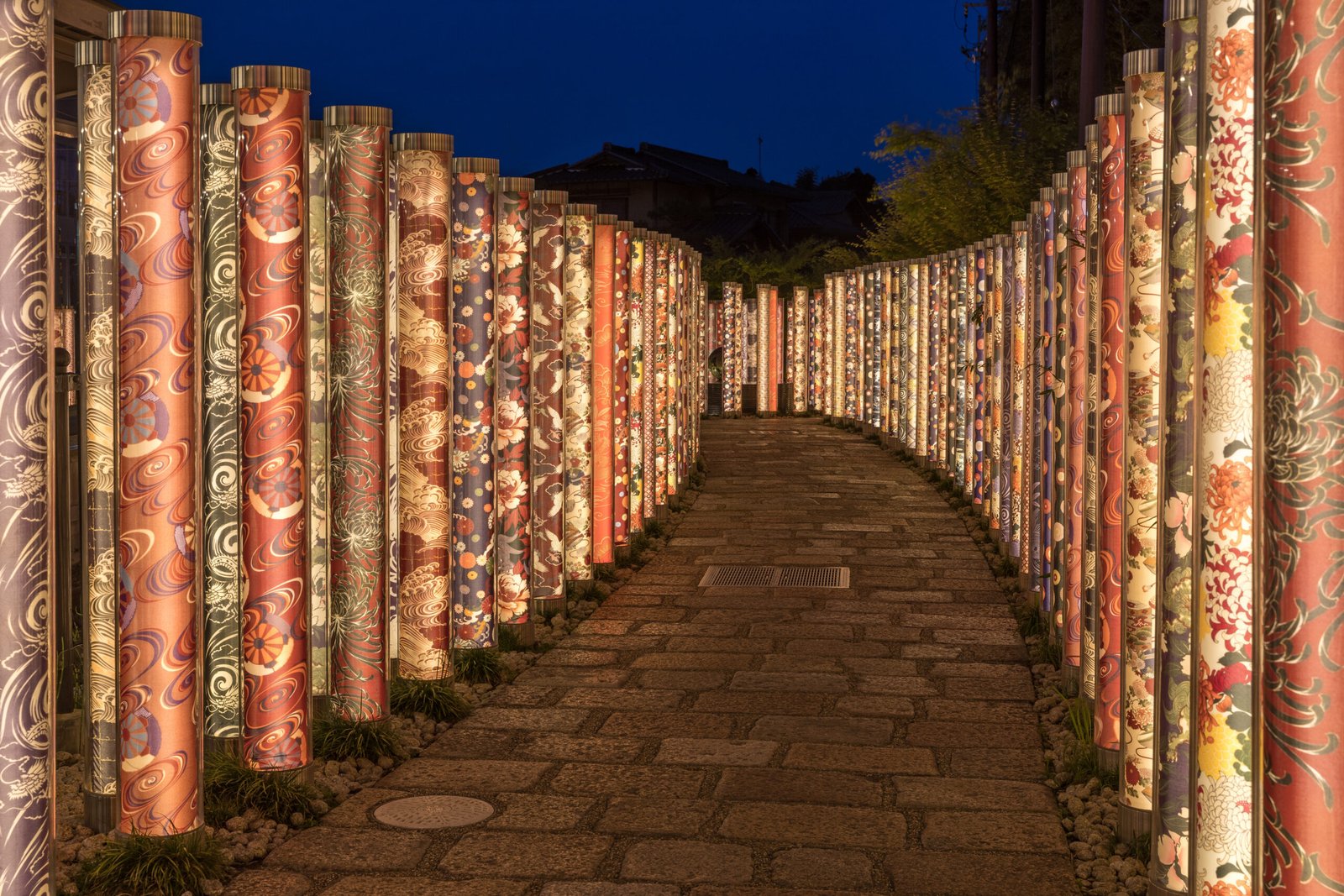
Heading out from Shijo-Omiya, the Arashiyama Line passes Uzumasa Koryuji-mae, a short walk from Koryu-ji and its seventh-century seated Miroku Bosatsu, Randen Tenjingawa, where you can transfer to the Tozai subway line, and Satsueisho-mae (literally “film studio front”), the closest stop for the samurai-movie studio park covered in our Toei Kyoto Studio Park guide. A few stops later is Rokuoin, worth knowing about if you’re riding through in autumn for its maples, before the line terminates at Arashiyama Station itself. The station building doubles as a small attraction of its own, with a free hot-spring footbath for riders and the Kimono Forest — several hundred illuminated pillars wrapped in Nishijin-style kimono fabric — lit up after dark right outside the entrance. From there it’s a short walk to the bamboo grove and Tenryu-ji.
The Kitano Line: A Shortcut Between Temples
The Kitano Line is the more useful half of Randen for anyone working through northwest Kyoto’s temple cluster. From Katabiranotsuji, it runs through Myoshinji, for the sprawling Zen complex covered in our Myoshin-ji guide, then Ryoanji, a short walk from the rock garden at Ryoan-ji, and Omuro-Ninnaji, at the gate of Ninna-ji and its late-blooming Omuro cherry trees. The line ends at Kitano-Hakubaicho, near Kitano Tenmangu’s plum orchard and monthly flea market, and within walking distance of Hirano Shrine. Doing Myoshin-ji, Ryoan-ji, and Ninna-ji in one loop without the Kitano Line would mean several bus transfers between stops that aren’t actually that close together on foot; the tram turns the same route into a string of short, cheap hops instead.
Randen Fares, IC Cards, and the 1-Day Pass
How much does the Randen cost?
Randen charges a flat fare no matter how far you ride: ¥250 for adults and ¥120 for children, a level set in the April 2023 fare revision. You pay when you get off, not when you board. At the four staffed stations (Shijo-Omiya, Katabiranotsuji, Arashiyama, and Kitano-Hakubaicho) you pay the attendant at the gate; everywhere else you pay into the fare box beside the driver as you leave through the front door.
Can you use Suica or ICOCA on the Randen?
Yes. ICOCA, Suica, PASMO, and the other nationwide transit IC cards all work on Randen. The one thing that trips people up is that there’s no tap when you board: you tap the reader only once, when you get off, either next to the driver or at the gate of a staffed station. Make sure your card has at least ¥250 on it before you ride, since you don’t want to be topping up while the driver waits.
Is the Randen 1-Day Free Ticket worth it?
The Randen 1-Day Free Ticket costs ¥700 for adults and ¥350 for children and gives unlimited rides on both lines for one day. With a single ride at ¥250, it pays for itself on your third ride, which is easy to reach if you’re hopping between Ryoan-ji, Ninna-ji, and Arashiyama. It also comes with small discounts and perks at a number of temples and shops along the line. It’s sold at the four staffed stations, and you can buy it in advance online through travel booking sites as a voucher you exchange at one of those stations.
Does the Japan Rail Pass cover the Randen?
No. Randen is run by Keifuku Electric Railroad, not JR, so neither the Japan Rail Pass nor JR West’s regional passes cover it. Plan on paying the flat fare or buying the 1-Day Free Ticket.
Riding etiquette
Board through the rear or middle door and get off through the front. Have your fare or IC card ready as your stop approaches so you aren’t holding up the line, and take large backpacks off on busy trams, especially on weekends and during cherry blossom and autumn foliage season, when the single-car trams fill up quickly.
When the Trams Get Scenic
Randen has one real seasonal spectacle: a stretch of the Kitano Line between Narutaki and Utano lined with cherry trees that form a dense tunnel over the tracks, usually blooming in the last days of March or the first week of April. For about a week at peak bloom, trains slow down through the tunnel, and in the evening the trees are lit up while the carriage lights are dimmed so riders can see out more clearly. It’s a short, specific window, so if cherry blossoms are the point of your trip, check the timing before building a day around it. Our Best Time to Visit Kyoto guide has the wider seasonal picture if you’re still mapping out when to come.
How to Get to the Randen from Kyoto Station
Randen doesn’t stop at Kyoto Station, so you’ll need one short hop first. The simplest option is city bus 26 or 28 from Kyoto Station to the Shijo-Omiya stop, right outside Randen’s Shijo-Omiya Station. If you’re heading straight for the western half of the line, take the JR Sagano Line to Uzumasa Station instead and walk a few minutes to Satsueisho-mae. From downtown (Kawaramachi or Karasuma), the Hankyu Kyoto Line gets you to Omiya, directly linked to Shijo-Omiya, in a couple of stops.
Getting There and Planning a Route
Shijo-Omiya connects to the Hankyu Kyoto Line at Omiya Station, an easy link from the city center, and the Arashiyama end sits close enough to JR Saga-Arashiyama Station to combine with the bamboo grove on the same outing. Our Getting Around Kyoto guide covers how Randen fits alongside the subway, city buses, and JR lines if you’re mapping out a day that touches several parts of the city. Because the Kitano Line stations sit so close to Myoshin-ji, Ryoan-ji, and Ninna-ji, it’s worth building an entire half-day around simply riding that line and getting off wherever looks interesting, rather than treating Randen as a way to reach one specific stop and nothing else.
Randen FAQ
Do you pay when you get on or off the Randen?
When you get off. Board through the rear or middle door without paying, then pay the flat fare or tap your IC card as you leave through the front door, or at the gate of a staffed station.
How much is the Randen fare?
A flat ¥250 for adults and ¥120 for children, regardless of distance.
Can I use Suica, ICOCA, or PASMO on the Randen?
Yes. Tap only once, when you get off. There’s no tap-in when boarding.
Is the Japan Rail Pass valid on the Randen?
No. Randen is a private line operated by Keifuku Electric Railroad, not JR.
Where can I buy the Randen 1-Day Free Ticket?
At the four staffed stations: Shijo-Omiya, Katabiranotsuji, Arashiyama, and Kitano-Hakubaicho. It costs ¥700 for adults and ¥350 for children.
How long does it take from Shijo-Omiya to Arashiyama?
A little over 20 minutes for the full length of the Arashiyama Line.
Is the Randen the best way to get to Arashiyama?
It’s the most scenic and drops you closest to the main street and the bamboo grove, but the JR Sagano Line is faster from Kyoto Station. Many visitors take JR out and ride Randen back, stopping at a temple or two on the way. Our Getting Around Kyoto guide compares the options.
Bottom Line
Randen isn’t trying to be an attraction, which is part of what makes it one. It’s a working, slightly old-fashioned streetcar that happens to connect a run of the city’s best temples without much fuss, and riding the full length of either line costs less than a convenience-store lunch. If you’re spending a day in Kyoto’s northwest, let the tram do the connecting instead of a taxi or a string of bus transfers.