Konpuku-ji: A Practical Guide to Kyoto’s Temple of Two Poets
Ichijoji already has a reputation among visitors willing to go a little further north: Shisen-do’s clipped azalea mounds, Manshu-in’s borrowed-scenery garden, the quiet run up the Eizan line to get there. Konpuku-ji sits a few minutes from Shisen-do’s front gate and gets a fraction of the attention, which is a little strange given that it has one of the better literary backstories of any small temple in the city — a hut where Matsuo Basho once stayed, later rebuilt by one of his most famous followers, whose grave is still on the hill out back.
The Essentials at a Glance
| What | Details |
|---|---|
| Admission | ¥400 |
| Hours | Generally in line with its Ichijoji neighbors, roughly 9:00am–5:00pm, though it’s worth confirming locally since Konpuku-ji publishes less information online than Shisen-do or Manshu-in |
| Visit length | 20–30 minutes |
| Access | About a 10-minute walk from Ichijoji Station on the Eizan Railway, or the Ichijoji Sagarimatsu-cho bus stop |
| Best time | Early summer for the satsuki azaleas on the hillside garden; autumn for quieter foliage around the Basho-an hut |
| Nearby | Shisen-do and Enko-ji are both within a few hundred meters; Manshu-in is about a kilometer away |
A Temple That Nearly Disappeared Twice
Konpuku-ji’s founding goes back to 864, when the priest An’e established it at the request of his teacher Ennin — better known by his posthumous title Jikaku Daishi, one of the most influential monks in the early history of Mount Hiei’s Tendai school. The temple’s Kannon statue is said to have been carved by Ennin himself, which is the kind of founding story a lot of old Kyoto temples tell about themselves and relatively few can actually back up with anything concrete, though it’s the story Konpuku-ji has told for a very long time.
Like plenty of Tendai temples from that era, Konpuku-ji eventually fell into disrepair, and by the late 1600s it was effectively gone as a functioning institution. Its revival came during the Genroku era, between 1688 and 1704, when the priest Tesshu rebuilt it as a branch temple of nearby Enko-ji and switched its affiliation to the Rinzai school of Zen, under the Nanzen-ji lineage — the same conversion from an older Tendai or Shingon foundation into a Zen temple that shows up again and again in Kyoto’s temple history, usually following a period when the original sect’s influence or funding had thinned out.
Basho’s Hut, and the Poet Who Saved It
The reason Konpuku-ji has any name recognition at all traces back to Tesshu’s friendship with Matsuo Basho, the poet most responsible for turning haiku into a serious literary form rather than a parlor game. During one of his trips through Kyoto, Basho stayed in a simple thatched hut at the back of Tesshu’s garden, and that hut later took on the name Basho-an in his honor — not because Basho built it, but because he’s the reason anyone remembers it.
The hut didn’t survive intact. By the mid-1700s it had fallen into the kind of disrepair that swallows a lot of minor historical structures in Japan, and it would likely have been forgotten entirely if Yosa Buson hadn’t stepped in. Buson — a painter as well as a poet, and one of the handful of figures credited with reviving serious haiku a century after Basho’s death — rebuilt the hut in 1776 specifically because of its connection to the poet he considered his own greatest influence. Buson asked to be buried on the hillside behind the temple when he died, and his grave, along with several of his students’ graves and a scattering of haiku stone monuments, is still up there today, a short climb above the garden.

What’s Actually There Now
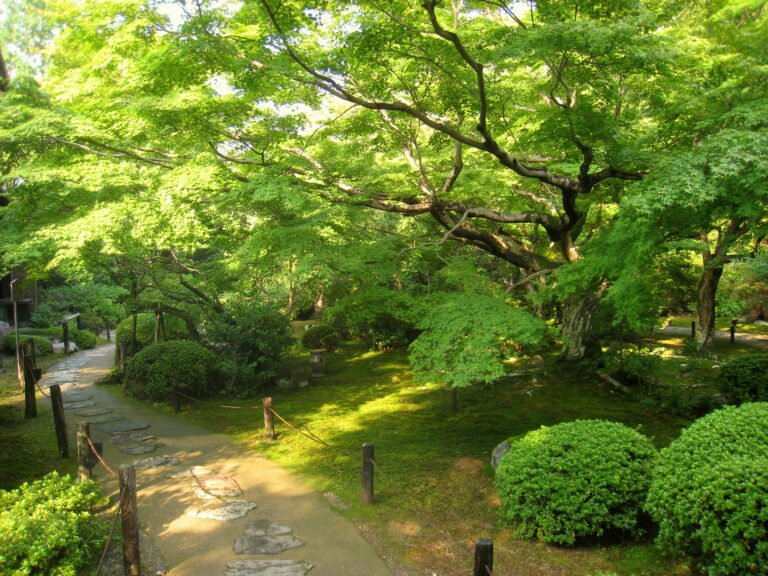
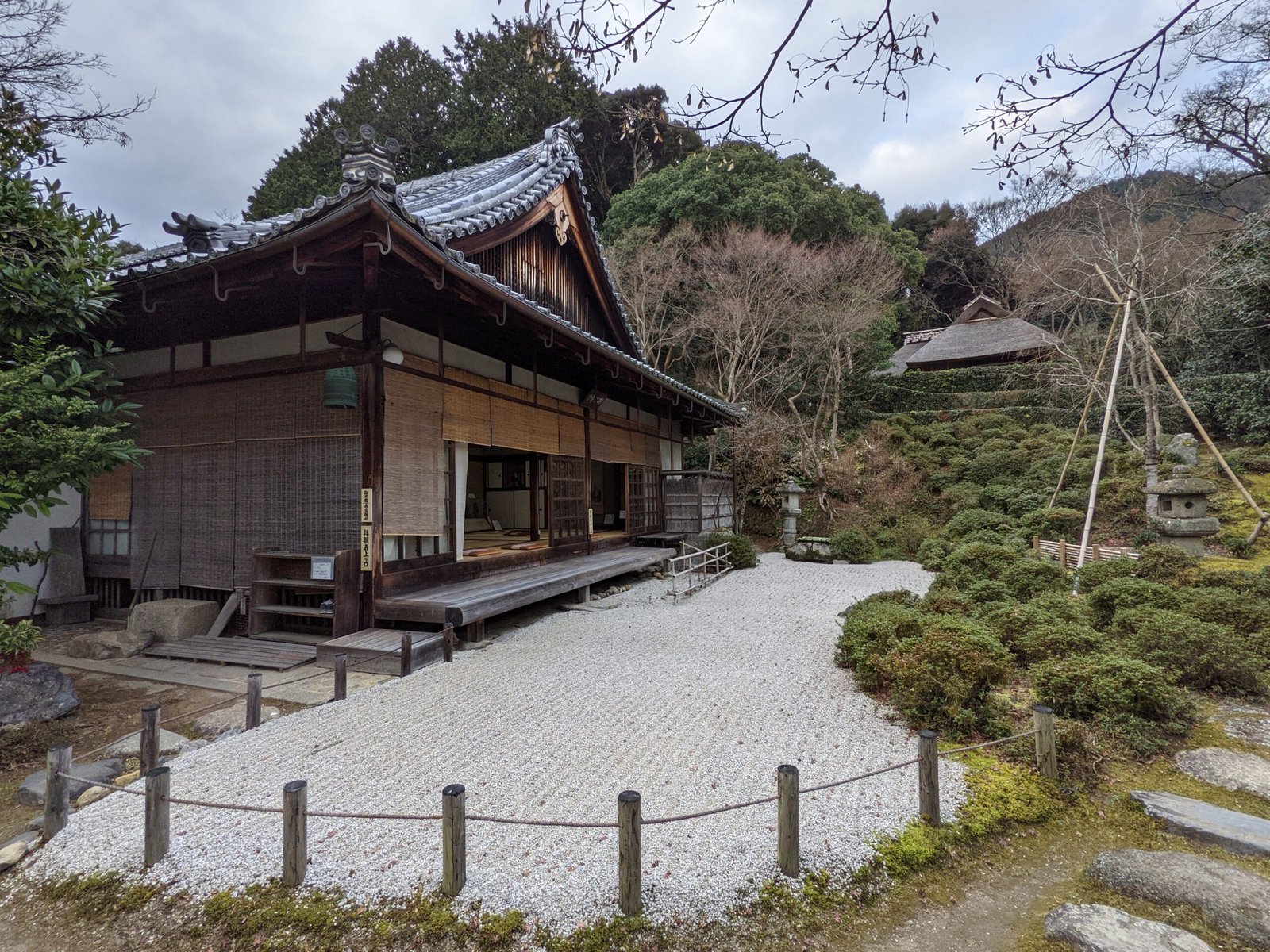
The temple itself is modest — a single main hall rather than the sprawling complexes you’ll find at places like Myoshin-ji or Daitoku-ji, with the Basho-an hut standing on the east side of a small garden behind it. The hut still functions as a simple tea room rather than a historical diorama sealed off behind glass, which is a large part of its appeal; it feels like a structure people actually used rather than a museum piece. The garden itself is built around a hillside mound planted with satsuki azaleas, the detail most frequently mentioned by visitors who come specifically in late May and early June, when the mound turns into a solid wash of color.
Autumn brings a quieter, more muted version of the same appeal — maples around the hut and up toward Buson’s grave, with far fewer people around than you’ll find at any of the headline autumn spots elsewhere in the city. It’s the kind of place where the main activity is sitting near the hut for ten minutes rather than working through a checklist of buildings, which suits a temple this size.

A Quiet Option in a Small, Busy Cluster
Ichijoji’s handful of temples tend to get visited together, and Konpuku-ji is usually the one people add on rather than the one they start with. Shisen-do, with its sweeping gravel garden and bell-shaped hedges, is only about 200 meters away and draws noticeably more visitors, as does Enko-ji a bit further on. That’s not a knock on Konpuku-ji so much as useful context: if Shisen-do or Enko-ji feel crowded when you visit, Konpuku-ji a few minutes up the road is where the same afternoon gets quiet again. Manshu-in, about a kilometer further north, rounds out the cluster if you have a full morning to spend up here.
Getting There
The easiest route is the Eizan Railway, the small private line that runs north out of Demachiyanagi Station. Get off at Ichijoji Station and it’s about a 10-minute walk uphill to the temple, passing Shisen-do’s gate along the way. By bus, the Ichijoji Sagarimatsu-cho stop is closer, around a 6-minute walk. Neither route is complicated, but this corner of the city doesn’t have a subway or JR line running through it, so the Eizan line is really the practical way in if you’re not driving. If you’re already working through the area, our One Day on the Eizan Railway itinerary covers Konpuku-ji’s neighbors in more detail and makes a reasonable template for stringing several of these temples together in one morning. The Philosopher’s Path is close enough on the map to combine with a longer day, though it’s a separate walk rather than a quick add-on from here.
Bottom Line
Konpuku-ji isn’t a headline stop, and it doesn’t try to be — it’s a small hillside temple that happens to hold one of the more genuine literary connections in the city, with a poet’s grave and a rebuilt hut that still feels lived-in rather than roped off. If you’re already heading to Shisen-do or Enko-ji, the extra ten minutes it takes to see Konpuku-ji is a small enough ask for what it adds to the morning.