Sekizan Zen-in: A Practical Guide to Kyoto’s Monkey-Guarded Autumn Temple
Most visitors who make it to Shugakuin do it for the Imperial Villa, book their reserved tour slot, and never notice the wooded trail running off into the trees just behind the station. Follow it for twenty minutes and you come out at Sekizan Zen-in, a small Tendai temple at the foot of Mount Hiei that locals treat as one of the city’s best-kept autumn secrets. It has no crowds to speak of most of the year, a rooftop monkey standing guard over a demon gate, and some of the most intense maple color in northern Kyoto by late November. It’s also, somewhat improbably, dedicated to a Chinese Taoist deity who oversees life and death — which is a strange thing to find tucked behind a Kyoto Imperial Villa, and part of why the place is worth the walk.
The Essentials at a Glance
| What | Details |
|---|---|
| Location | Shugakuin, Sakyo-ku, at the foot of Mount Hiei |
| Hours | 9:00am to 4:30pm, daily, no fixed closing days |
| Admission | free |
| Main deity | Sekizan Daimyojin, a Taoist-rooted guardian deity associated with longevity and often linked to Jizo and to Fukurokuju |
| Founded | traditionally dated to 888, in fulfillment of a wish by the Tendai priest Ennin (Jikaku Daishi); treat the exact founding story as tradition rather than settled fact |
| Access | Eizan Railway from Demachiyanagi to Shugakuin (about 7 minutes), then roughly a 20-minute walk through a wooded path; or city bus 5 to the Shugakuin Rikyu-michi stop, about 15 minutes on foot |
| Pairs well with | Shugakuin Imperial Villa, Manshu-in, and Shisen-do, all within about a kilometer |
A Temple Built On a Promise
The story behind Sekizan Zen-in starts with Ennin, the Tendai priest better known by his posthumous title Jikaku Daishi, who served as the third head priest of Enryaku-ji on Mount Hiei. Sources differ on whether the deity Sekizan Daimyojin protected Ennin on his voyage to China or on his return voyage home, and the early record is thin enough that it’s worth treating either version as tradition rather than fact. What both accounts agree on is the outcome: Ennin wanted to build a temple honoring the deity who had watched over him, but died before he could see it done. His successor carried out the plan in 888, which is the date the temple traces its founding to today.
The temple’s fortunes later became tied to its neighbor. Retired Emperor Go-Mizunoo, who built the nearby Shugakuin Imperial Villa in the 17th century, supported Sekizan Zen-in’s upkeep and is said to have presented it with a scroll bearing the name “Sekizan Daimyojin” in his own hand — a copy of which is still replicated on the temple’s torii nameplate today. That royal connection is one reason the temple, despite its modest size, carries more historical weight than its quiet grounds suggest.

Sekizan Daimyojin and the Rooftop Monkey
The temple’s central figure, Sekizan Daimyojin, has roots that go back further than Japanese Buddhism itself. The deity originates from Taizan Fukun, a Taoist god of Mount Tai in China who was believed to oversee the boundary between life and death and who became an important figure in onmyodo, the Japanese tradition of cosmology and divination. Over the centuries Sekizan Daimyojin came to be regarded as an incarnation of Jizo and the guardian deity of Enryaku-ji, with a secondary association with Fukurokuju, one of the Seven Lucky Gods tied to long life and prosperity — which is why visitors still come here to pray for health and longevity as much as for anything else.
Keep an eye on the roofline near the temple’s northeast corner and you’ll spot a small carved monkey, known as Masaru, standing guard over what’s traditionally considered the “demon gate” — the unlucky northeast direction in old Japanese cosmology. Monkeys were believed to ward off evil from that direction, and Masaru has stood watch here for generations as a quiet piece of protective folklore that most visitors walk right past without noticing.
Why Everyone Comes in November
Sekizan Zen-in’s grounds are planted with a mix of maple and ginkgo, and the combination is what gives the temple its quiet reputation among Kyoto’s autumn-color regulars. The color typically peaks toward the end of November, later than some of the more famous spots around the city, which makes it a useful stop if you’re visiting Kyoto late in the season and worried the main attractions will already be past their best. The temple leans into the timing with a Momiji Festival held through November, and on November 23 specifically it hosts the Juzu Kuyo, a memorial service built around two large prayer-bead rings that visitors can pass through, timed deliberately to land when the maples are at their most vivid.

If you’re planning a foliage trip around this part of the city, our guide to koyo season and our guide to Kyoto in November both cover the citywide timing in more detail — Sekizan Zen-in is worth folding into either itinerary precisely because it tends to color later and get overlooked by the bus-tour crowd.
A Temple That Monks Still Pass Through
Sekizan Zen-in isn’t only a photogenic stop — it’s still an active waypoint in one of the most demanding forms of Buddhist practice still carried out in Japan. Enryaku-ji’s monks undertake the Sennichi Kaiho, a thousand-day circuit of ascetic walking around Mount Hiei spread across years, and in the circuit’s sixth and seventh years the route runs through Sekizan Zen-in. It’s a genuinely rare feat — by most counts, only about fourteen monks have completed the full thousand-day practice since the end of World War II — and the temple also keeps its own smaller-scale rhythm of devotion, holding Buddhist services on the 5th, 15th, 25th, and 28th of each month, with the 5th singled out as a traditional worship day going back to Edo-period merchants.
Getting There
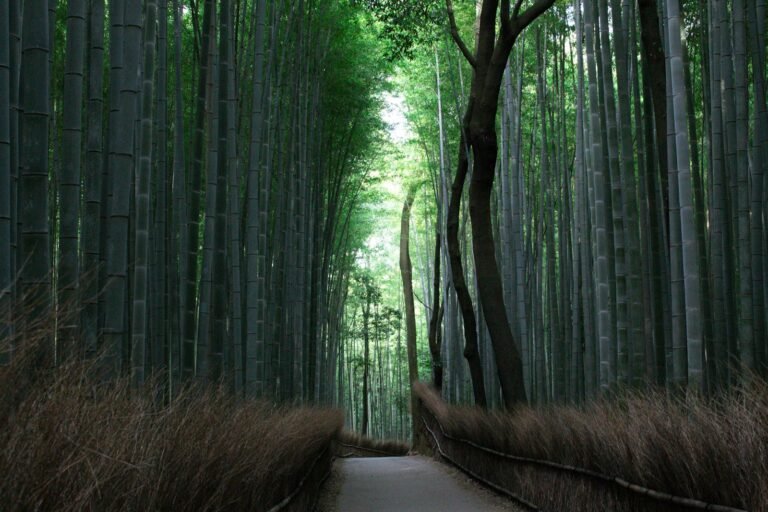
The easiest route is the Eizan Railway, which isn’t covered by the Japan Rail Pass but is cheap and quick on its own: board at Demachiyanagi and get off at Shugakuin, a ride of about seven minutes for around ¥210. From the station, follow the signed path into the trees for about twenty minutes and you’ll reach the temple gate. If you’d rather take a bus, city bus 5 stops at Shugakuin Rikyu-michi, leaving a shorter walk of around fifteen minutes. Either way, build in time for the walk itself — the wooded approach, especially in autumn, is part of the experience rather than a detour from it.
Because the walk from the station isn’t signed as aggressively as routes to bigger attractions, it’s worth having a map pulled up rather than relying on memory, especially if you’re arriving later in the day. If you’re new to the city’s transit network generally, our guide to getting around Kyoto covers IC cards, buses, and the private rail lines like the Eizan that don’t always show up on first-time visitors’ radar.
Bottom Line
Sekizan Zen-in rewards exactly the kind of visitor who’s willing to walk twenty minutes into the woods on the strength of a recommendation. It’s free, it’s rarely crowded, its autumn color runs later than the city’s headline spots, and its deity and folklore are strange enough to make the detour memorable on their own terms. Pair it with Shugakuin Imperial Villa if you’ve booked a tour slot there, or with Manshu-in and Shisen-do for a fuller morning in this quieter corner of northeastern Kyoto, and budget at least half an hour once you account for the walk in and out.