Manshu-in: A Practical Guide to Kyoto’s Hidden Monzeki Temple
Manshu-in sits a couple of hundred meters up the hill from Shisen-do, in the same quiet stretch of northern Sakyo-ku, and it shares a similar problem: almost nobody who visits Kyoto for the first time puts it on their list. That’s a shame, because Manshu-in is a genuine monzeki temple, meaning it was historically run by a member of the imperial family, and it has the architecture and the garden to prove it. Come for the dry garden with its 400-year-old crane-shaped pine, stay because the whole place is almost always quiet enough to actually sit and look at it.
The Essentials at a Glance
| What | Details |
|---|---|
| Admission | ¥800 regular season; typically rises to around ¥1,000 during the autumn foliage weeks — check the temple’s notice board or official site before you go |
| Hours | 9:00 a.m.–5:00 p.m., last entry around 4:30 p.m., open year-round |
| Address | 42 Ichijoji Takenouchi-cho, Sakyo-ku |
| Getting there | Kyoto City Bus 5 from Kyoto Station to the Ichijoji Shimizu-cho stop (roughly 50 minutes), then a 20-minute walk uphill; or JR/Keihan/Eizan Railway to Shugakuin Station, then about a 15–20 minute walk |
| Visit length | 45–60 minutes |
| Good to know | Photography is generally not allowed inside the shoin buildings themselves, only in the garden — staff will point out where the line is |
From Mount Hiei to an Imperial Retreat
Manshu-in traces its roots back to the 8th century, when it began as a small hall called Tobibo on Mount Hiei, founded in connection with Saicho, the monk who established the Tendai school of Buddhism in Japan. The temple took the name Manshu-in in the early 12th century and moved around Kyoto more than once over the following centuries before settling into its current spot in the Ichijoji area in 1656, under the direction of Prince Ryosho, an imperial prince who took the tonsure. That imperial connection is what makes Manshu-in a monzeki temple — one of a handful of temples in Kyoto historically headed by a member of the imperial or aristocratic family rather than an ordinary monk — and it shows in how deliberately the place was built, right down to the guest quarters.
A Little Katsura Rikyu
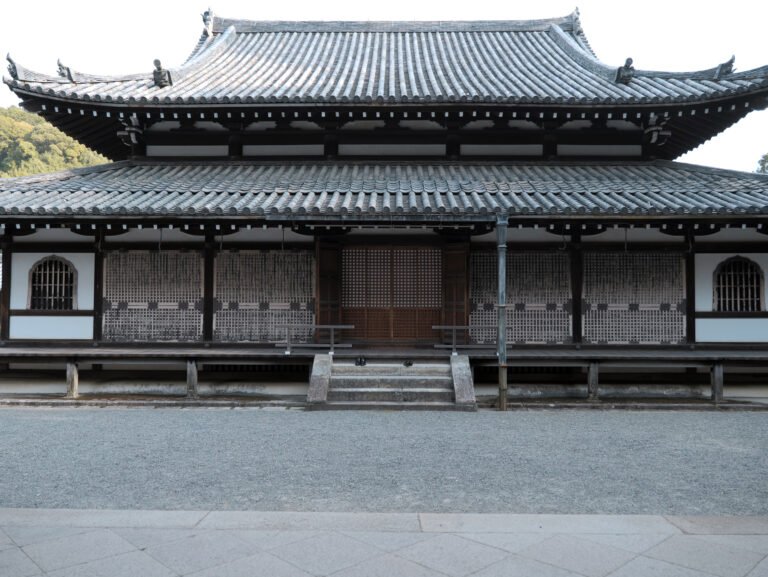
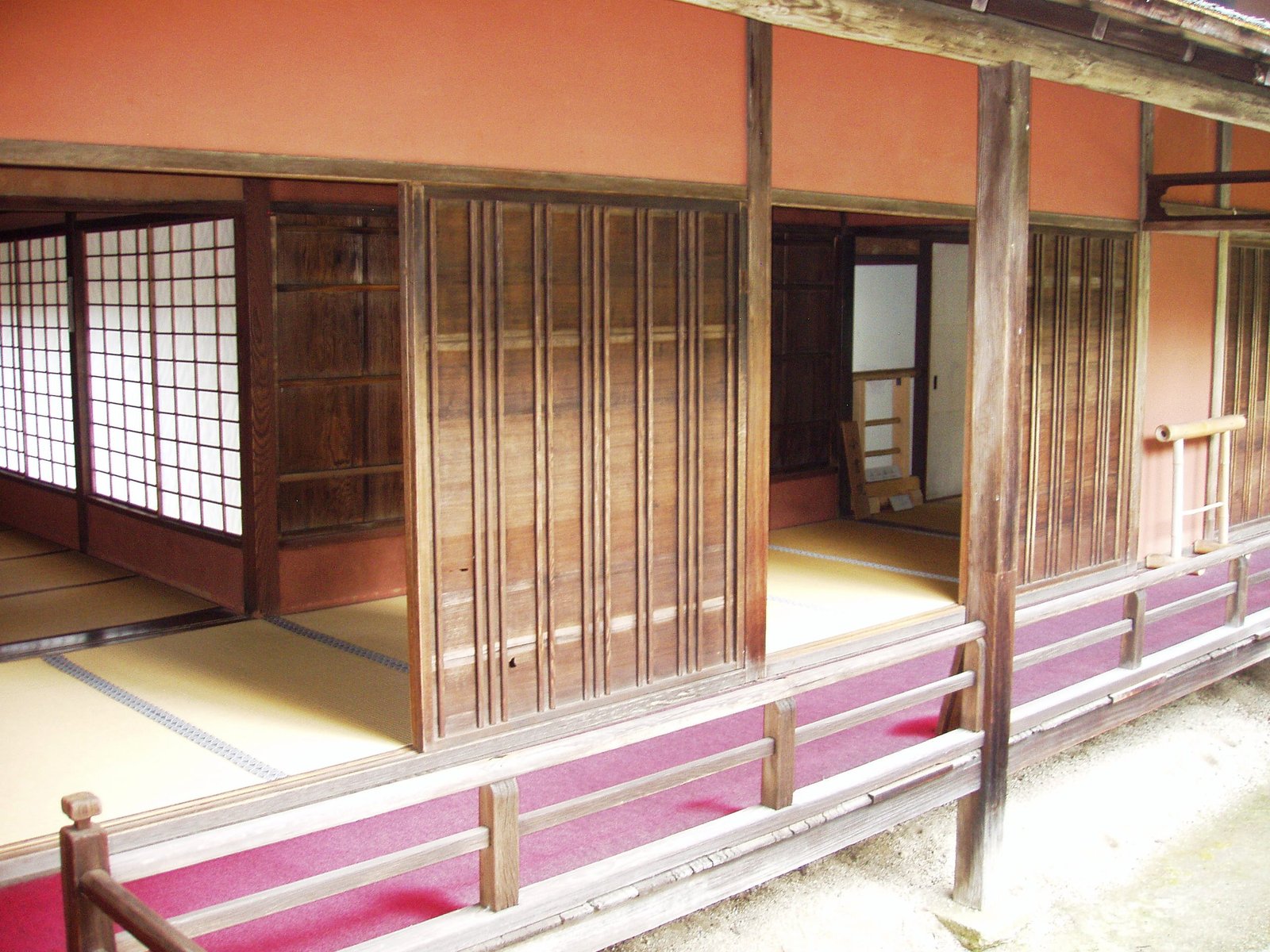
The shoin buildings at Manshu-in are often described as a smaller cousin of Katsura Imperial Villa, the famous 17th-century imperial retreat on the other side of the city, and the resemblance isn’t a coincidence — both were built in the same era, in the same restrained shoin-zukuri style, by patrons close to the same court circles. Two rooms in particular, the Daishoin and the Koshoin, are registered as Important Cultural Properties. Their sliding doors and screens carry paintings attributed to the Kano school, the dominant painting workshop of the era, and each room takes its name from what’s painted on its walls — there’s a Peacock Room and a Tiger Room, among others. It’s a quieter, more domestic kind of grandeur than the gold leaf of Kinkaku-ji or the scale of Nijo Castle — built to be lived in by a prince, not to overwhelm a visitor.
The Garden and Its 400-Year-Old Pine
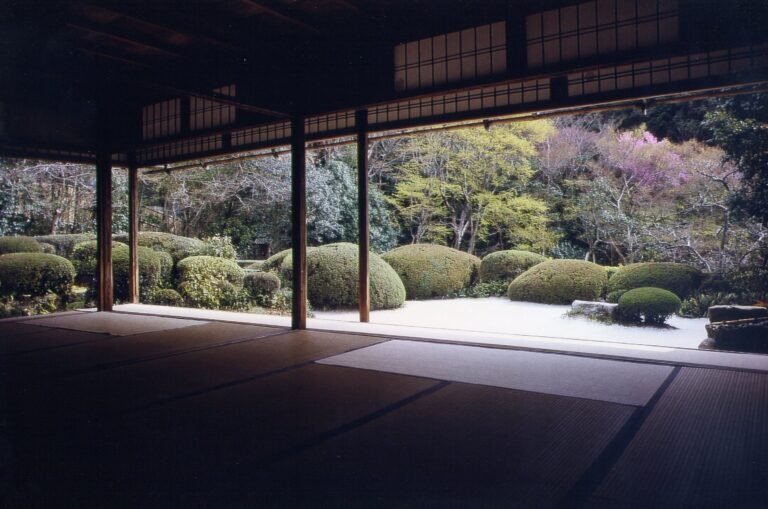
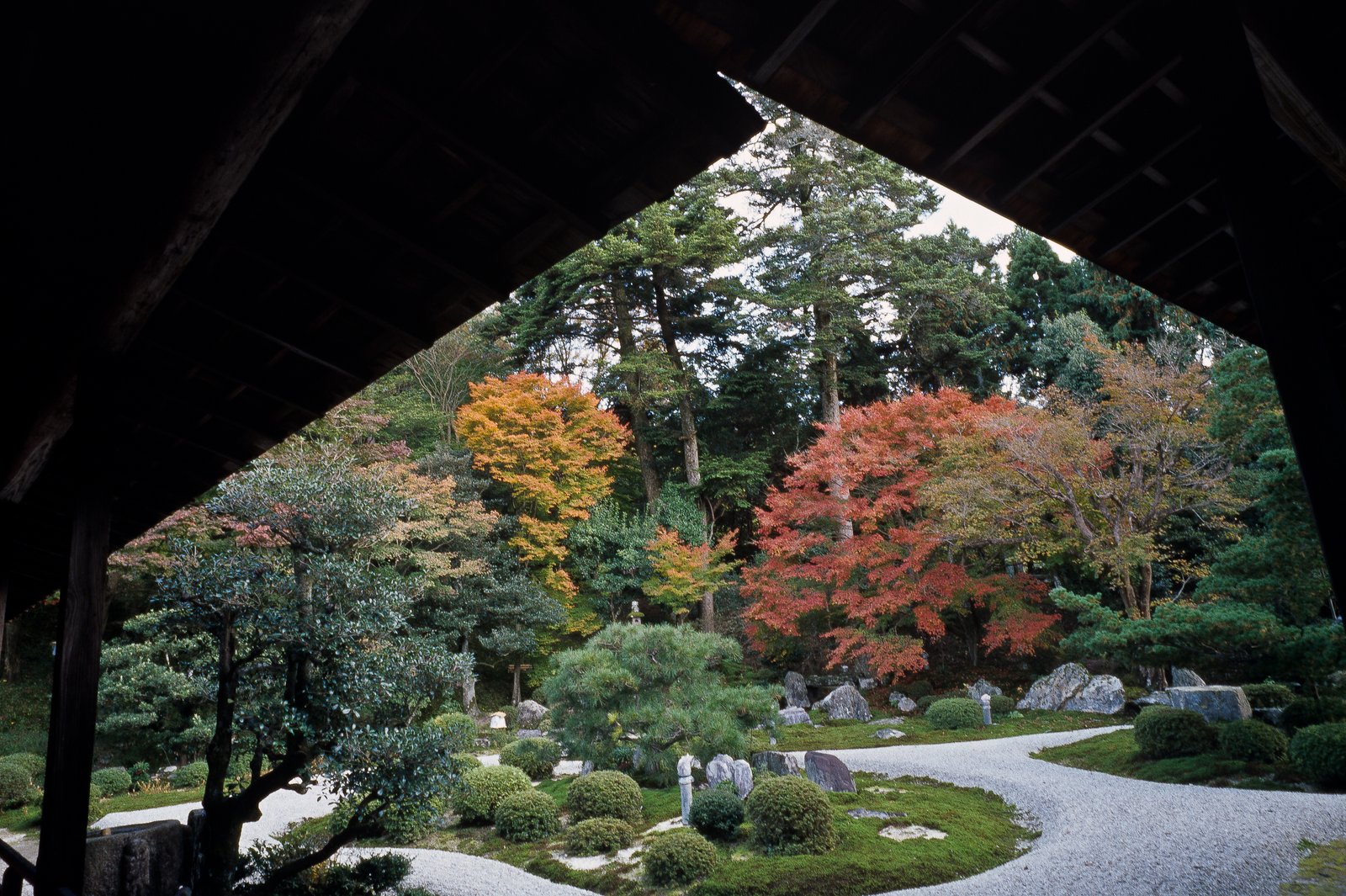
The garden in front of the Daishoin is a karesansui, dry-landscape design, and it’s officially designated a Place of Scenic Beauty of Japan. Raked white gravel stands in for an ocean, broken by two islet-like mounds, and the larger of the two is anchored by a Japanese white pine trained over roughly four centuries into the shape of a crane in flight — one wing stretched low along the gravel, the trunk twisted upward. It’s the kind of tree that takes generations of careful pruning to maintain, and the temple’s gardeners have kept it in shape since well before anyone alive today was born. Mount Hiei rises in the near distance beyond the garden wall, which the original designers almost certainly treated as borrowed scenery, tying the whole composition back to the mountain where the temple’s story started.
Unlike some of Kyoto’s more famous dry gardens, there’s rarely a crowd standing between you and the veranda here. You can sit at the edge of the Daishoin for as long as you like and watch how the light changes across the gravel through the afternoon, which is really the point of a garden built for a resident rather than a stream of visitors.
When to Go
Autumn is Manshu-in’s strongest season by a wide margin. The maples around the garden and the approach path turn in mid-to-late November, generally a touch later than the citywide peak covered in our Kyoto Autumn Foliage guide, and some recent years have seen the temple add a limited evening illumination period during that window — worth checking the temple’s own announcements closer to your trip, since it isn’t held every year and the schedule shifts. Outside of autumn, Manshu-in is a low-key, contemplative stop any time the temple is open, and our Best Time to Visit Kyoto guide has the broader seasonal picture if you’re still mapping out your trip.
Getting There and Pairing It With Nearby Temples
Manshu-in is out in the Shugakuin/Ichijoji area on the northern edge of the city, which means it takes a real bus or train trip rather than a quick walk from a subway stop — Kyoto City Bus 5 covers it directly from Kyoto Station in around 50 minutes, and our Getting Around Kyoto guide walks through how the day-pass and IC card systems work if you haven’t used Kyoto’s buses before. The upside of the trip out is that Manshu-in isn’t a lone destination: Shisen-do, the former samurai retreat known for its shishi-odoshi and its azaleas, is a short walk downhill, and a little further south sits Rurikoin, the temple famous for its reflected-maple table, though note Rurikoin is only open during limited spring and autumn windows. Stack two or three of these together and the trek out to Ichijoji turns into a full, unhurried half-day rather than a single quick stop.
Bottom Line
Manshu-in won’t be the temple that makes it onto someone’s highlight reel after a quick weekend in Kyoto, and that’s exactly its appeal. It’s a place built for someone to actually live in and look at, not to be rushed through, and the crane-shaped pine alone is worth the bus ride if you have any interest in how much patience Japanese garden design can demand. Pair it with Shisen-do and give yourself a slow afternoon rather than trying to fit it between two bigger sights.