Jingo-ji: A Practical Guide to Takao’s Clifftop Temple and Its Clay-Disc Ritual
Our Day Trip to Takao guide already makes the case for heading into the mountains northwest of the city, and when people ask which of Takao’s three temples to prioritize if they only have time for one, the answer is almost always Jingo-ji. It’s the oldest of the three in spirit if not quite in surviving buildings, it holds the bulk of Takao’s National Treasures, and it’s home to a small ritual — throwing clay discs off a cliff — that you won’t find anywhere else in Kyoto. It also happens to sit at the top of the steepest climb in the valley, so it helps to know what you’re walking up for before you commit to the stairs.
The Essentials at a Glance
| What | Details |
|---|---|
| Location | Takao, Ukyo-ku — a wooded valley in the mountains northwest of central Kyoto |
| Sect | Shingon, with Kukai (Kobo Daishi) as its first chief priest under that name |
| Known for | A steep stone staircase approach, a hall full of National Treasure statues and documents, and kawarake-nage — throwing unglazed clay discs into the valley below |
| Hours | Roughly 9:00am–4:00pm, open daily with no regular closing days |
| Admission | Around ¥1,000 for adults; it’s worth double-checking the current fee before you go, since Takao’s temples adjust pricing from time to time |
| Access | JR bus from Kyoto Station (about 50 minutes) or City Bus 8 from Shijo-Karasuma (about 45 minutes), both to the Takao stop, followed by a steep climb of roughly 20 minutes |
Where Two Buddhist Traditions Took Shape
Jingo-ji’s story starts in 781, when the Nara-period statesman Wake no Kiyomaro founded a temple here called Takaosan-ji, hoping to secure peace for the nation from this remote mountain site. What happened over the next few decades turned that modest beginning into one of the most consequential addresses in Japanese Buddhist history. Saicho, the monk who would go on to found the Tendai school and establish Enryaku-ji on Mount Hiei, stayed at the temple from 802. Kukai, who would found the rival Shingon school, arrived in 809 and in 812 led an esoteric initiation ceremony here known as kanjo — a ritual significant enough that the handwritten list of participants in Kukai’s own calligraphy, the Kanjo Rekimei, survives today as a National Treasure. Saicho and Kukai’s paths diverged within a year or two after that, each developing the separate school of Buddhism he’s remembered for, but both had passed through this same mountain temple first. In 824, Takaosan-ji merged with a second Wake-family temple, Jingan-ji, took the combined name Jingo-ji, and installed Kukai as its chief priest — and it’s remained a Shingon temple ever since.
Burned, Rebuilt, and Rebuilt Again
Very little of what Kukai would have recognized is still standing, because the Onin War of 1467–77 destroyed almost every building on the mountain, sparing only the Daishi-do hall. The temple’s current layout owes more to two later rebuilding efforts than to its ninth-century origins. In 1623, the feudal lord Itakura Katsushige financed a round of Edo-period reconstruction that gave Jingo-ji its main gate (Romon), the Bishamon-do, the Godai-do, and its bell tower. The Kondo, the hall you’ll see dominating the upper terrace today, and the adjacent Tahoto pagoda are newer still — both were rebuilt in the 1930s with funding from the merchant Yamaguchi Gendo, with the Kondo completed in 1934. Despite all that rebuilding, Jingo-ji’s holdings weren’t lost along the way: the temple counts more than a dozen National Treasures among its paintings, sculptures, and documents, including the Yakushi Nyorai statue enshrined as the Kondo’s principal image.
The Climb, and the Clay Discs at the Top
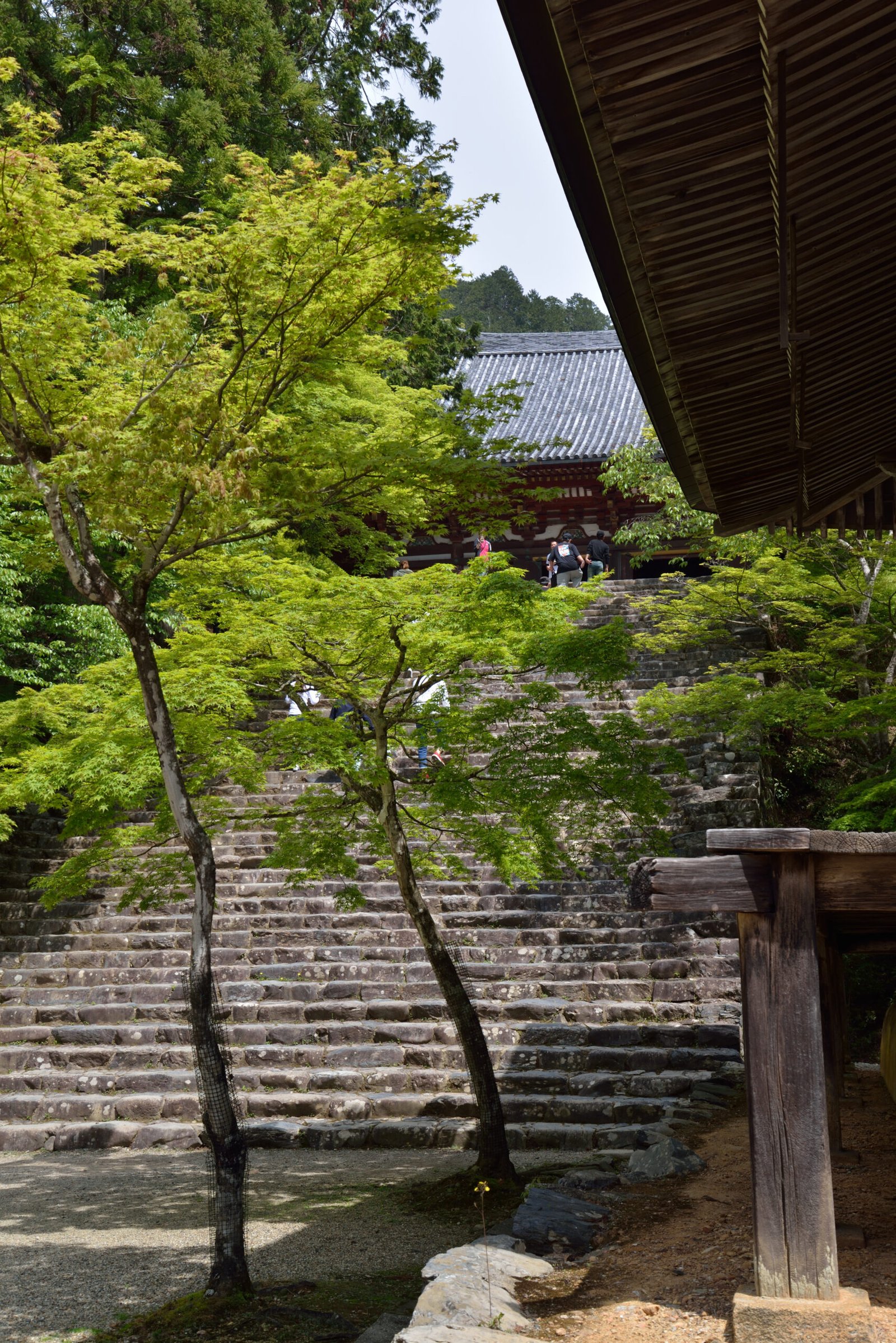
Getting to Jingo-ji is part of the experience, for better or worse. From the Takao bus stop, the path crosses a bridge over the Kiyotaki River and then climbs steadily uphill past a scattering of old teahouses and snack stalls, up a long run of stone steps that visitors generally reckon at somewhere around 350 of them. Budget a solid 20 minutes for the walk if you’re not rushing, longer if you stop to catch your breath or browse the stalls. The reward at the top, beyond the temple buildings themselves, is a small ritual most first-time visitors have never heard of: kawarake-nage. Near the Jizo-in hall, you can buy a set of small unglazed clay discs and throw them, frisbee-style, out over the edge of the cliff and down into the forested Kinunkei valley below — a practice meant to cast off bad luck as the discs sail out of sight. It costs only a few hundred yen for a set of discs, and it’s a genuinely fun five minutes in a temple visit otherwise built around quiet contemplation.
One of Kyoto’s Oldest Maple Valleys
Takao has been praised for its autumn color in Japanese poetry for centuries, long before koyo tourism became the citywide event it is today, and Jingo-ji’s steep approach through maple cover is a large part of why. The valley’s elevation means its leaves tend to turn earlier and more dramatically than the temples down in central Kyoto, with color typically building toward a peak in mid-November, and the temple has run evening illuminations in past autumns to let visitors see the valley lit up after dark. If you’re mapping out a longer autumn itinerary, our Kyoto Autumn Foliage guide covers how Takao’s timing compares to other koyo spots around the city, and our Kyoto in November guide is worth a look if your trip falls in that specific window.

Treasures Shown Only on Set Dates
Most of Jingo-ji’s National Treasure paintings and statues aren’t on permanent public display, which is fairly typical for a temple with a collection this old and this fragile. Instead, the temple opens specific treasures to viewing on a handful of set dates each year — historically including an early-May window and a few days around the autumn Sports Day holiday in October — rather than keeping a dedicated treasure hall open year-round. These dates can shift from year to year, so if seeing the paintings and statuary up close matters to your visit, it’s worth checking the temple’s current schedule before you plan a trip specifically around it. On an ordinary visit outside those windows, the Kondo’s principal Yakushi Nyorai image and the temple’s historic buildings are still very much worth the climb on their own.
Getting There
The most direct option is the JR bus running the Takao/Kyokitasen route from Kyoto Station, which takes roughly 50 minutes and costs around ¥230. If you’re starting from somewhere more central, City Bus 8 runs from Shijo-Karasuma to the same Takao stop in about 45 minutes for a similar fare. Neither ride is especially short, which is part of why Takao feels more remote than Arashiyama or the eastern hills despite not being all that far away in a straight line. From the Takao stop, follow the other visitors downhill toward the river and then back uphill on the temple approach — there’s really only one path, so it’s hard to get lost even without directions.
Pairing It With the Rest of Takao
Jingo-ji is the largest and most historically significant of Takao’s three mountain temples, but it’s not the only reason to make the trip. Our Day Trip to Takao guide covers the other two, Saimyo-ji and Kozan-ji, both a short walk from Jingo-ji and each with its own smaller-scale, quieter charm — a good way to round out a half-day in the valley once you’ve made the climb. Since the whole outing runs on buses rather than the subway or JR lines most visitors use downtown, it’s also worth a quick look at our Getting Around Kyoto guide for a refresher on IC cards and bus fares before you set out.
Bottom Line
Jingo-ji asks more of visitors than most Kyoto temples — a longer bus ride, a steeper climb, no subway shortcut — and pays it back with a genuinely unusual mix: deep Buddhist history that touches both of Japan’s major esoteric schools, a collection of National Treasures, one of the city’s oldest-praised maple valleys, and a cliffside ritual you won’t find anywhere else. Plan for 45 minutes to an hour at the temple itself, more if you want to add Saimyo-ji or Kozan-ji to the same trip, and wear shoes you don’t mind climbing roughly 350 stone steps in.