Saimyo-ji: A Practical Guide to Takao’s Vermilion Bridge and Quietest Temple
Our Day Trip to Takao guide and our closer looks at Jingo-ji and Kozan-ji all mention a third temple sitting between them on the mountain, usually in a single sentence before moving on. That is Saimyo-ji, and it earns a bit more than a passing mention. It is smaller than its two neighbors and has no single headline attraction on the order of Jingo-ji’s clay-disc throwing or Kozan-ji’s frolicking-animal scrolls, but it has a genuinely pretty vermilion bridge, a main hall you can walk right up to, and a quietness that the other two temples lose once a tour bus or two shows up. If you are doing the full Takao loop, Saimyo-ji is the calm middle act.
The Essentials at a Glance
| What | Details |
|---|---|
| Location | Mount Makinoo, Takao — roughly midway along the path between Jingo-ji and Kozan-ji |
| Sect | Shingon, originally founded as a sub-temple of Jingo-ji |
| Known for | The vermilion Shigetsukyo Bridge over the Kiyotaki River, a Kamakura-period Shakyamuni Buddha, and a quiet, uncrowded main hall |
| Hours | Roughly 9:00am–5:00pm daily; some listings note a closure around New Year’s, so it is worth confirming if visiting then |
| Admission | Often free outside peak autumn, with a seasonal fee commonly cited around ¥500 for adults during the November maple season — worth double-checking at the gate since this varies by year |
| Access | JR bus from Kyoto Station or City Bus 8 from Shijo-Karasuma, both to stops in the Takao area, followed by a walk of roughly 10–15 minutes along the river path |
A Sub-Temple That Outlived Its Parent’s Troubles
Saimyo-ji’s history is tied up with Jingo-ji’s from the start. Temple tradition places its founding sometime between 824 and 834, when Chisen Daitoku, a leading disciple of Kobo Daishi (the monk better known as Kukai), established it as one of Jingo-ji’s sub-temples on the same mountain. Like a lot of small Heian-period temples, it did not have a smooth run after that: it fell into disrepair over the following centuries before a monk from Makinoo-dera in what was then Izumi Province restored it between 1175 and 1178. In 1290 it broke off to become an independent Shingon temple in its own right, a status it held until a fire in the late 1500s damaged it badly enough that it was folded back into Jingo-ji once again. Myonin Risshi restored it a second time in 1602, and the main hall standing today dates from 1700, donated by Keisho-in, mother of the fifth Tokugawa shogun, Tsunayoshi. It is a history of near-misses and quiet recoveries rather than one continuous golden age, which suits a temple that still does not try very hard to draw attention to itself.
Inside the Main Hall
The principal image inside is a Shakyamuni Buddha carved in the Seiryo-ji style, traditionally attributed to the Kamakura-period sculptor Unkei, one of the most celebrated Buddhist sculptors in Japanese history. The east and west halls hold a Heian-period Thousand-Armed Kannon and a statue of the wisdom king Aizen Myo-o. None of this is roped off at a distance the way it might be at a bigger, busier temple — Saimyo-ji’s hall is small enough that you end up standing fairly close to several Important Cultural Properties without really trying. If Jingo-ji’s draw is scale and Kozan-ji’s is a specific famous artwork, Saimyo-ji’s is this kind of unhurried, close-up access to genuinely old religious art.
The Shigetsukyo Bridge
Most people who know Saimyo-ji at all know it for this one feature: a vermilion arch bridge crossing the Kiyotakigawa, linking the temple to the road that runs between Kozan-ji and Jingo-ji. It is a genuinely photogenic spot, especially once the maples around it start turning, and it is the kind of thing that photographs better than it sounds described in a paragraph — a single curved red bridge over a narrow river gorge, framed by trees on both banks. In November the temple lights the bridge at night as part of the broader Mount Takao Illumination, and visitors who come for the evening lighting are typically offered green tea and a seasonal sweet in one of the side halls. It is a smaller, lower-key version of the illuminated-garden events held at some of the bigger temples elsewhere in the city, but the setting suits it — this is not an attraction built for crowds.
When to Visit
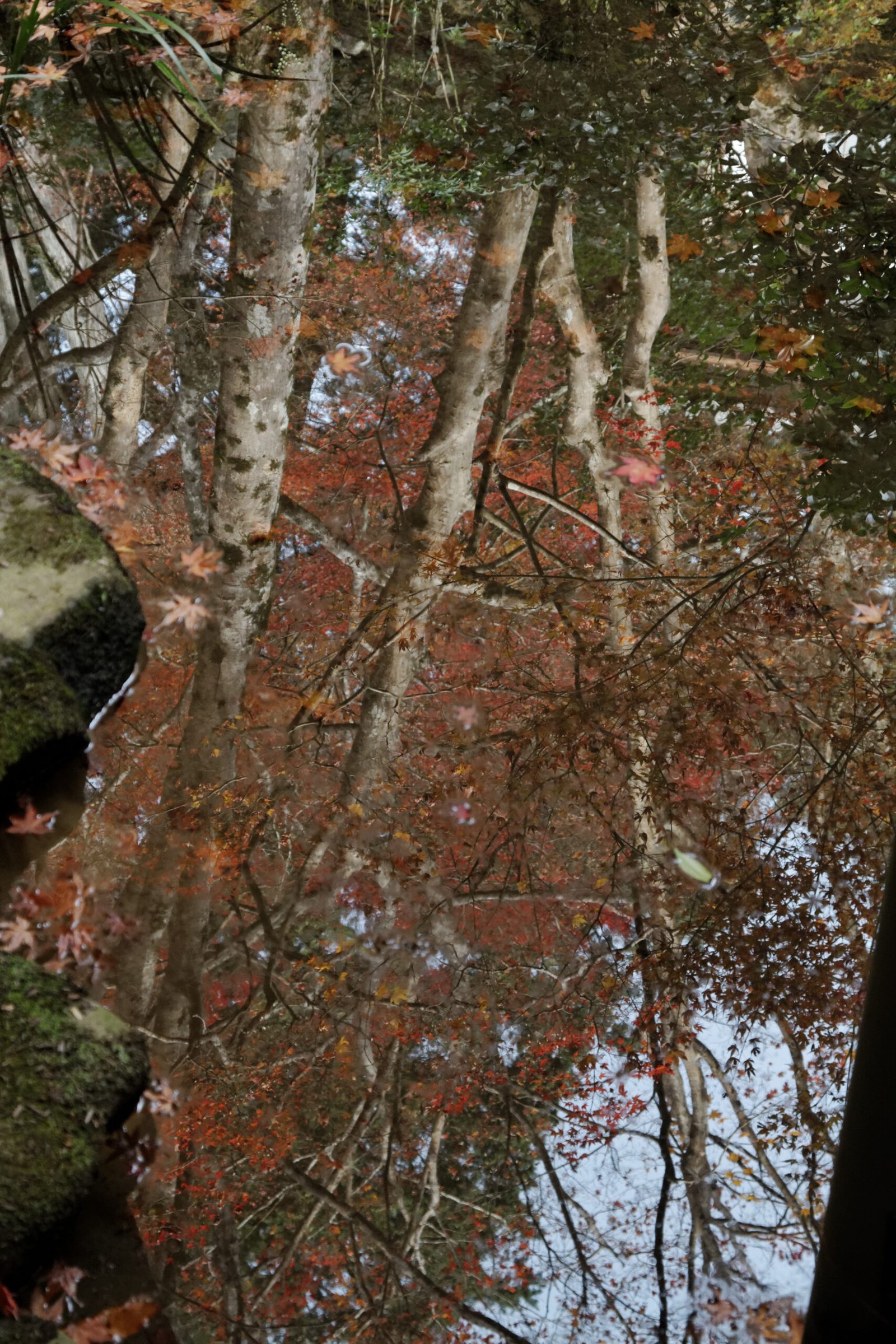
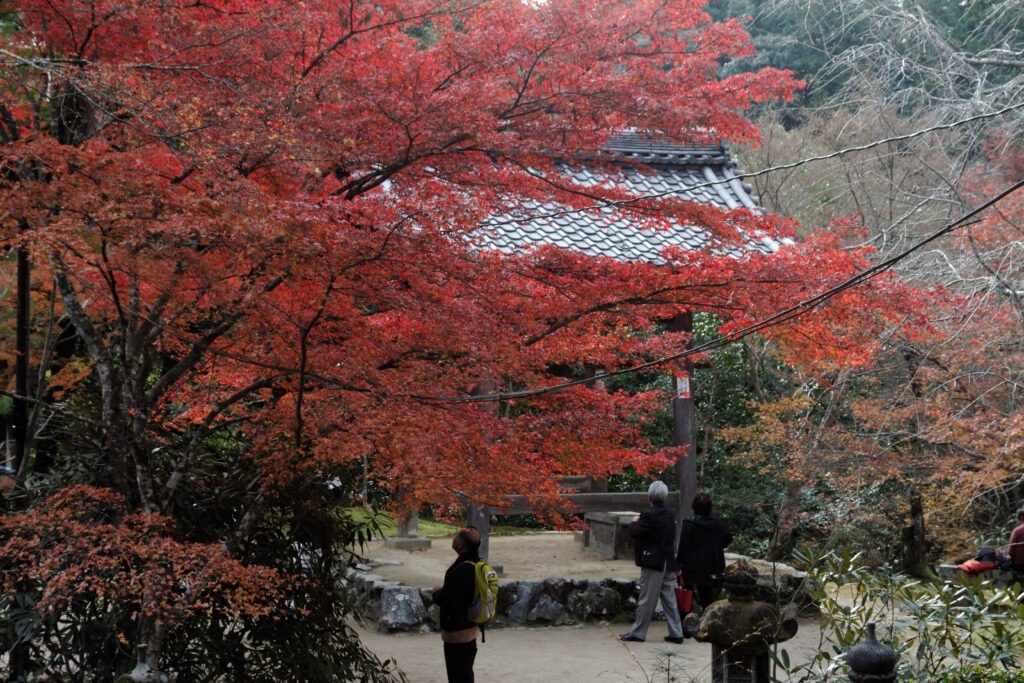
Autumn is the obvious answer, and for the same reason it is the obvious answer at Jingo-ji and Kozan-ji: Takao’s elevation means its maples color later than central Kyoto’s, typically building toward a peak from mid to late November. Our Kyoto Autumn Foliage guide covers how Takao’s timing fits into the wider koyo calendar, and our Kyoto in November guide is worth checking if your trip lands in that window specifically. Saimyo-ji has a quieter second season too: in late spring, azaleas bloom across the mountainside and are visible from the temple’s side garden, a reminder that Takao is not purely an autumn destination even if that is when most people show up.
Getting There
The JR bus running the Takao/Keihoku route from Kyoto Station takes roughly 50 minutes; get off at the Togano’o stop and it is about a 15-minute walk in, or at the Shuzan stop for a shorter walk of around 10 minutes. City Bus 8 from Shijo-Karasuma covers similar ground in around 35 to 45 minutes to the Takao stop, followed by a walk of about 15 minutes. However you arrive, you are walking along the same river path that connects to Jingo-ji and Kozan-ji, so there is no real risk of getting lost — just follow the Kiyotakigawa upstream or downstream depending on which temple you are coming from.
Pairing It With the Rest of Takao
Saimyo-ji’s whole appeal is positional as much as anything: it sits between Jingo-ji’s long staircase and Kozan-ji’s flatter grounds, so most visitors fold it into the middle of the walk rather than planning a special trip around it alone. Our Day Trip to Takao guide lays out the full loop through all three temples, and the Jingo-ji and Kozan-ji guides cover the two bigger stops on either side of it. Budget 20 to 30 minutes here — it is not a place that asks for much of your time, just a pause on the way between the other two.
Bottom Line
Saimyo-ji is never going to be the reason someone plans a trip to Takao, and it does not need to be. It is the reason the walk between Jingo-ji and Kozan-ji is worth taking slowly rather than rushing — a red bridge over a river gorge, a small hall with genuinely old statues you can stand close to, and none of the crowds its neighbors occasionally pick up. If you are already committing to the bus ride out to Takao, there is no good reason to skip it.