Byodo-in: A Practical Guide to Uji’s Phoenix Hall and the Temple on the Ten-Yen Coin
There’s a decent chance you’ve already seen Byodo-in before setting foot in Uji, even if you’ve never been to Japan. Its Phoenix Hall is stamped on the obverse of the ¥10 coin, and one of the bronze phoenixes from its roof appears on the ¥10,000 note — which means most people in Japan are carrying a small picture of this temple around in their wallet without necessarily knowing it. Our Day Trip to Uji guide already points toward Byodo-in as the main event of a trip south of the city, so here’s the longer version: what the temple actually is, why it looks the way it does, and what’s worth slowing down for once you’re inside the gate.
The Essentials at a Glance
| What | Details |
|---|---|
| Location | Uji, a short train ride south of central Kyoto |
| Built | Converted from a Fujiwara-family villa into a temple in 1052, with the Phoenix Hall completed the following year |
| Known for | The Phoenix Hall (Hoo-do) — the only original Heian-period building still on-site — its Jocho-carved Amida statue, and a Pure Land-style garden |
| Hours | Grounds roughly 8:45am–5:30pm (last entry 5:15pm); the Hoshokan museum closes earlier, around 5:00pm |
| Admission | Around ¥700 for grounds and museum, plus a small extra charge for a timed Phoenix Hall interior viewing (guided in Japanese only) |
| Access | JR Nara Line rapid train from Kyoto Station to JR Uji Station, about 20 minutes, then roughly a 10–15 minute walk |
A Fujiwara Villa Turned Pure Land Temple
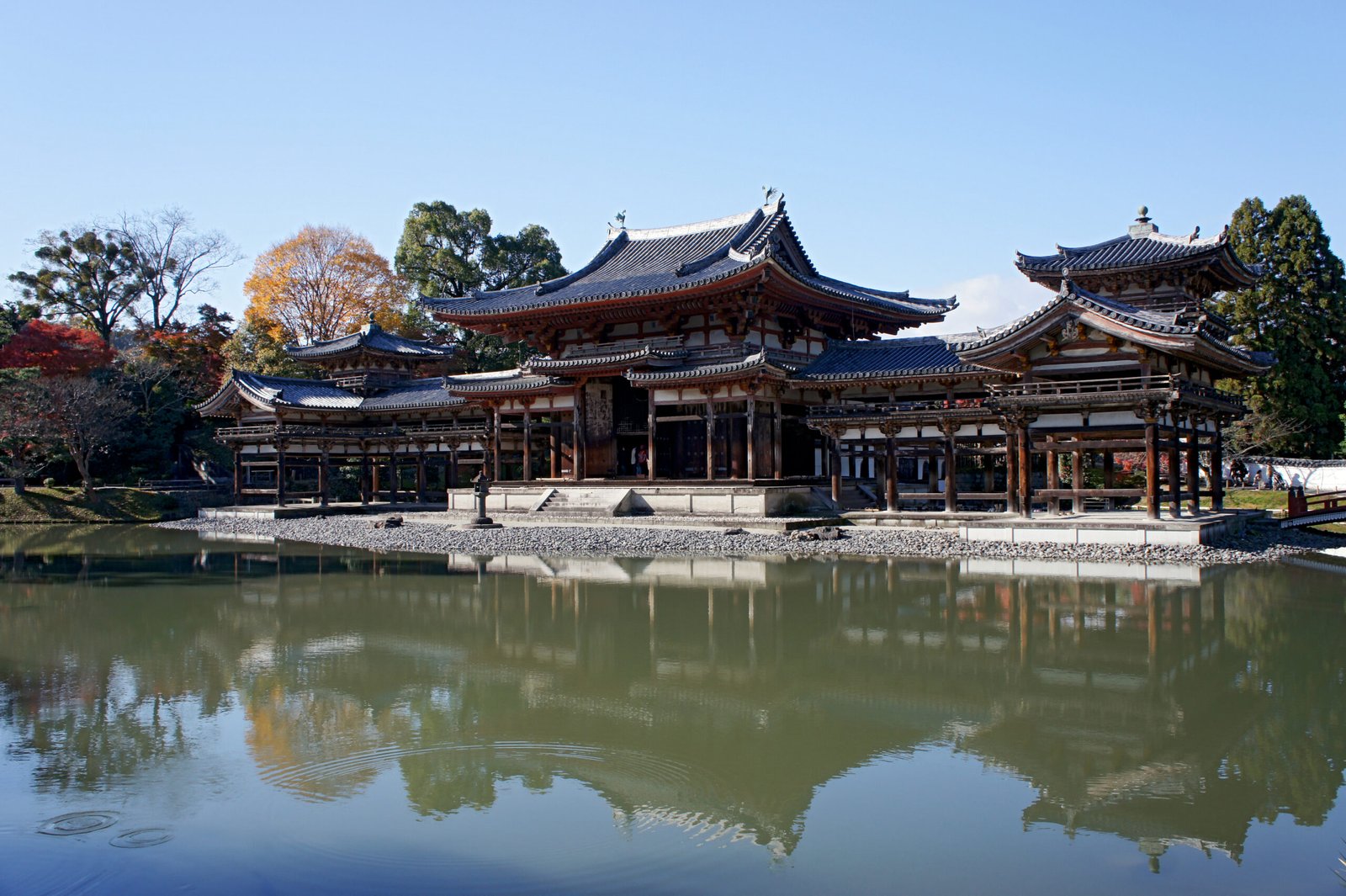
Byodo-in didn’t start out as a temple at all. The land was originally the site of a villa built in 998 by the courtier Minamoto no Shigenobu, which was later acquired by Fujiwara no Michinaga, the most powerful aristocrat of his era and effectively the man running Japan from behind the imperial throne. Michinaga’s son, Fujiwara no Yorimichi, inherited the property and converted it into a Buddhist temple in 1052 — a year that, by the calendrical beliefs of the time, many believed marked the start of mappo, a predicted age of Buddhist decline, which gave the project added urgency. Yorimichi had the Amida Hall built the following year to house a central Buddha image, and it’s this hall, later nicknamed Hoo-do, or Phoenix Hall, for its bird-like silhouette and the pair of bronze phoenixes mounted on its roof, that still stands today. Nearly everything else on the original site was lost to fire during civil war fighting in 1336, which is part of why the Phoenix Hall feels so singular: it isn’t one surviving piece of a larger Heian-period complex, it’s essentially the whole thing.
A Garden Built to Look Like Paradise
The pond and garden surrounding the Phoenix Hall weren’t laid out for casual strolling the way a lot of later Kyoto gardens were. They follow the conventions of Jodo-shiki, or Pure Land-style, garden design, meant to represent the Buddhist paradise that devotees of Amida Buddha hoped to be reborn into. The hall itself sits on an island in the pond, approached visually across the water rather than walked straight up to, so that from the right vantage point on the opposite shore, the building appears to float above its own reflection. It’s a deliberate piece of religious theater built into the landscape, and it’s worth taking a few minutes at the edge of the pond rather than walking straight past toward the entrance.
The Statue That Set a New Standard
Inside the Phoenix Hall sits a large seated Amida Nyorai, carved around 1053 by the sculptor Jocho out of Japanese cypress and finished in gold leaf. Jocho is a significant figure in the history of Japanese Buddhist art in his own right: he pioneered the yosegi technique of assembling a statue from multiple joined blocks of wood rather than carving it from a single trunk, which let workshops produce large, finely detailed figures more efficiently, and his proportions for depicting Amida became something of a template that later sculptors across Japan continued to follow. Both the Amida statue and the Phoenix Hall itself were designated National Treasures in 1951, and seeing the two together — the building built specifically to house this one statue, nearly a thousand years after it was carved — is really the heart of a Byodo-in visit.
The Hoshokan Museum
Byodo-in’s modern museum, the Hoshokan, opened in 2001 and was deliberately built mostly underground so it wouldn’t visually compete with the Phoenix Hall above ground. Inside, you’ll find the temple’s original pair of bronze roof phoenixes — the ones now mounted on the hall itself are replicas, with the originals kept here for preservation — along with the temple’s historic bell and a set of 26 wooden bodhisattva figures known as the Unchu Kuyo Bosatsu, depicted riding on clouds in attitudes of music-making and dance. They originally lined the upper walls of the Phoenix Hall’s interior and have been moved to the museum’s climate-controlled galleries, where you can actually see their carved detail up close in a way the dim interior of the hall never quite allowed.
UNESCO Status and a Town Built Around Tea and Genji
Byodo-in was inscribed as a UNESCO World Heritage Site in December 1994, as part of the wider “Historic Monuments of Ancient Kyoto” listing that also covers landmarks like Kiyomizu-dera and Nijo Castle across the city. Uji itself has two other claims to fame that are easy to combine with a Byodo-in visit: it’s the setting of the closing chapters of The Tale of Genji, Japan’s classical eleventh-century novel, and it’s one of the country’s most historically important tea-producing regions, with Uji matcha served and sold at shops throughout the town. Our Day Trip to Uji guide covers both of those angles in more detail if you’d like to build a fuller day around the temple rather than treating it as a quick in-and-out stop.
Getting There
From Kyoto Station, the JR Nara Line is the most straightforward route: rapid trains reach JR Uji Station in about 20 minutes, local trains in closer to 30, and both cost the same fare either way. From JR Uji Station, it’s roughly a 10–15 minute walk to the temple, mostly along the river and through the older part of town. If you’re coming from somewhere closer to the Kamogawa River, like Gion or downtown, the Keihan Railway is a workable alternative — via a transfer at Chushojima onto the Keihan Uji Line — though it isn’t covered by the Japan Rail Pass the way the JR route is, so it’s generally the better option only if you’re not starting from Kyoto Station itself.
Pairing It With the Rest of Your Trip
If you’re interested in how Byodo-in’s National Treasures compare to what’s on display elsewhere in the city, our Kyoto National Museum guide is a useful companion piece, since the museum regularly rotates in Buddhist statuary and paintings from temples across the region. Our Best Time to Visit Kyoto guide is also worth a look if you’re still deciding when to schedule a Uji day trip within a longer itinerary, and our Getting Around Kyoto guide covers IC cards and ticketing basics that apply just as much on the Uji leg of a trip as they do downtown.
Bottom Line
Byodo-in rewards the short trip out of central Kyoto with something genuinely different from the city’s hillside temples and rock gardens: a single, nearly thousand-year-old building constructed around one statue, set in a garden designed to look like paradise itself, backed up by a modern museum that lets you see the finer details up close. Most visits run 45 minutes to an hour and a half depending on whether you add the Phoenix Hall interior tour, and it pairs naturally with an afternoon spent wandering Uji’s riverside tea shops once you’re done.