Shimabara: A Practical Guide to Kyoto’s Forgotten Pleasure Quarter
Ask someone to picture Kyoto’s geisha culture and they’ll picture Gion — lantern-lit alleys, latticed teahouse windows, maybe a glimpse of a maiko hurrying between appointments. Shimabara rarely comes up, even though it has a longer and stranger history in several ways. It was one of three licensed pleasure quarters the Tokugawa shogunate set up to confine this kind of entertainment to designated districts, and its signature entertainers weren’t geisha at all, at least not at first — they were tayu, a higher-ranked class of courtesan trained in everything from calligraphy to the tea ceremony. Today Shimabara is mostly a quiet residential neighborhood with three real attractions left standing, and almost none of the tour buses that pack Gion’s streets ever make it out here.
The Essentials at a Glance
| What | Details |
|---|---|
| The district | Now residential; the gate and street are free to see any time |
| Sumiya admission | ¥1,000 adults, ¥800 junior/senior high students, ¥500 elementary students; younger children aren’t admitted |
| Sumiya hours | Roughly 10:00am–4:00pm, closed Mondays — confirm the current hours before visiting |
| Sumiya open season | Roughly mid-March to mid-July and mid-September to mid-December; closed in deep summer and midwinter |
| Visit length | 20 minutes to see the gate and walk the street; 45 minutes to an hour if you tour inside Sumiya |
| Access | About a 10-minute walk from JR Tambaguchi Station, or roughly 20–25 minutes on foot from Kyoto Station |
| English support | Minimal — no English-language guide at Sumiya, so a translation app or phrasebook helps |
A District the Shogunate Moved Twice
Licensed pleasure quarters in Edo-period Japan didn’t just spring up where demand existed — the shogunate decided where they could exist and moved them when it suited the authorities. Kyoto’s version started out as a willow-lined district near Nijo in 1589, permitted under Toyotomi Hideyoshi, then relocated to Rokujo. In 1640, a brothel keeper named Hara Saburoemon opened a new establishment on the current Shimabara site, and the shogunate ordered the rest of the district to follow him there the following year, pushing it further from the city center in the process.
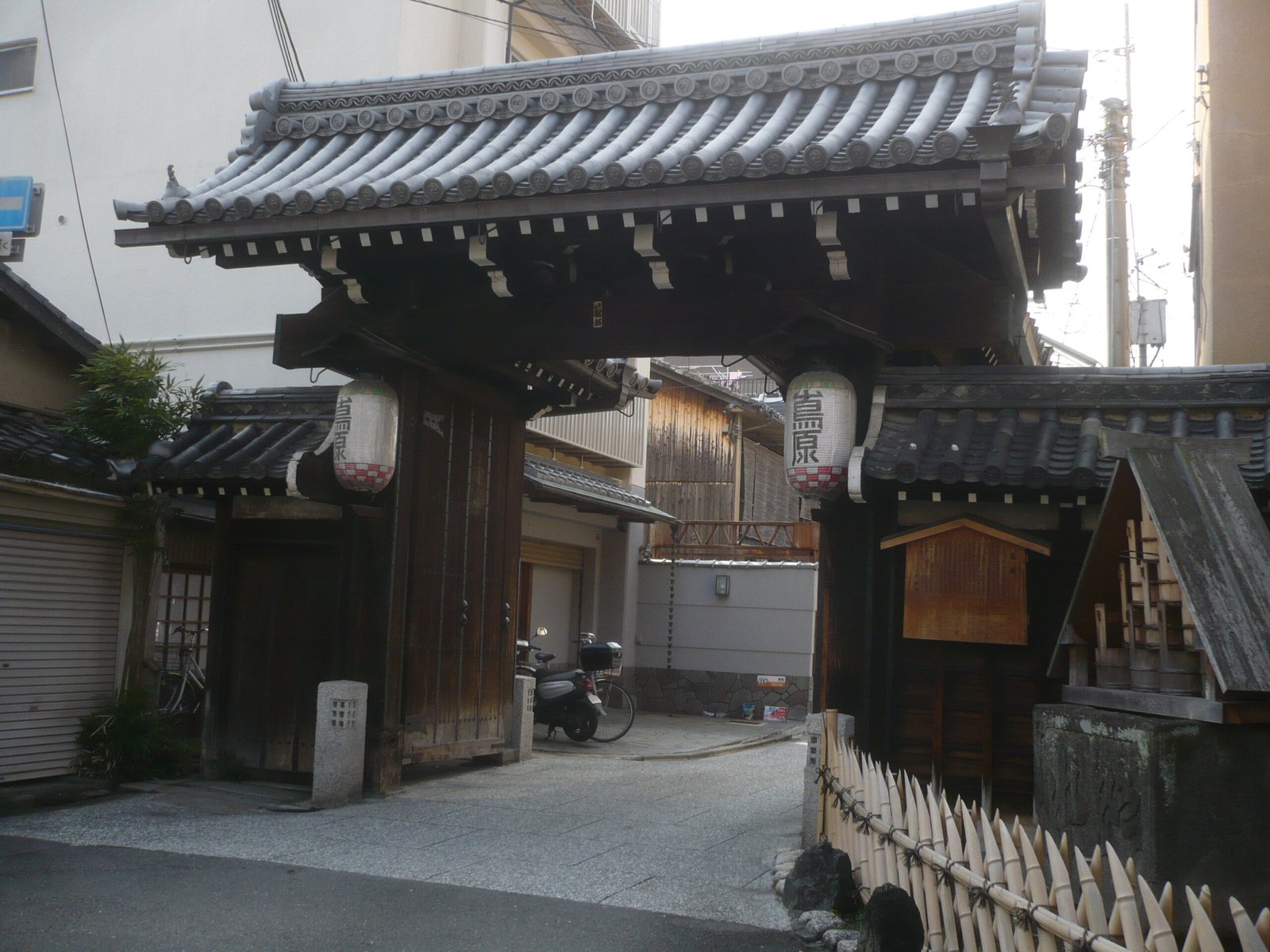
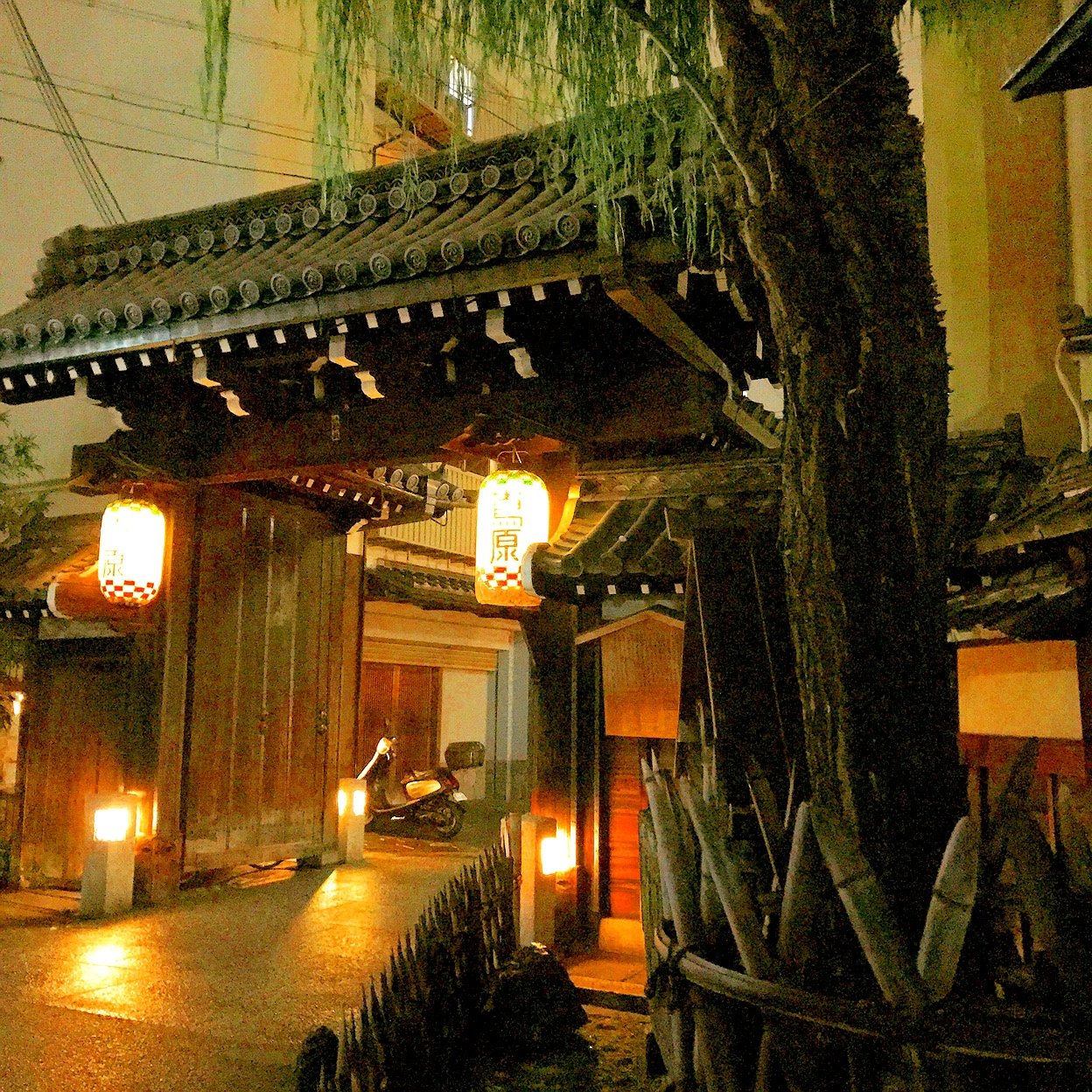
Where the name “Shimabara” actually comes from isn’t entirely settled. One explanation says the district’s large main gate resembled the gate of Shimabara Castle in Hizen province, on the far side of the country in modern Nagasaki Prefecture. The other says the name borrowed from the Shimabara Rebellion of 1637–38, the uprising sparked by that same castle’s construction, which had only just ended when the quarter was established and would still have been fresh in everyone’s memory. Either way, the name has nothing to do with the Shimabara Peninsula itself beyond that secondhand association.
Tayu, Not Geisha — At First
In its early decades, Shimabara’s entertainment centered on tayu and oiran working out of ageya — banquet houses built for elaborate, formal parties rather than the more intimate teahouse culture associated with Gion. Geisha as a profession didn’t really appear in Kyoto until the mid-1700s, and only then did some begin working in Shimabara alongside the existing tayu tradition, which is the point at which the district becomes a hanamachi in the broader sense people use the word today. After prostitution was outlawed nationally in the late 1950s, the tayu tradition didn’t simply vanish — practitioners were allowed to register as a distinct, ceremonial category of geisha, and a tayu still appears for occasional scheduled performances in Shimabara, continuing a role that technically never disappeared so much as changed its paperwork.
Sumiya: 345 Years in One Building
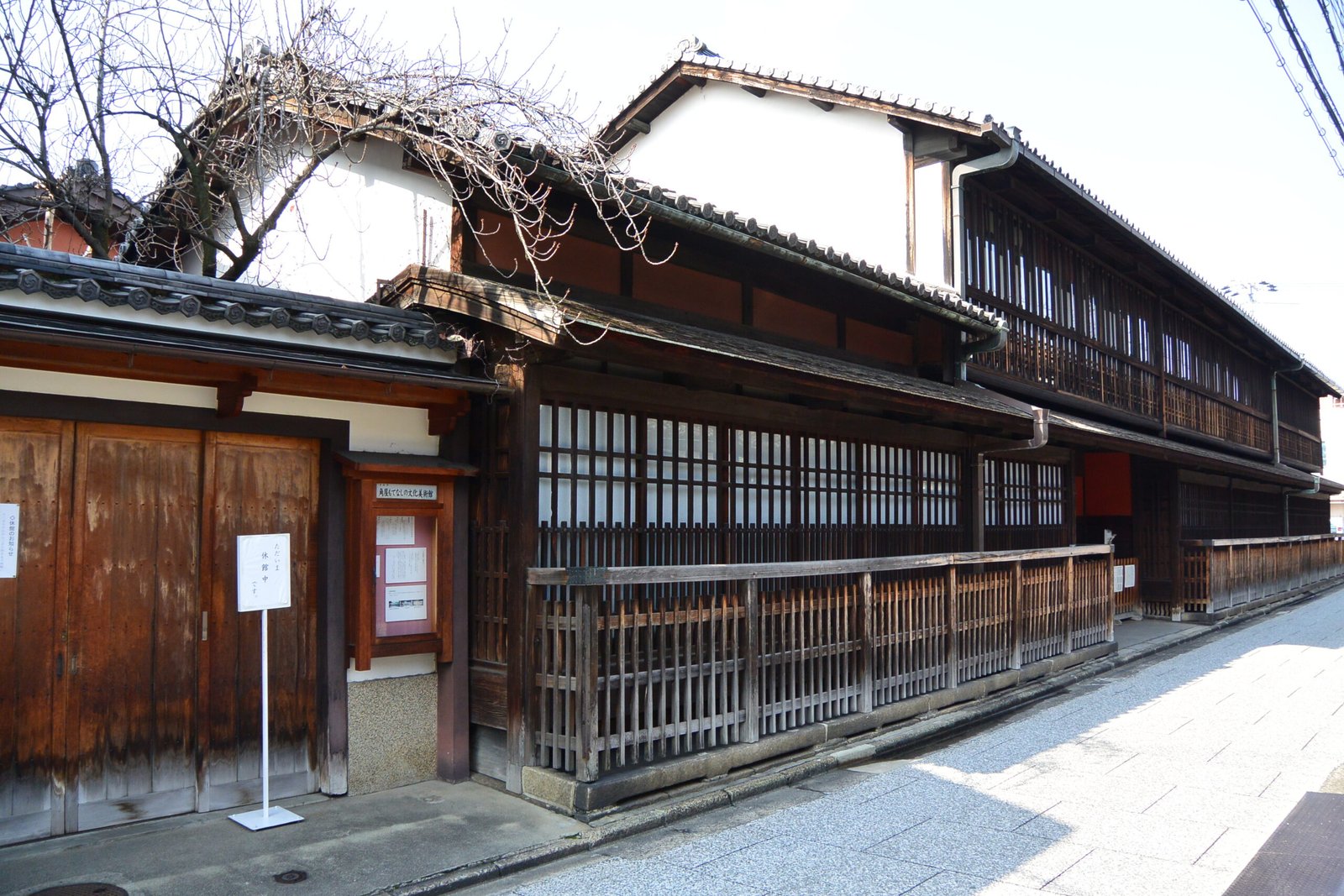
Sumiya is the one building in Shimabara you can actually walk into, and it earns the trip on its own. Built as an ageya in 1641, it’s the only surviving example of that kind of structure anywhere in Japan, and it’s often described as the largest machiya — traditional Kyoto townhouse — still standing in the city. Its clientele over the centuries ranged from the Shinsengumi, the shogunate’s special police force during Kyoto’s chaotic final Edo-period years, to reform-era figures like Saigo Takamori. Sumiya operated continuously as a restaurant and entertainment venue until 1985, a 345-year run that’s hard to find a parallel for anywhere. Various parts of the building began receiving Important Cultural Property designations in 1952, and after it closed, a preservation society formed in 1989 and reopened it as a museum in 1998.
Inside, the building holds party rooms decorated with gold-leaf murals, more modest banquet rooms, a small garden, and assorted furnishings and artwork collected over three and a half centuries of continuous use. Most of the interior is tatami, so wear shoes you don’t mind slipping off repeatedly. The upstairs galleries require advance booking rather than a walk-in visit, and there’s no English-language guide on site — a phrasebook, a translation app, or low expectations for the written explanations will all serve you about equally well. The seasonal closures catch some visitors off guard: Sumiya is only open roughly mid-March through mid-July and mid-September through mid-December, closed on Mondays within that window, which rules out a casual midsummer or midwinter stop.
Wachigaiya, and What Else Is Left
A short walk from Sumiya stands Wachigaiya, a working ochaya — a teahouse where a geisha or tayu would entertain guests — that’s still technically in operation but not open to tourists; entry requires an invitation and existing connections, so admiring it from the street is the realistic option. Near the train station, the small Shimabara Sumiyoshi Shrine once served the pleasure quarter directly, though it’s now largely in disrepair, with just a scattering of offerings in its yard suggesting it hasn’t been entirely forgotten. Between Sumiya, Wachigaiya, and the Omon gate, you can see the three sites most people come for in well under an hour — Shimabara isn’t a half-day destination so much as a quiet hour tacked onto a trip to somewhere else nearby.
Getting There
JR Tambaguchi Station, on the San’in Line, is the closest stop, with the Omon gate about a 10-minute walk away. On foot from Kyoto Station, it’s closer to 20 to 25 minutes, and buses heading toward Nishi Hongan-ji stop a short walk from the district as well, which makes it easy to fold Shimabara into a visit to Nishi Hongan-ji and Higashi Hongan-ji rather than treating it as a separate trip. If you want the fuller contrast of Kyoto’s entertainment history in a single day, pairing a quiet morning in Shimabara with an evening in Gion or a walk down Pontocho says more about how that history actually developed than either district does on its own. For the logistics of buses and trains generally, Getting Around Kyoto is worth a read before you go.
If the Shinsengumi side of this neighborhood’s history interests you, Mibu-dera, the temple most closely linked to the group, is a short walk away.
Bottom Line
Shimabara won’t give you the lantern-lit crowds of Gion, and that’s more or less the point. What it offers instead is a 345-year-old building that somehow survived as a working business into the 1980s, a gate with a name nobody’s fully agreed on the origin of, and a district quiet enough that you can actually take in its history without jostling for space on the street. If you’re already heading toward Nishi Hongan-ji or the station area, the extra half hour it takes to see Shimabara is a reasonable trade for a side of Kyoto’s past that most itineraries skip entirely.