Jisso-in: A Practical Guide to Kyoto’s Mirror-Floor Temple
Most of Kyoto’s famous reflecting gardens ask you to stand at the edge of a pond and look down. Jisso-in, a quiet monzeki temple tucked into the Iwakura neighborhood at the foot of Mount Hiei, does something different: it keeps a lacquered wooden floor polished to the point that the garden outside appears to float on it. If you’ve already made the climb covered in our Mount Hiei and Enryaku-ji guide, or you’re simply looking for a reason to get off the beaten path in northeast Kyoto, Jisso-in is worth the detour.
The Essentials at a Glance
| What | Details |
|---|---|
| Location | Iwakura, Sakyo-ku, at the foot of Mount Hiei in northeast Kyoto |
| Founded | 1229, by the priest Seiki; moved to its present site during the Onin War (1467-1477) |
| Status | A monzeki temple, historically headed by priests from the imperial family; also known as Iwakura Monzeki or Iwakura Goten |
| Known for | A lacquered floor inside the main hall that reflects the garden’s seasonal color |
| Hours | 9:00am–5:00pm |
| Admission | ¥500 |
| Access | Subway to Kokusaikaikan, then city bus 24, which terminates at the temple; roughly 40–50 minutes from central Kyoto |
From the Imperial Palace to the Foot of Mount Hiei
Jisso-in was founded in 1229 by the priest Seiki, and for its first two and a half centuries it stood near the Imperial Palace in the heart of the city. It moved to its current site in Iwakura during the Onin War of 1467 to 1477, the decade-long conflict that burned down much of the rest of Kyoto and sent a number of temples looking for calmer ground. Jisso-in is a monzeki temple, meaning its head priests were traditionally drawn from the imperial family rather than appointed through the usual clerical route, which is why it’s sometimes referred to by the older names Iwakura Monzeki or Iwakura Goten. That imperial connection is part of why the temple feels a notch more formal than the average neighborhood temple, even tucked away as it is.
The Floor That Reflects the Garden
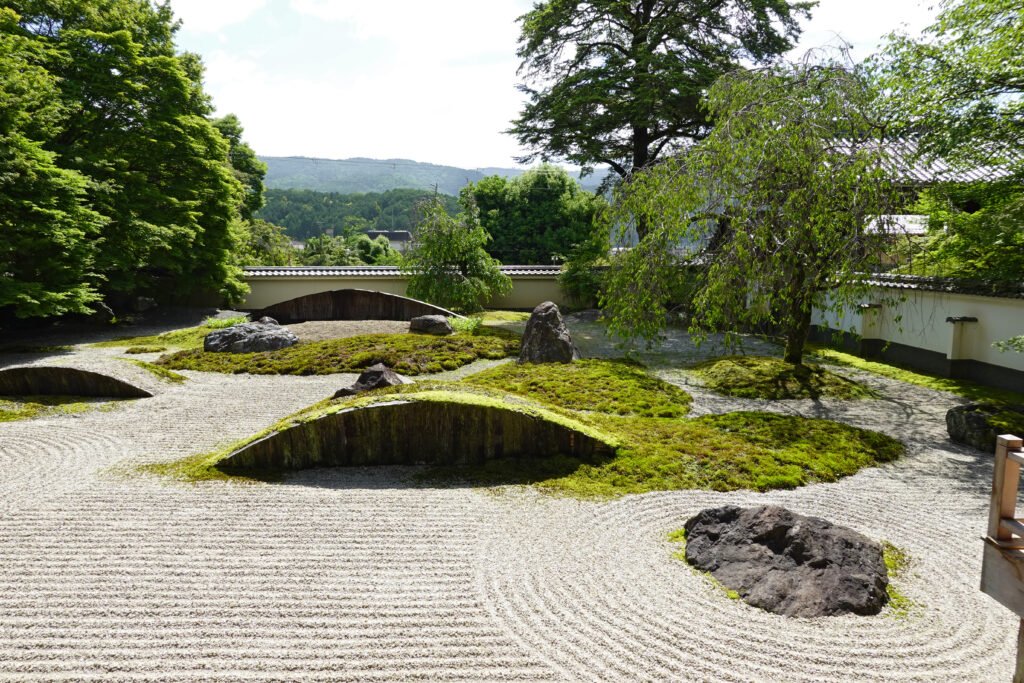
The reason most visitors make the trip out to Iwakura is a single lacquered wooden floor inside the main hall, positioned so that the garden just beyond the veranda shows up in it almost like a second image laid underneath the first. The effect changes with the seasons: green in summer as the maples fill in, a deep red once autumn color takes hold, and a pale white when snow settles over the garden in winter. The garden itself is built around that same idea of borrowed scenery, using the slope of Mount Hiei in the distance as a backdrop rather than trying to enclose everything within its own walls, with large stone lanterns placed through the grounds to anchor the view. It’s a small, contemplative space rather than a sprawling one, and it rewards sitting still at the edge of the hall for a few minutes rather than rushing through for a single photo. Photography rules inside the hall can be stricter than elsewhere on the grounds, and policies do shift from season to season, so it’s worth checking the signage when you arrive rather than assuming anything based on photos you’ve seen online.
What’s Inside, Besides the Floor
The floor tends to get all the attention, but Jisso-in holds a couple of genuine art-historical pieces as well. A standing statue of Fudo Myo-o, the fierce-looking guardian deity, dates to the Kamakura period (1185-1333), and the sliding fusuma doors in several of the rooms were painted by artists of the Kano school during the Edo period (1603-1868), the same workshop tradition responsible for commissions at Nijo Castle and other major Kyoto sites. None of it is displayed with much fanfare, which fits the temple’s general mood: understated, well cared for, and clearly used to seeing far fewer visitors than the big-name sights closer to downtown.
Visiting: Hours and Admission
Jisso-in is open daily from 9:00am to 5:00pm, and admission is a flat ¥500. There’s no need to book ahead for a regular visit; you pay at the entrance and are free to move through the halls and garden at your own pace. Most people are in and out within thirty to forty-five minutes, though it’s easy to stay longer if the hall is quiet and you’d rather just sit with the view.
Getting There
The most straightforward route from central Kyoto is the subway’s Karasuma Line north to Kokusaikaikan Station, followed by city bus 24, which conveniently terminates right at Jisso-in, so there’s no risk of missing your stop. Iwakura sits just outside the zone covered by the Kyoto City Bus & Kyoto Bus One-Day Pass, so budget an extra ¥170 for that final bus leg even if you’re using a day pass for everything else. From Shijo Kawaramachi, bus 21 or 23 will get you there directly. From Demachiyanagi Station, you can take the Eiden Eizan line to Iwakura Station and walk about 20 minutes, or hop on bus 21 or 23 instead if you’d rather skip the walk.
Nearby, If You Have Time
Iwakura is a residential pocket of the city rather than a tourist cluster, but there are a few low-key spots worth knowing about if you’re already out there. The old residence of the Meiji-era statesman Iwakura Tomomi sits nearby, along with Iwakura Shrine and Daiunji Temple. A short walk brings you to the Fudo-no-Taki waterfall, and Lake Takaragaike is about 2 kilometers south if you want a longer walk back toward the subway. None of these are must-see attractions on their own, but together with Jisso-in they make for a pleasant, unhurried afternoon well away from the crowds downtown.
Pairing It With the Rest of Kyoto
Jisso-in sits close enough to the base of Mount Hiei that it pairs naturally with a visit to Mount Hiei and Enryaku-ji, especially if you’re coming or going via Kokusaikaikan. If reflective, garden-built-around-a-floor temples are your thing, our guide to Enko-ji covers a different take on the same idea a little further south. For timing a visit around the floor’s autumn color, our Kyoto Autumn Foliage and Kyoto in November guides are worth a look, and our Getting Around Kyoto guide has more detail on bus passes and zones if the Iwakura fare question comes up elsewhere on your trip.
Bottom Line
Jisso-in isn’t a long visit, and it isn’t trying to be one. Pay the ¥500 admission, take the bus out to Iwakura, and give yourself a few quiet minutes at the edge of that lacquered floor before heading back. It’s one of the easiest ways to see a genuinely different kind of garden experience in Kyoto, without fighting a single tour group for the view.