Mount Atago and Atago Shrine: A Practical Guide to Kyoto’s Sacred Fire-Prevention Peak
Most of what fills a Kyoto itinerary rewards you for showing up: pay the entrance fee, walk through the gate, admire the garden. Mount Atago asks for a half-day of climbing before it gives you anything at all, and what is waiting at the 924-meter summit is not a view so much as a shrine — the head shrine, as it happens, of roughly 900 Atago shrines spread across Japan, all of them dedicated to protection from fire. For a city built almost entirely of wood and paper, that is not a minor deity to have looking out from the mountain above it.
The Essentials at a Glance
| What | Details |
|---|---|
| Location | 924-meter peak in northwest Kyoto, above Kiyotaki village near Arashiyama and Takao |
| Shrine founded | Traditionally 701–704, revived in 781 |
| Role | Head shrine of roughly 900 Atago shrines nationwide, dedicated to fire prevention |
| Hike distance | About 4 km round trip on the main Omote-Sando route |
| Hike time | Roughly 4–5 hours round trip for most hikers |
| Elevation gain | About 800 meters, from a trailhead around 100 meters up to the 924-meter summit |
| Best-known event | Sennichi Mairi, the night of July 31 into the morning of August 1 |
| Access | JR to Saga-Arashiyama Station, then a Kyoto Bus to the Kiyotaki stop |
A Mountain Climbed for Protection, Not Scenery
There is no shuttle bus up Mount Atago and no cable car — one used to run partway up the mountain decades ago, along with a small amusement park and a hotel, but all three closed down around the Second World War and were never rebuilt. What is left is a straightforward climb on foot, which is exactly how most of the shrine’s regular visitors have always reached it. The appeal is not a dramatic vista, though the upper slopes do open onto views of the Tamba highlands on a clear day. It is the fact that a shrine this specifically purposeful — built, maintained, and climbed almost entirely around the single idea of keeping fire out of people’s homes — still functions exactly as intended, in a city where wooden temples and wooden houses have burned down more than once over the last thousand years.
From a Legendary Founding to a Linked-Verse Omen
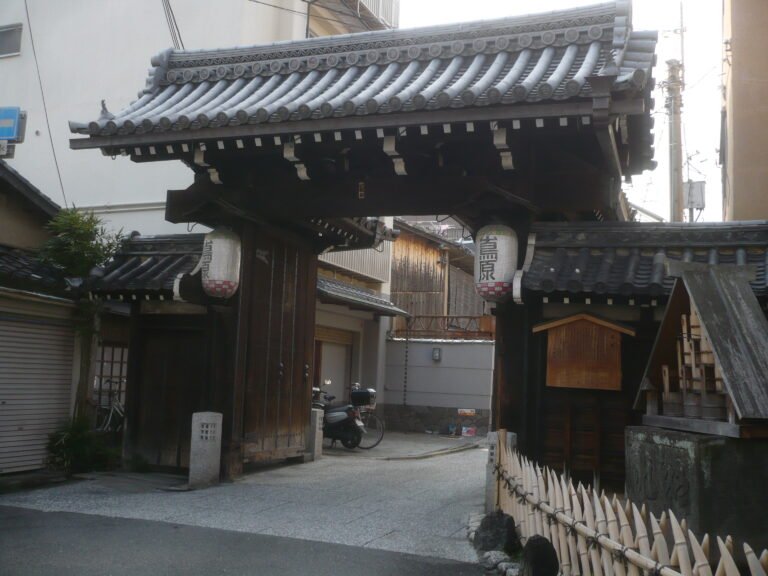
Tradition dates the shrine’s founding to 701–704, when the semi-legendary ascetic En no Ozunu and the monk Tai-cho are said to have established a sacred site at what is known as Asahi Peak. The site was revived in 781, and a Buddhist temple, Hakuun-ji, was later built alongside the shrine — a common arrangement in pre-modern Japan, where Shinto and Buddhist institutions frequently shared a single mountain. Hakuun-ji is long gone, but its black gate, the Kuro-mon, still stands near the shrine entrance as the one physical trace of it.
The mountain’s best-known historical footnote involves neither fire nor religion directly. In May 1582, shortly before the Honno-ji Incident, the general Akechi Mitsuhide stayed at the shrine while ostensibly praying for victory in an upcoming campaign. According to the traditional account, he drew lots three times over whether to turn on his own lord, Oda Nobunaga, then hosted a linked-verse poetry gathering at the shrine known as the Atago Hyakuin, whose opening verse is still read by some historians as a coded statement of his resolve. Within days, Nobunaga was dead at Honno-ji and Mitsuhide briefly held power over central Japan — a story that gives one quiet mountain shrine an outsized role in one of the more consequential weeks in Japanese history.

The Climb Itself
The standard route, Omote-Sando, starts at a torii a short walk upriver from the Kiyotaki bus stop and is the best-marked trail on the mountain — worth sticking to, since several hiking accounts note that people wander off the unmarked alternatives and get lost most years. It is a steady, step-heavy climb rather than a technical one: roughly 4 km to the summit and back, with about 800 meters of elevation gain from a trailhead around 100 meters above sea level to a peak at 924 meters. Budget 4 to 5 hours round trip and start in the morning, since the descent takes real time too. Partway up, Osugi Shrine offers a rest point with views back toward Arashiyama and the Katsura River, and the sites of several former teahouses — now just clearings — mark where earlier generations of pilgrims used to stop for tea and sweets before continuing on. In winter, snow is common on the upper slopes, and bringing snow cleats is worth the extra weight in your bag.
The Shrine at the Top
You reach the honden, the shrine’s main hall, just past the Kuro-mon gate. It is a working shrine rather than a museum piece — staffed, with an office selling the fire-prevention charms that make their way into kitchens, restaurants, and company break rooms across the Kyoto region and well beyond it, usually printed with a short phrase urging caution around flame. After the climb it takes to get here, there is a particular satisfaction in picking one up for your own kitchen rather than buying it at a shop in the city.

Sennichi Mairi: One Night Worth a Thousand Days
The shrine’s biggest night by far is the Sennichi Mairi, or Thousand-Day Pilgrimage, held from the night of July 31 into the early hours of August 1. Tradition holds that climbing the mountain during this specific window earns a thousand days’ worth of protection from fire, and tens of thousands of people make the climb in a single overnight stretch to claim it — a very different experience from the quiet weekday hike most of the rest of the year offers. The mountain road from Kiyotaki is lit for the occasion, and climbers exchange the traditional greetings “okudari-yasu” and “onobori-yasu” as they pass each other heading down and up. If a summer trip happens to land on those dates, it is worth knowing the mountain will be a completely different place than it is the rest of the year — crowded rather than solitary, and considerably more festive.
Pairing It With the Rest of Your Trip
Mount Atago sits at the far edge of the Arashiyama and Sagano area, which makes it easy to combine with a morning spent lower down before you commit to the climb. The Arashiyama Bamboo Grove and Tenryu-ji and Okochi Sanso Villa are both on the way if you are approaching from Saga-Arashiyama Station, and the lower torii that marks the traditional start of the old pilgrim route sits near Adashino Nenbutsu-ji in Toriimoto, so a stop there folds in naturally on the way to the bus. Given how much of a full day the mountain already takes, this works better as a dedicated hiking day than as an add-on to the walking route described in One Day in Sagano, though the two share enough territory that saving the lower Sagano sights for the same trip’s early morning is reasonable if you get moving early enough.
Getting There
Take the JR Sagano Line from Kyoto Station to Saga-Arashiyama Station, about 17 minutes and 240 yen. From there, walk roughly 10 minutes to the Arashiyama Tenryuji-mae bus stop and take a Kyoto Bus to the Kiyotaki stop, about 11 minutes and 230 yen — an IC card works on the bus, though a JR Pass does not cover it. Buses on this route run infrequently, so check the return timetable before you start climbing rather than after you come back down tired. From Kiyotaki, walk a few minutes upriver to reach the trailhead torii.
Bottom Line
This is not a stop to fit between two temples on a packed sightseeing day. Mount Atago asks for most of a day, a decent pair of shoes, and an early start, and gives back a shrine whose entire reason for existing — keeping fire away from a city that has burned down more than once — still feels specific and sincere rather than ceremonial. If you want one hike in Kyoto that is also a genuine pilgrimage rather than a scenic detour, this is the one to pick.