Ryogen-in: A Practical Guide to Daitoku-ji’s Smallest Rock Garden
Daitoku-ji’s walled compound holds more than twenty sub-temples, only a handful of them open to the public at any one time, and this blog has already worked through three of the regulars: the main complex itself, the maple-shaded approach at Koto-in, and the hidden cross at Zuiho-in. Ryogen-in is a fourth, older than either, and built around a rock garden so small that it’s routinely described as the smallest in Japan, tucked into a pocket of ground behind the main hall. It’s an easy add to a Daitoku-ji morning and one of the better reasons to linger inside the compound longer than a single sub-temple usually warrants.
The Essentials at a Glance
| What | Details |
|---|---|
| Location | within the Daitoku-ji complex, Murasakino, Kita-ku |
| Tradition | Rinzai Zen, Daitoku-ji school |
| Founded | 1502, traditionally credited to the Zen priest Tokei |
| Known for | five small gardens surrounding a single Hojo hall, including Totekiko, often called Japan’s smallest rock garden |
| Hours | roughly 9:00am-4:20pm daily |
| Admission | around ¥350 for adults, among the cheapest of Daitoku-ji’s sub-temples |
| Access | city bus 205 or 206 to the Daitokuji-mae stop, or the Karasuma subway line to Kitaoji Station and a 15-minute walk |
One of Daitoku-ji’s Oldest Corners
Ryogen-in was built in 1502, with its founding traditionally credited to the Zen priest Tokei, around the same period that several of Daitoku-ji’s earliest sub-temples were going up as the complex expanded under shogunate and samurai patronage. The Hojo, the hall that serves as the abbot’s residence and the room from which most of the gardens here are viewed, is frequently described as the oldest such hall surviving anywhere at Daitoku-ji, and some sources extend that claim, more cautiously, to all of Japan. Either way, it’s old enough that walking through it feels less like visiting a historical attraction and more like being let into a building that simply never got around to being replaced.
Totekiko, the Garden That Fits in a Teacup
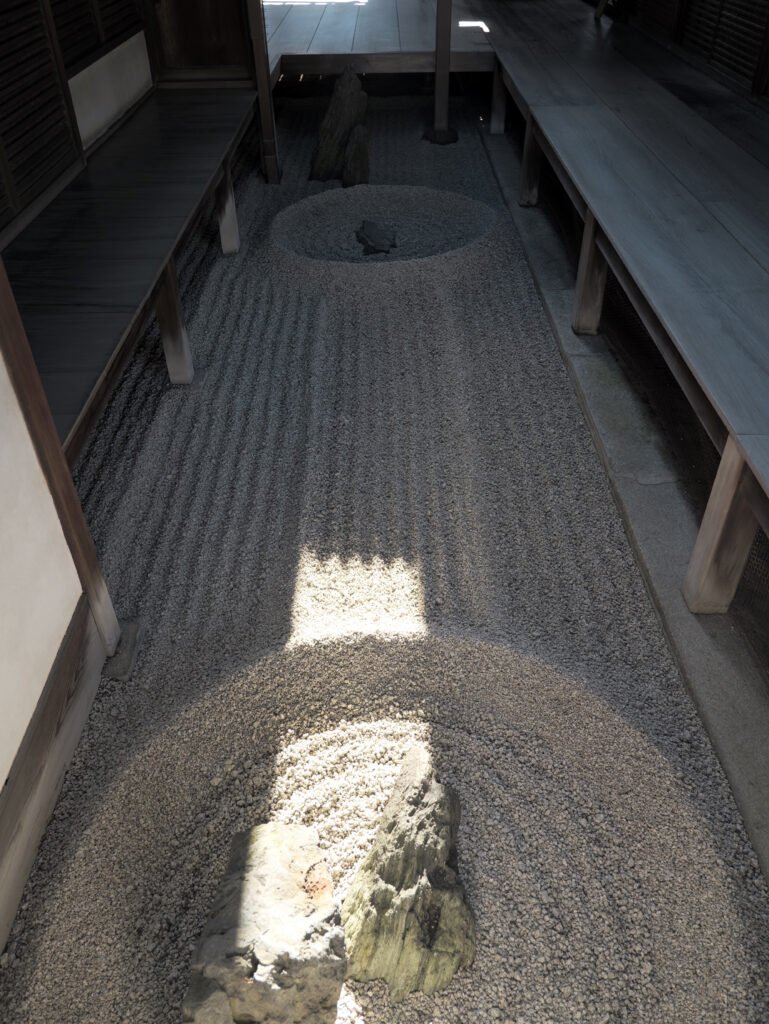
The garden Ryogen-in is actually known for is Totekiko, a tiny rectangle of raked white gravel tucked against the building’s wall, with a scattering of rocks and the faintest trace of wave patterns combed into the sand. It’s commonly called the smallest rock garden in Japan, a claim that’s hard to verify against every other tsuboniwa in the country but easy to believe standing in front of it, since the whole thing is barely bigger than a large tatami mat. There’s no signage trying to explain what it means, which is fairly typical of Zen dry gardens generally. You’re meant to sit with it rather than decode it, and a garden this size doesn’t take long to sit with before your eye starts noticing how deliberate every rock placement actually is.
Four More Gardens Around the Same Hall

Totekiko is one of five gardens arranged around Ryogen-in’s Hojo, and the other four are worth the slow walk around the veranda rather than a quick glance from one spot. The largest, to the south, is a broad sweep of raked gravel meant to represent the universe, centered on a rock standing in for Mount Horai, the mythical mountain of Chinese legend, with smaller rock-and-moss groupings read as a crane and a turtle, both long-standing symbols of longevity in Japanese garden design. To the north is Ryogin-tei, a quieter moss garden traditionally attributed to the painter and garden designer Soami and sometimes described as the oldest garden anywhere in Daitoku-ji, predating even the Hojo that looks out onto it. The remaining two are smaller still, named, according to temple tradition, after a riddle Tokei was given by his own teacher, and most visitors treat them as a kind of coda after the bigger, more legible gardens on either side.
A Go Board With a Famous Rumor Attached
Inside the hall, alongside the usual run of hanging scrolls and screens, Ryogen-in displays a weathered go board that the temple identifies as having once been used in a match between Toyotomi Hideyoshi and Tokugawa Ieyasu, two of the era’s biggest rivals and, eventually, successive rulers of a unified Japan. It’s the kind of attribution worth taking with a healthy grain of salt, since plenty of temples around Kyoto hold objects linked by tradition rather than documentation to famous names, but it’s a fun detail regardless, and a reminder that a sub-temple this quiet and this small still sat close enough to power to end up with stories like this attached to it.
Pairing It With Daitoku-ji’s Other Sub-Temples
Ryogen-in is close enough to the main Daitoku-ji compound and to Koto-in and Zuiho-in that all four make a reasonable single-morning combination, especially since each charges separately and keeps slightly different hours. Of the sub-temples covered so far on this blog, Ryogen-in is the plainest in terms of color and the most purely about garden design, so it pairs well as a change of pace after the Christian backstory at Zuiho-in or the maple canopy at Koto-in. Before working through any of Daitoku-ji’s halls, our Temple and Shrine Etiquette guide is worth a quick read, since several of the sub-temples here are stricter than average about where photography is allowed.
Getting There and Best Time to Visit
Daitoku-ji sits in Kita-ku, north of the city center, reached by city bus 205 or 206 to the Daitokuji-mae stop, or by the Karasuma subway line to Kitaoji Station and about a 15-minute walk west. There’s no train station directly at the complex, so it takes a bit more planning than somewhere like Kinkaku-ji on the same side of town. Ryogen-in’s gardens are dry landscape designs that don’t depend on flowers or foliage, which makes them a solid year-round visit, though the moss at Ryogin-tei tends to look its richest in the damper months of early summer.
Bottom Line
Ryogen-in doesn’t have Zuiho-in’s hidden cross or Koto-in’s famous approach, and it’s easy to walk straight past it inside a compound as large as Daitoku-ji. What it has instead is five small gardens that reward actually sitting down in front of them, a history that reaches back further than most of its neighbors, and a running claim to the smallest rock garden in the country. For anyone who’s already enjoyed the bigger-name dry gardens elsewhere in Kyoto, it’s a worthwhile next stop.