Yasaka Koshindo: A Practical Guide to Kyoto’s Most Colorful Temple
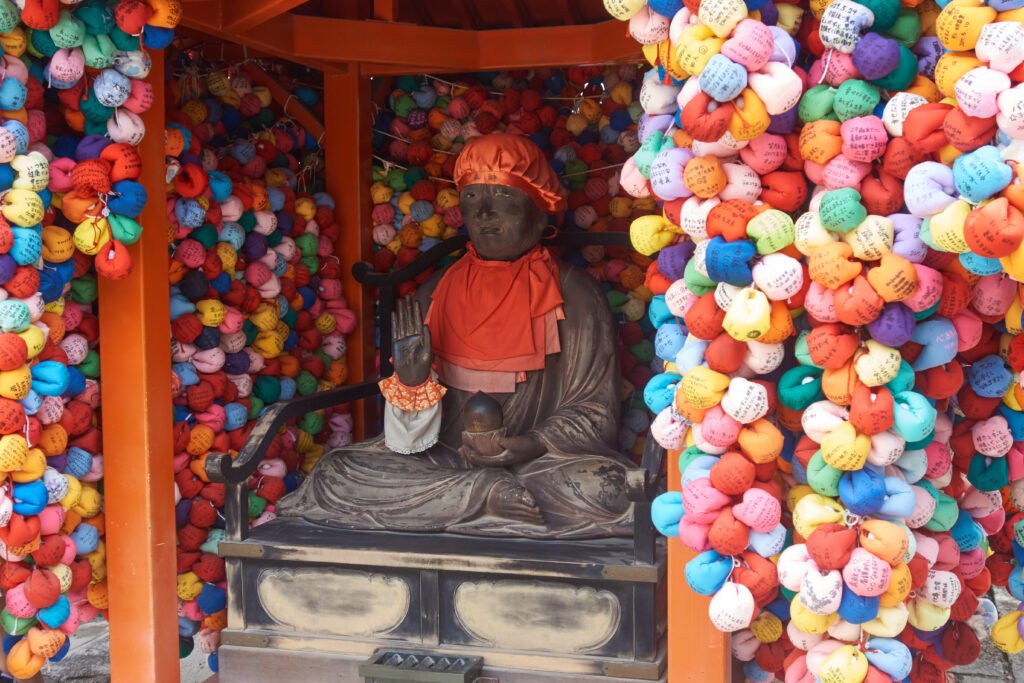
Walk up Ninenzaka toward the Yasaka Pagoda and you’ll likely see a small crowd clustered around a gate a few steps past it, phones raised at a ceiling draped in what looks, from a distance, like a cloud of multicolored balloons. That’s Yasaka Koshindo, and the balloons are actually kukurizaru — bundled cloth monkey charms — hung by the thousands above the temple’s incense stand. It’s become one of the most photographed small temples in Kyoto, but it’s still a working temple, not a backdrop, and knowing a bit about what you’re looking at makes the stop worth more than a quick photo.
The Essentials at a Glance
| What | Details |
|---|---|
| Location | Kinencho, Higashiyama-ku, on Ninenzaka, just past the Yasaka Pagoda (Hokan-ji) |
| Hours | roughly 9:00am to 5:00pm, daily, with no fixed closing days reported |
| Admission | free — bring cash if you want a kukurizaru charm, since cards generally aren’t accepted here |
| Formal name | Kongo-ji, more commonly called Yasaka Koshindo; dedicated to Shomen Kongo, a Taoist-linked protective deity also known as Koshin-san |
| Founded | traditionally dated to the Heian period, sometimes given more specifically as the year 960 — treat the exact date as approximate |
| Access | a short walk from Kiyomizu-dera or the Yasaka Pagoda; by bus, city bus 206 runs through the area, though stop names vary by source, so ask your driver or check a current map for “Kiyomizu-michi” or “Higashiyama-Yasui” |
| Pairs well with | Kiyomizu-dera, the Yasaka Pagoda, and the rest of the Sannenzaka-Ninenzaka slope |
A Small Temple With an Outsized Reputation
Yasaka Koshindo sits on a tiny plot just off Ninenzaka, close enough to the Yasaka Pagoda that most visitors stumble onto it on the way between the pagoda and Kiyomizu-dera. Its grounds are modest — you can see most of it in a single glance from the entrance — but the ceiling of colorful kukurizaru hanging over the incense area has turned it into one of the more recognizable images of Higashiyama, showing up constantly on social media and in guidebooks that otherwise skip past it. That popularity is a fairly recent development; for most of its history this was simply a neighborhood temple tied to Koshin folk belief, not a destination in its own right.

The Kukurizaru: Why a Temple Is Covered in Colorful Balls
Kukurizaru literally means “bound monkey,” and that’s roughly what each charm is meant to represent: a small cloth bundle, tied up so its limbs are pulled in tight, like a monkey restrained from acting on impulse. They’ve largely replaced the wooden ema plaques you’d write wishes on at most other temples and shrines. The idea behind them draws on an old Buddhist and Taoist notion that monkeys are driven by restless desire, and that tying one up — literally or symbolically — is a way of holding your own cravings in check. Visitors write a wish on a charm and give up one indulgence or bad habit in exchange for it, then hang the charm among the others, which is how a single stand at a small temple ends up buried under thousands of them in every color imaginable. Nobody seems to record why any particular color was chosen for any particular charm; by most accounts it’s simply decorative, and the sheer density of color is the point.
Who (or What) Is Koshin-san
The temple’s object of worship is Shomen Kongo, known locally as Koshin-san — a figure with roots in Chinese Taoist belief who was absorbed into Japanese Buddhist and folk practice over the centuries as a protector against evil and misfortune. Koshin-san is traditionally linked to the three “see no evil, hear no evil, speak no evil” monkeys, which is the other reason monkeys dominate the imagery here; you’ll spot statues of the trio tucked around the grounds in addition to the kukurizaru. The temple’s own account places its founding sometime in the Heian period, with 960 sometimes given as a specific year, though as with a lot of temples this old, the early record is thin and the date is worth treating as a tradition rather than a certainty.
Visiting Respectfully
It’s easy to treat Yasaka Koshindo as a photo op and move on — the grounds are small, there’s no fee, and the kukurizaru practically compose the shot for you — but it’s a functioning Buddhist temple, and the usual courtesies for visiting one still apply: keep your voice down, don’t block the narrow approach while you’re framing a photo, and be mindful that other visitors may be there to make an actual wish rather than take a picture. If you want a deeper refresher on temple and shrine manners generally, our guide to Kyoto temple and shrine etiquette covers the basics that apply here as much as anywhere else in the city. Expect company — this is rarely an empty spot during the day, especially since it sits directly on the route most people walk between Kiyomizu-dera and the pagoda — so an early start or an off-season winter visit are about the only reliable ways to get the grounds closer to yourself.
Getting There
Most visitors reach Yasaka Koshindo on foot, as part of a walk through the Sannenzaka and Ninenzaka slopes between Kiyomizu-dera and the rest of Higashiyama — it sits right on Ninenzaka itself, just past the Yasaka Pagoda, so if you’re already doing that walk you’ll pass within a few steps of the entrance without any detour. From Kyoto Station, it’s about a 30-minute walk if you want to see the neighborhood along the way, or a shorter ride on city bus 206, which runs through the area; the exact stop name differs depending on the source and the route variant, so it’s worth confirming with the driver or a current transit app rather than relying on any single name. There’s no dedicated parking, and given how narrow and stepped the surrounding streets are, walking or taking the bus is the more practical choice over driving in any case.
Bottom Line
Yasaka Koshindo earns its reputation honestly — there’s genuinely nowhere else in Kyoto quite like standing under a ceiling of a thousand hand-tied, hand-colored wishes — but it rewards the few extra minutes it takes to understand what you’re actually looking at. Pair it with Kiyomizu-dera and the Sannenzaka-Ninenzaka slope, budget it fifteen or twenty minutes rather than rushing through in two, and it becomes less of a photo stop and more of a small, genuinely strange piece of Kyoto’s folk religious history that just happens to also be extremely photogenic.