Kenninji: A Practical Guide to Kyoto’s Oldest Zen Temple
Most visitors who spend an afternoon in Gion walk straight past Kenninji without realizing it’s there. It sits at the quiet southern end of Hanamikoji, the same street lined with teahouses and, some evenings, a hurrying maiko or two, but the temple itself doesn’t compete with any of that. It’s the oldest Zen temple in Kyoto, founded in 1202, and it carries one of the more understated identities of any major temple in the city — it isn’t trying to be Kinkaku-ji. What it has instead is a ceiling painted with two enormous dragons, a full-scale reproduction of one of Japan’s most recognizable folding screens, and enough quiet courtyard space that you can actually sit with it for a while before moving on.
The Essentials at a Glance
| What | Details |
|---|---|
| Admission | ¥800 |
| Hours | 10:00 a.m.–5:00 p.m., last entry 4:30 p.m., open daily with no fixed closing days |
| Address | 584 Komatsucho, Yamatooji-dori Shijo-sagaru, Higashiyama-ku |
| Getting there | About a 10-minute walk from Gion-Shijo Station (Keihan Line) or Kawaramachi Station (Hankyu Line); also a short walk south from Yasaka Shrine and the main Gion streets |
| Visit length | 30–45 minutes |
| Good to pair with | Yasaka Shrine and Gion, a few minutes’ walk north |
A Temple Built on Tea and Zen
Kenninji was founded in 1202 by the monk Eisai, also known as Myoan Eisai, who had spent time studying in Song-dynasty China and came home with two things that would go on to shape Japanese culture for centuries: Rinzai Zen Buddhism and tea seeds. He’s usually credited as the person most responsible for popularizing tea drinking in Japan — less as a refined pastime at first and more as a way to help monks stay alert through long stretches of meditation — and Kenninji has held onto that connection ever since. Rinzai Zen is one of the two major schools of Zen Buddhism practiced in Japan today, and Kenninji serves as the head temple of its own Kenninji-ha branch within that school, one of more than a dozen such branches recognized across the country.
The Twin Dragons and the Dharma Hall
The building most people come to see is the Hatto, the Dharma Hall, where the ceiling is covered by a pair of dragons coiling around each other — a fairly common motif for temple ceilings in Japan, meant to symbolize protection of the Buddhist teachings, but rendered here at a genuinely large scale. The painting was completed in 2002 by the artist Junsaku Koizumi to mark the temple’s 800th anniversary, which makes it modern by temple standards even though the hall it sits in is centuries older. Look straight up and the two dragons resolve into a single connected composition that’s hard to take in from any one angle, which is part of why people tend to linger under it longer than they planned to.

The Wind God and Thunder God Screens
Kenninji also holds one of the best-known images in Japanese art: a pair of folding screens depicting Fujin and Raijin, the gods of wind and thunder, originally painted by the early Edo-period artist Tawaraya Sotatsu. The original screens are a National Treasure and live permanently at the Kyoto National Museum for conservation reasons, so what’s on display at the temple itself is a high-resolution reproduction — which sounds like a letdown until you’re actually standing in front of it. The composition turns up everywhere from museum posters to phone cases, and seeing it at full scale, in something close to the setting it was made for, gives it a different weight than any photo of it does.
Chotei and the ○△□ Garden
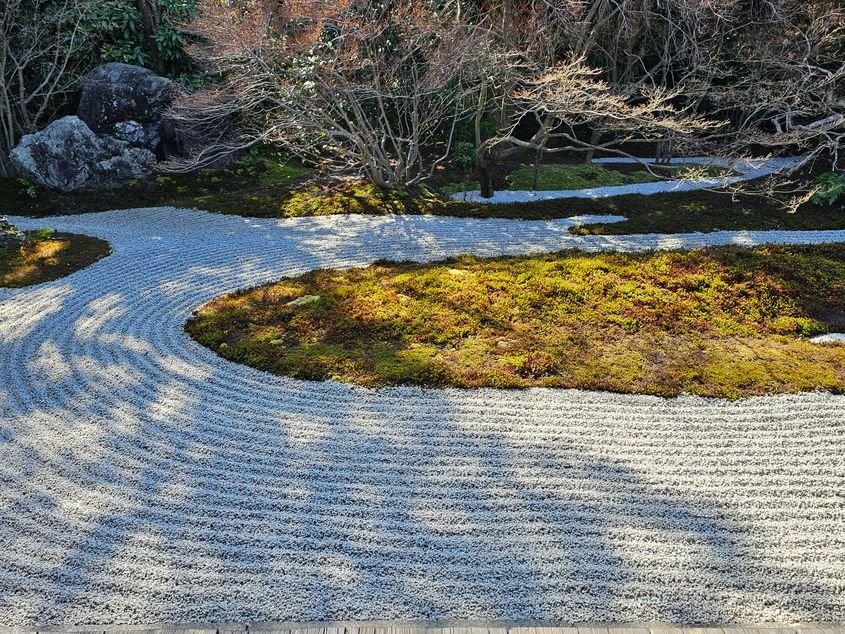
Two gardens are worth slowing down for. Chotei, sometimes translated as the Garden of the Sound of the Tide, is a compact dry-landscape garden built around three stones set into a bed of moss — simple by the standards of Kyoto’s more elaborate rock gardens, which is more or less the point. A short walk away, the ○△□ no Niwa, literally the Circle, Triangle, Square Garden, arranges the three basic geometric shapes into a small courtyard space. Interpretations of exactly what it’s meant to represent vary depending on who you ask, and the temple itself doesn’t spell it out, which fits the general Zen instinct to let a visitor sit with the ambiguity rather than hand them a tidy answer.
When to Go
Because Kenninji doesn’t show up on most first-time itineraries, it rarely feels crowded even on a Saturday. Weekday mornings right after the 10:00 opening tend to be the quietest window, and if you’ve already spent the earlier part of the day at Yasaka Shrine or wandering Gion, tacking Kenninji onto the end of that walk usually means having the Hatto ceiling mostly to yourself instead of sharing it with a tour group.
Ryosoku-in and the Sub-Temples
Kenninji isn’t a single building but a small campus of sub-temples tucked around the main grounds, most of which stay closed to the public most of the year. Ryosoku-in is the one worth watching for: it holds its own garden and a collection of paintings, and it periodically opens for limited special viewings, sometimes tied to an art exhibition, sometimes to the season. None of this is guaranteed on any given visit — check what’s open when you’re planning the trip rather than assuming — but it’s a reason to look twice at Kenninji if you’ve already been through once and assumed you’d seen everything it had.
Getting There and Nearby Sites
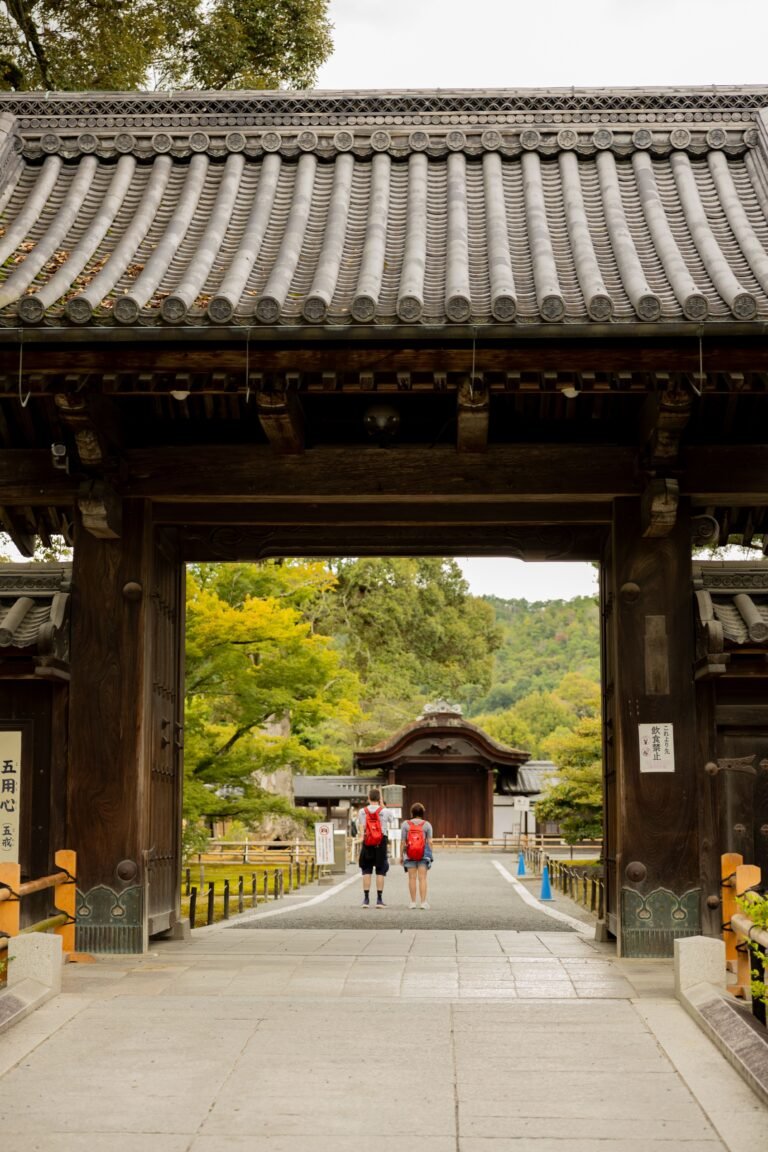
Kenninji sits at the southern edge of Gion, close enough to Yasaka Shrine and the Hanamikoji teahouse streets that it’s easy to fold into the same afternoon; our Gion guide and Yasaka Shrine guide cover that stretch of the neighborhood in more detail. It’s about a 10-minute walk from Gion-Shijo Station on the Keihan Line or Kawaramachi Station on the Hankyu Line, and the approach takes you beneath the Chokushimon, the temple’s Imperial Messenger Gate, before you reach the main grounds. If you’re building a longer Higashiyama walking day, Kenninji works well as a starting or ending point before heading up through Sannenzaka and Ninenzaka toward Kiyomizu-dera — the whole stretch is walkable without much backtracking.
Bottom Line
Kenninji doesn’t ask for much time and it doesn’t try to overwhelm you the way some of Kyoto’s headline temples do. Thirty to forty-five minutes covers the Hatto ceiling, the screen reproduction, and both gardens comfortably, and its location means it rarely needs to be a special trip of its own. It’s the temple you fold into a Gion afternoon rather than the one you plan a whole day around, and Kyoto has surprisingly few of those.