Hogon-in: A Practical Guide to Arashiyama’s Seasonal Lion’s Roar Garden
Most of Arashiyama’s temples keep ordinary hours: pay at the gate, walk in any day of the year. Hogon-in does not. This sub-temple of Tenryu-ji, tucked behind the main temple’s western wall barely five minutes from Arashiyama’s streetcar stop, opens to the public only during two short windows a year — a spring run and an autumn one — and spends the rest of the year closed to visitors entirely. That makes it one of the few sights in this guide where timing isn’t a convenience so much as the whole question of whether you get in at all.
The Essentials at a Glance
| What | Details |
|---|---|
| Location | Sub-temple of Tenryu-ji, Saga-Arashiyama, Ukyo-ku, Kyoto |
| Garden name | Shishiku no Niwa (the Lion’s Roar Garden) |
| Founded | Muromachi period, by Hosokawa Yoriyuki |
| Public opening | Two special viewing periods a year — a spring run and a shorter autumn one (exact dates set fresh each year) |
| Typical hours | 9:00am–5:00pm during viewing periods; autumn night viewing has run as late as 8:00pm–8:15pm last entry |
| Typical admission | Roughly ¥500–¥1,000 for adults, around ¥300 for school-age children (varies by year) |
| Access | 5 min walk from Keifuku Arashiyama Station; 10 min from JR Saga-Arashiyama; 15 min from Hankyu Arashiyama |
A Sub-Temple With Its Own Reason to Exist
Hogon-in was founded in the Muromachi period by Hosokawa Yoriyuki, a powerful deputy shogunal administrator who admired the teachings of the Zen master Muso Soseki — the same monk credited with designing Tenryu-ji’s own garden nearby. Soseki had already died by the time construction began, so it fell to his third-generation disciple, the priest Seichu Eiko, to carry the plan through. Like much of Arashiyama, the temple did not have an easy run of it afterward: it was destroyed during the Onin War, the decade of fighting in the 1460s that leveled large parts of Kyoto, and rebuilt only to be moved again in the Meiji period to its present spot, directly beside Tenryu-ji’s western approach, where it remains one of that temple’s sub-temples today.
The Lion’s Roar Garden
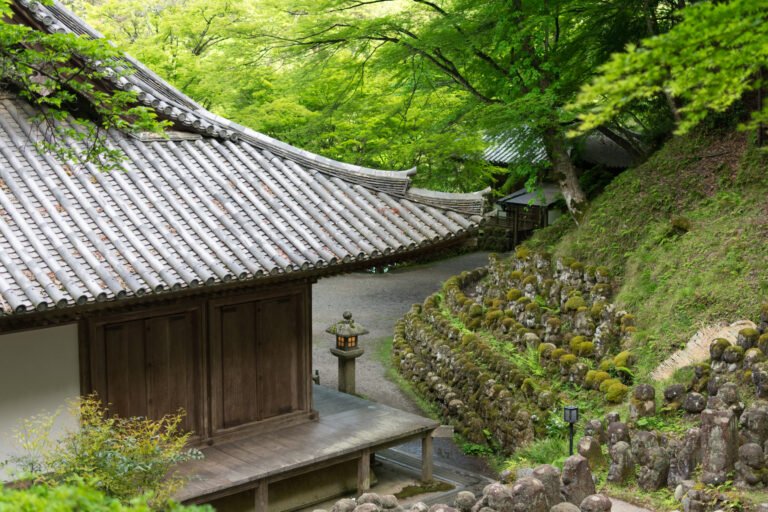
The reason to make the trip is Shishiku no Niwa, the Lion’s Roar Garden, laid out by the Muromachi-era monk Sakugen Shuryo. It borrows the wooded hillside behind the temple as a backdrop — a technique called shakkei, or borrowed scenery, that lets a relatively small garden feel like it extends straight into the mountain — and builds the foreground around two large rock formations, Shishi Iwa and Aoiwa, whose shapes are said to resemble a crouching lion. A small cascade called Ryumon Falls runs through the grounds, representing a carp fighting its way upstream to become a dragon, a folk image for perseverance on the path to enlightenment that’s traditionally associated with the Chinese-born monk Lanxi Daolong. None of it is meant to be taken in at a glance. The paths wind rather than cut straight through, and the moss-covered stones reward the kind of slow, unhurried walk that’s easy to forget about after a morning of temple-hopping through busier parts of Arashiyama.

Why It’s Only Open Part of the Year
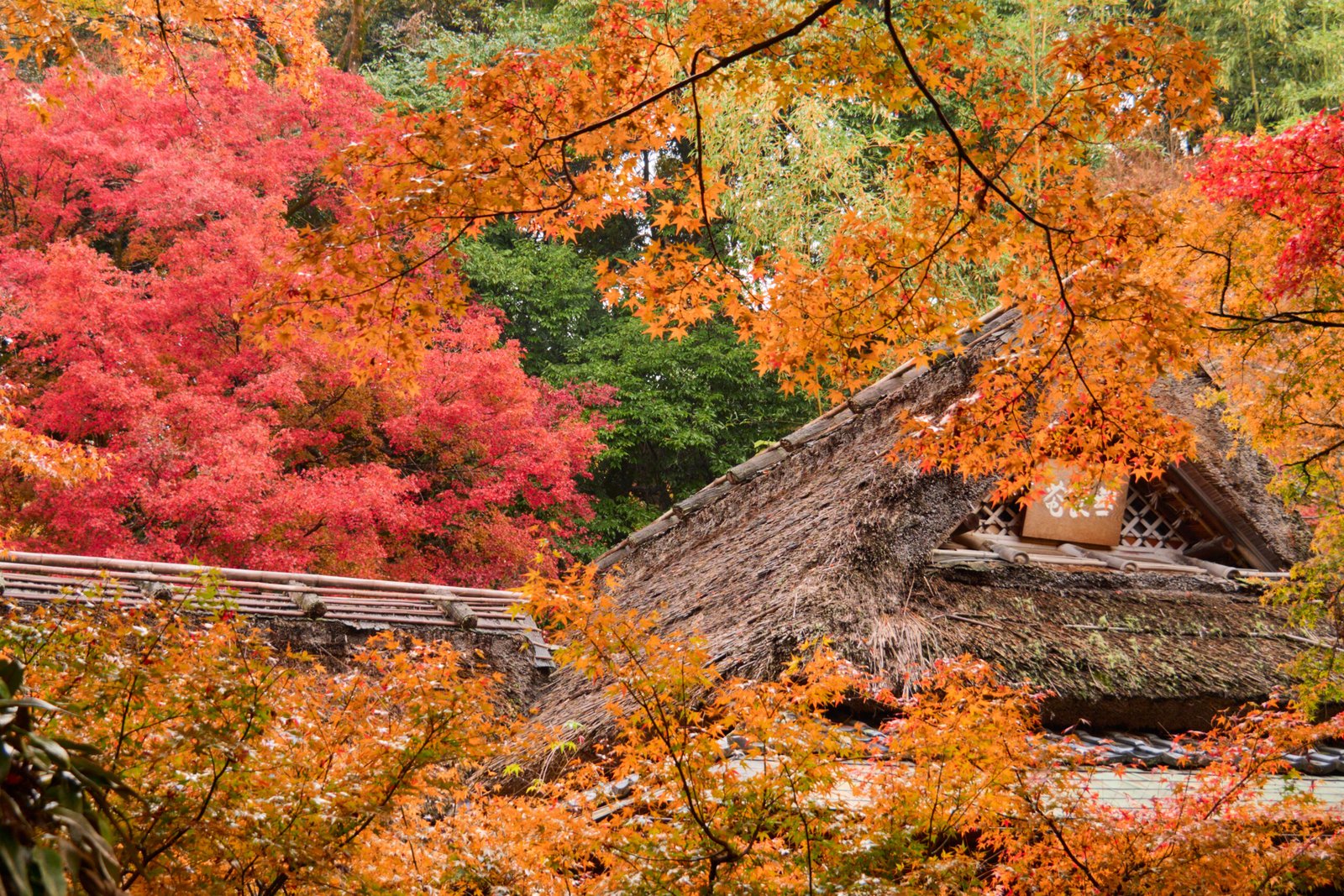
Hogon-in belongs to a small group of Arashiyama sub-temples that keep their gardens closed most of the year and open them only for scheduled viewing periods — a practice that has as much to do with preserving a quieter, more contemplative space as it does with tradition. The pattern is generally two openings a year: a spring run, usually spanning a couple of months in the March-to-June stretch, and a shorter autumn one timed to the maple colors, typically clustering somewhere between mid-November and early December. In recent years the autumn opening has also included evening hours, with the garden lit after dark; one recent autumn ran from November 14 through December 7, with entry to the main hall until 8:00pm and last entry to the garden around 8:15pm. Daytime hours during an open period are generally 9:00am to 5:00pm, and admission has run in the neighborhood of ¥500 to ¥1,000 for adults and around ¥300 for school-age children, though the fee has varied by year and by whether a night-viewing ticket is involved. None of these numbers are fixed from year to year, so before building a day around Hogon-in, check the temple’s official site or a current Kyoto events listing to confirm the exact dates, hours, and fee for whichever season you’re visiting in — showing up on a random Tuesday in January will mean a locked gate.
The Rest of the Grounds
Even outside the main garden’s scheduled openings, Hogon-in’s position just off the main Tenryu-ji approach means it’s easy to fold into a Sagano walk without a special trip, since you’ll likely pass its gate anyway. When it is open, a small hall near the entrance has occasionally hosted contemporary art alongside the garden viewing — a modern touch that sits a little unexpectedly next to Muromachi-era stonework, but one that fits with how many Arashiyama temples use their open seasons to try something beyond the standard garden tour. Don’t expect a long visit regardless; most people spend somewhere between twenty minutes and an hour here, which is part of why it pairs so easily with other stops in the area rather than standing as a destination on its own.
Pairing It With the Rest of Your Trip
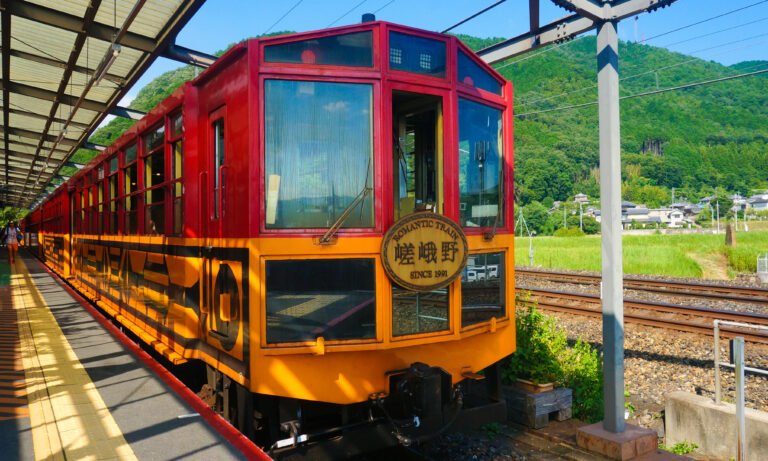
Hogon-in’s location makes it close to automatic to combine with other Sagano sights. It sits right along the path to the Arashiyama Bamboo Grove and Tenryu-ji, so a visit during an open season slots in naturally before or after either one, and Okochi Sanso Villa is a short uphill walk further on if you want to continue into the quieter part of the district. If the maples are the draw, it’s worth reading through Kyoto Autumn Foliage for how Hogon-in’s viewing window tends to compare with the city’s other big-name koyo spots, and the Randen streetcar line is the easiest way to reach the area if you’re coming from elsewhere in the city rather than walking in from JR Saga-Arashiyama. For a longer day that treats Sagano as a proper outing rather than a quick stop, One Day in Sagano lays out a fuller walking route that a Hogon-in visit can be grafted onto when the garden happens to be open.
Getting There
The Keifuku Arashiyama Line’s Arashiyama Station is the closest stop, about five minutes on foot from the gate, and it’s a convenient option if you’re coming from central Kyoto via the Randen streetcar. JR Saga-Arashiyama Station is about ten minutes away on foot, reachable from Kyoto Station on the JR Sagano Line in well under twenty minutes, and the Hankyu Arashiyama Line’s station is roughly fifteen minutes away if you’re approaching from Osaka or southern Kyoto. There’s no dedicated parking at Hogon-in itself, though the nearby Tenryu-ji lot has paid spaces if you’re driving in.
Bottom Line
Hogon-in rewards planning rather than spontaneity. It’s a small, deliberately quiet garden that happens to sit beside one of Arashiyama’s busiest attractions, and the fact that it’s only open for a few weeks a year, twice a year, is precisely what keeps it from feeling like one more stop on an overcrowded circuit. If your Kyoto trip lines up with one of its viewing windows — check the dates before you go — it’s a worthwhile detour of twenty minutes to an hour tacked onto a Tenryu-ji or bamboo grove visit. If it doesn’t line up, there’s no harm done; the rest of Sagano will still be there, open as usual.