Gokonomiya Shrine: A Practical Guide to Fushimi’s Fragrant-Water Shrine
Fushimi’s sake breweries get most of the attention from visitors walking the district’s canal paths, but the reason any of that brewing happens here in the first place sits a short walk away, inside a shrine most tour itineraries skip entirely. Gokonomiya Shrine takes its name — “Shrine of Fragrant Water” — from a spring that’s said to have surfaced on the grounds over a thousand years ago, and that same water is still what Fushimi’s brewers credit for the quality of their sake today. Add in a Momoyama-style gate salvaged from a demolished castle, a rock garden with stones laid out centuries ago, and a front-row seat to one of the bloodiest days of the Meiji Restoration, and you’ve got a shrine that punches well above its quiet, uncrowded reputation.
The Essentials at a Glance
| What | Details |
|---|---|
| Location | Fushimi Ward, a short walk from Fushimi Momoyama Station |
| Enshrined deity | Empress Jingu, alongside Emperor Chuai, Emperor Ojin, and six other emperors |
| Founded | date unknown; records of repairs date back to the Heian period, with the famous spring recorded from 863 |
| Known for | the “fragrant water” spring prized by Fushimi’s sake brewers; a Momoyama-style gate moved from Fushimi Castle; its role in the 1868 Battle of Toba-Fushimi |
| Hours | roughly 9am to 4pm daily for the grounds; worth confirming locally for the rock garden, which closes during festivals |
| Admission | free for the shrine grounds; a small fee (around ¥150–200) for the Enshu-yukari-no-sekitei rock garden |
| Access | about a 5-minute walk from JR Momoyama, Keihan Fushimi-Momoyama, or Kintetsu Momoyama-Goryomae stations |
The Spring That Gave the Shrine Its Name
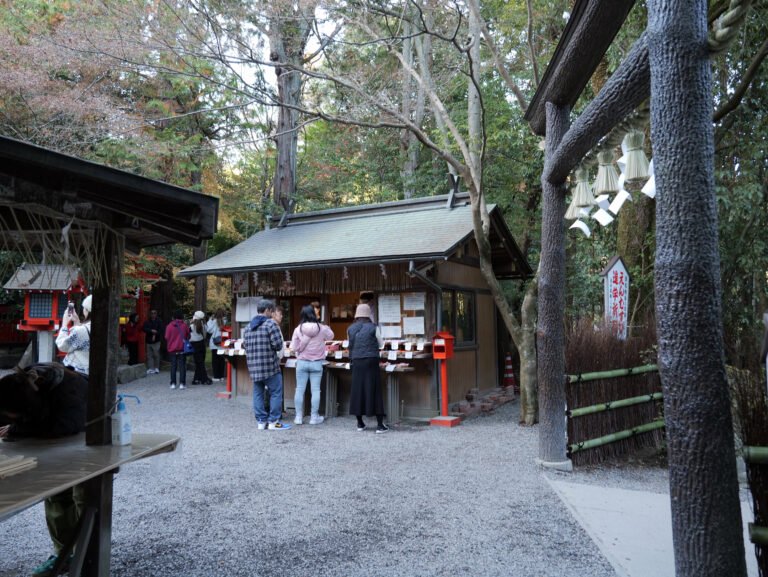
Gokonomiya was originally known as Mimoro Shrine, and its founding date isn’t recorded, though repairs noted from the Heian period suggest it had already been standing for some time. The shrine’s current name dates to September 9, 863, when clear, cold water is said to have begun flowing from the ground with a notably pleasant, sweet aroma. According to the story, Emperor Seiwa was impressed enough by the water that he ordered the shrine renamed Gokonomiya — literally “Shrine of Fragrant Water.” The spring eventually dried up during the Meiji era, but local contributions restored its flow in the early 1980s, and in 1985 Japan’s Environment Agency named it one of the country’s hundred Remarkable Waters. It still flows today, just to the left of the main sanctuary entrance, and it’s genuinely normal to see locals arrive with empty bottles and leave with full ones — nobody will stop you from doing the same.
That water is also the reason Fushimi became one of Japan’s great sake-producing districts in the first place, and the connection isn’t just folklore the breweries like to repeat — it’s the actual water table the district draws on. If you’ve already walked the canal-side breweries at the Fushimi Sake District, Gokonomiya is effectively the spiritual source code for everything you tasted there, and plenty of brewers still visit to pray for a good brewing season.
A Gate Borrowed From a Castle, Twice Relocated
The shrine’s current buildings date mostly to the early 1600s and sit in the colorful Momoyama architectural style, but they haven’t always been in this spot. In the 1590s, Toyotomi Hideyoshi ordered the shrine moved to the northeast corner of his newly built Fushimi Castle — northeast was considered an unlucky direction, the so-called “demon gate,” and shrines were routinely positioned there to ward off misfortune. After Hideyoshi’s death and the castle’s eventual demolition, Tokugawa Ieyasu had the shrine moved back to its original site in 1605, and the move brought along pieces of the castle itself: the shrine’s main gate was transferred over from Fushimi Castle and still stands today, its carved woodwork decorated with a water theme — waves, waterfalls, flowers, and clouds — that got a careful restoration of its original colors in a 1990 renewal. The main hall carries a matching turquoise water motif, tying the architecture visually back to the spring the whole shrine is named for.
Behind the shrine office, the Enshu-yukari-no-sekitei rock garden adds a quieter layer of history. Its stones are said to come from a garden laid out by the tea master and garden designer Kobori Enshu roughly 350 years ago, moved to Gokonomiya after World War II. A stone water basin inscribed in the 15th century sits among the rocks, and a maple tree drops orange leaves over the garden each autumn — a small, un-crowded alternative if you’re visiting Kyoto during peak foliage season and want a moment away from the lines at the bigger maple spots.
Headquarters for a Battle That Burned the Town Around It
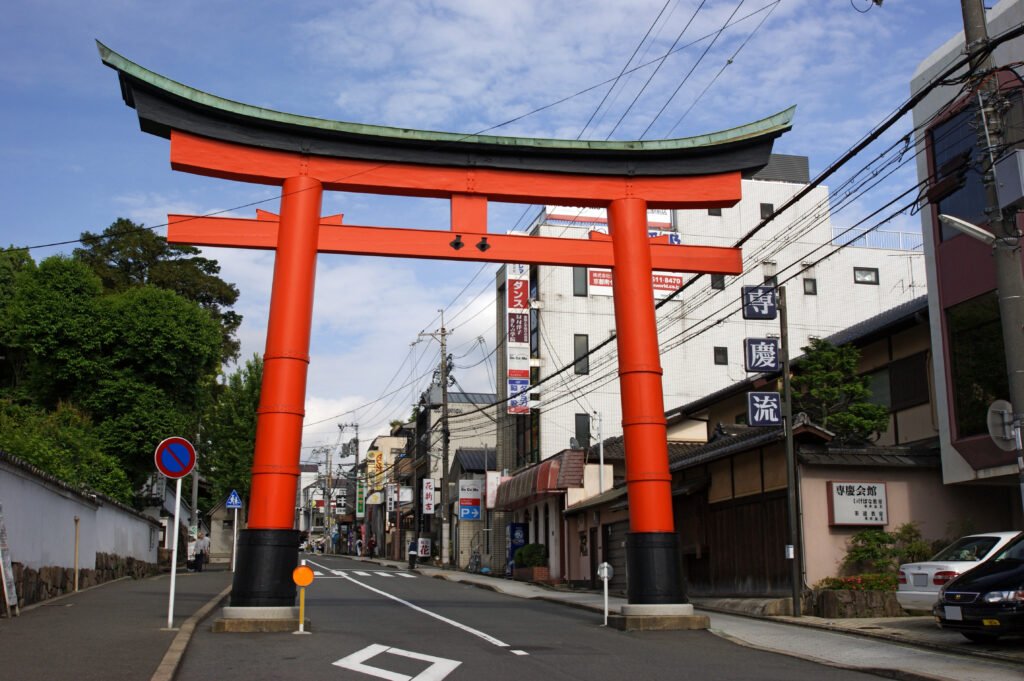
Gokonomiya’s history takes a sharper turn in 1868, during the Battle of Toba-Fushimi, the opening clash of the Boshin War that effectively decided the end of shogunate rule in Japan. Samurai from the Satsuma domain, fighting on the imperial side, used the shrine as their headquarters during the fighting, and Gokonomiya itself survived largely intact even as much of the surrounding town burned. A small Tenmangu shrine east of the main torii gate still bears bullet holes from the battle, a detail easy to miss unless you know to look for it. It’s a striking contrast to walk from that war-scarred corner of the grounds back to the peaceful spring at the entrance, two sides of the same thousand-year site. Readers who’ve already covered Fushimi Momoyama Castle or Jonan-gu, which sat directly in the path of the same fighting, will recognize how much of Fushimi’s quiet modern streets were a genuine battlefield a little over a century and a half ago.

What Else Is Worth Noticing
Gokonomiya is widely regarded as a leading shrine to pray for safe childbirth, owing to its main deity, Empress Jingu, who’s enshrined here alongside Emperor Chuai, Emperor Ojin, and six other emperors. A large sago palm, a tropical species that has no business thriving in Kyoto’s climate, grows on the grounds and is locally credited to the nourishing effect of the spring water. The emado, a small open-air structure beside the main hall, holds a collection of faded but still legible old ema paintings, worth a slow look if that kind of folk art interests you. The shrine also hosts a notably full calendar of small annual rituals — a first-water ceremony on New Year’s Day, a seven-herb porridge ritual on January 7, and an autumn Shinko-sai procession in October among them — none of which are likely to coincide with a typical visit, but they’re a reminder that this is a shrine still woven tightly into the rhythm of the neighborhood around it.
Pairing It With Nearby Sights
Gokonomiya sits close enough to Fushimi’s other sights that it slots easily into a longer day in the area. It belongs naturally alongside the breweries and canal walk of the Fushimi Sake District, and if you’re building a fuller itinerary, our One Day in Fushimi route covers Fushimi Inari, the sake district, and Fushimi Momoyama Castle in sequence — Gokonomiya fits neatly into that same loop, particularly between the sake district and the castle grounds. For the 1868 history, pairing it with Jonan-gu, which sat on the same battle’s front line a short distance south, fills in a fuller picture of how the fighting moved through the district.
Visiting Gokonomiya Shrine
The shrine grounds are open roughly 9am to 4pm daily and cost nothing to enter; the rock garden behind the shrine office charges a small fee, generally in the ¥150–200 range, and may close during festivals, so it’s worth checking if that’s a priority for your visit. Getting there is straightforward: JR’s Momoyama Station, Keihan’s Fushimi-Momoyama Station, and Kintetsu’s Momoyama-Goryomae Station are all within about a five-minute walk, and city buses stop even closer, at the Gokonomiya-mae stop roughly a minute from the entrance. If you’re not sure which train line makes sense from where you’re starting, our Getting Around Kyoto guide breaks down the city’s overlapping rail and bus networks.
Bottom Line
Gokonomiya Shrine is easy to treat as a footnote to the Fushimi sake district, but it’s worth building in real time for — fifteen or twenty minutes at least, longer if you want to sit with the rock garden or trace the bullet holes left from 1868. It’s the rare Kyoto shrine where the backstory for something you’ve probably already tasted, in this case Fushimi’s sake, happens to be sitting right there in the ground, still flowing.