Matsunoo Taisha: A Practical Guide to Kyoto’s Sake-Brewers’ Shrine
Most visitors to western Kyoto get off the train at Arashiyama and never go another stop further. That’s a missed turn, because one stop past on the Hankyu line sits Matsunoo Taisha, a shrine old enough to predate the city itself, that doubles as the unofficial patron shrine of sake brewing in Japan. Barrels donated by breweries line the approach, a spring said to bring health and long life bubbles up beside the main hall, and three gardens by one of the twentieth century’s most respected designers sit almost entirely free of the crowds you just left behind at the bamboo grove.
The Essentials at a Glance
| What | Details |
|---|---|
| Location | Arashiyama-miyamachi, Nishikyo-ku, Kyoto — one stop south of Arashiyama on the Hankyu line |
| Founded | Traditionally dated to 701, by the Hata clan |
| Known for | Guardian shrine of sake and miso brewers; Shigemori Mirei’s three gardens; the Kame-no-i spring |
| Grounds hours | 5:00am–6:00pm daily, no regular closing days |
| Admission | Shrine grounds free; garden and treasure hall roughly ¥500 (garden viewing hours run shorter than the grounds, so arrive well before closing) |
| Access | Hankyu Arashiyama Line to Matsuo-taisha Station, about a 3-minute walk; also reachable by Kyoto City Bus route 28 |
Older Than the City That Grew Around It
Matsunoo Taisha’s traditional founding date of 701 puts it ahead of Heian-kyo itself by nearly a century, and its origin story is tied directly to the Hata clan, immigrants from the Korean peninsula who settled this stretch of the Katsura River and brought engineering and brewing knowledge with them. According to shrine tradition, when the capital moved to what is now Kyoto in 794, a member of the Hata clan spotted a turtle resting beneath a waterfall near the shrine and took it as a favorable sign — part of why turtles turn up throughout the grounds today, from a black stone turtle by the gate that visitors rub for good fortune to the shape of one of the three modern gardens. The Hata clan founded Fushimi Inari Taisha around the same period and with similar backing, which is worth knowing if you’ve already visited Fushimi’s torii gates and want the lesser-known sibling site on the other side of the city.
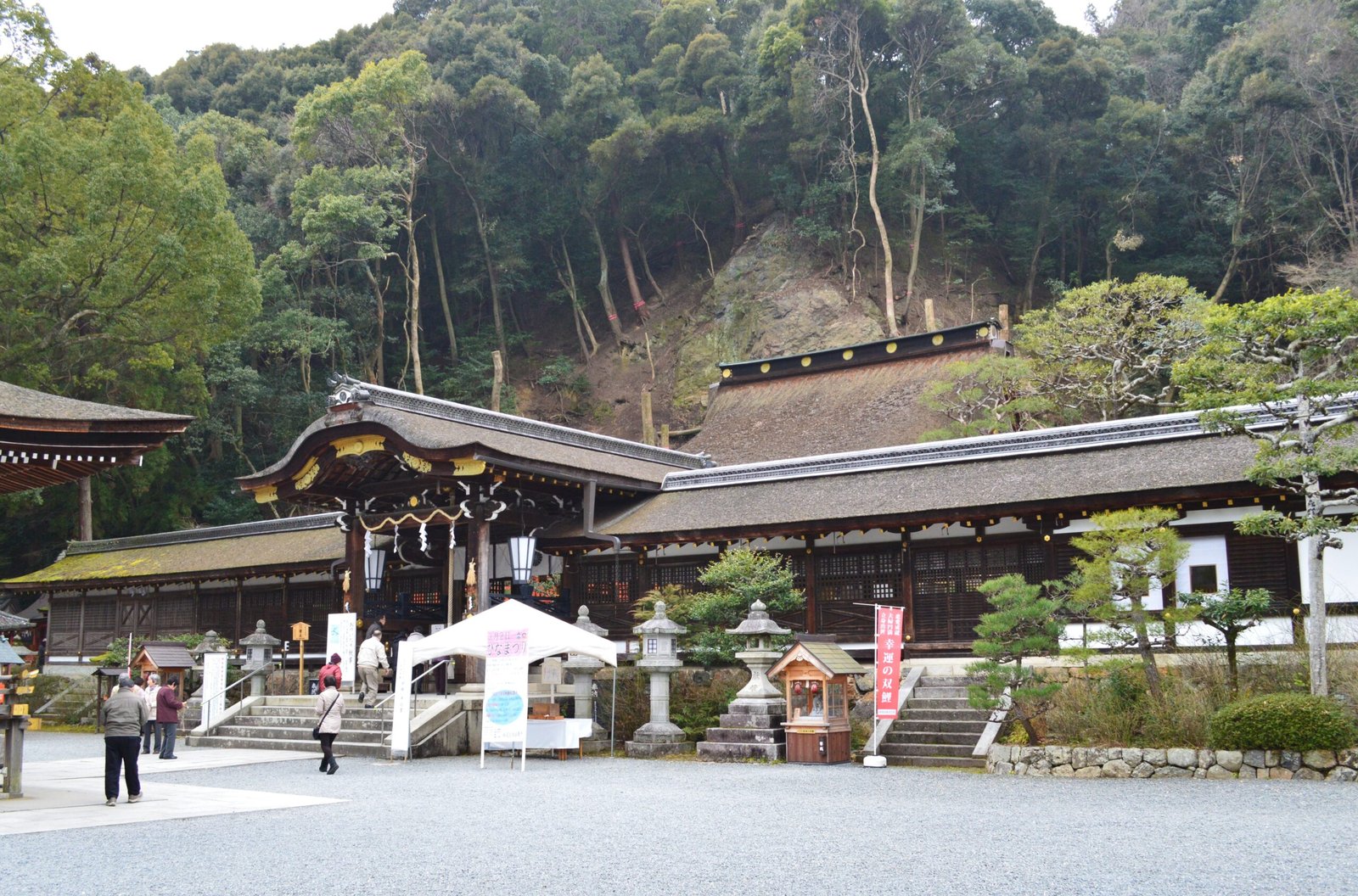
The shrine’s current honden, the inner sanctuary, dates to 1397 and is built in a distinctive style named directly after the shrine, Matsuo-zukuri, recognized as an Important Cultural Property. It’s not a building most visitors get close to — like most honden, it’s viewed from a respectful distance behind the haiden, the worship hall where offerings and prayers actually happen — but its age alone makes it one of the older wooden structures still standing in the Kyoto area.
The Guardian Shrine of Sake Brewing
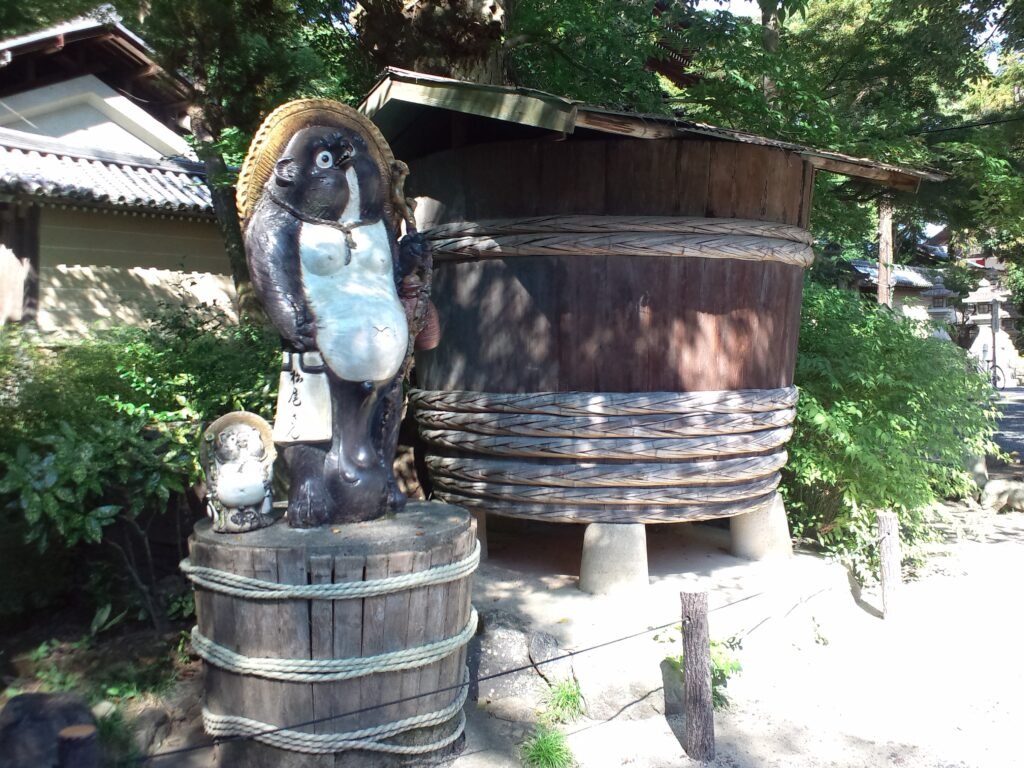
What sets Matsunoo Taisha apart from Kyoto’s hundreds of other shrines is its specific role in the sake industry. Brewers and miso makers from across Japan travel here to receive water from the shrine’s spring and waterfall, which tradition holds improves fermentation, and many donate full casks of sake in return, stacked and displayed near the haiden in a wall of wood and rope that’s worth a slow look rather than a quick photo. The shrine sells its own kinpaku sake, flecked with gold leaf, along with blessed miki sake that’s especially popular around New Year, and if you’ve already read our guide to the Fushimi Sake District, this is the spiritual counterpart to that neighborhood’s working breweries — the place brewers themselves visit rather than a place set up primarily for visitors to taste.
The Kame-no-i, or Tortoise Well, sits near the entrance to the paid garden area and is the most visited of the shrine’s water features. Drinking from it is said to bring health and long life, which pairs naturally with the turtle symbolism found throughout the grounds — turtles are considered messengers of the mountain god here, and a black stone turtle statue known as Nade Kame-san invites visitors to pet it on the way in for good measure.
Three Gardens, Three Eras
The paid section of the grounds centers on a set of three gardens completed in 1975 by Shigemori Mirei, one of the most influential Japanese garden designers of the twentieth century, known for reinterpreting historical styles rather than simply restoring them. Each garden at Matsunoo Taisha represents a different period of Japanese garden history: the Joko Garden imagines an ancient-period landscape with large, jagged rocks arranged like a wild mountaintop; the Horai Garden follows a Kamakura-period style built around the Chinese idea of a paradise island, its rocks standing in for that distant shore; and the Kyokusui Garden takes a flatter Heian-period form, built around a winding stream bordered with azaleas. Walking all three in sequence works almost like a short course in how Japanese garden design changed over a thousand years, compressed into one shrine visit and without the crowds you’d find doing the same exercise at some of central Kyoto’s more famous temple gardens.
Kerria Flowers and the Shrine’s Festival Calendar
Spring brings a specific reason to visit beyond the gardens: the shrine’s free outer grounds fill with yamabuki, bright yellow kerria flowers, typically blooming in quantity through late April once the cherry blossoms elsewhere in the city have already dropped. It’s a good fallback if you’re visiting Kyoto just after peak sakura season and feel like you missed the window — the kerria here tends to peak a little later and costs nothing to see.
The shrine’s two biggest festivals both revolve around its mikoshi, portable shrines carried in procession. Shinko-sai, held on the first Sunday after April 20, sees six mikoshi carried down to the Katsura River and ferried across by boat, a striking sight if your trip happens to land on that date; about three weeks later, Kanko-sai (also called Okaeri) brings them back the same way. Ondasai, in mid-July, is a smaller rice-protection rite, and Hassakusai, on the first Sunday of September, combines prayers for a good harvest with sumo matches and a women’s mikoshi procession toward Arashiyama. None of these require advance booking, but they do turn an ordinarily quiet shrine briefly crowded, so factor that in if you’re hoping for the usual calm visit.

Pairing It With the Rest of Your Trip
Matsunoo Taisha sits close enough to central Arashiyama that it’s easy to fold into the same day as the Arashiyama Bamboo Grove and Tenryu-ji, just a short ride or a longer walk away along the Katsura River. It’s an even more natural pairing with Saiho-ji (Kokedera), the reservation-only moss temple that sits less than a kilometer south — since Saiho-ji requires booking ahead and a fixed arrival window, Matsunoo Taisha is a good way to fill the rest of that morning or afternoon without a reservation of its own. If sake is the thread you’re following through Kyoto, read this alongside the Fushimi Sake District guide for the working-brewery side of the same story, and our Getting Around Kyoto guide covers the IC card basics if the Hankyu line is new territory for your trip.
Getting There
The simplest approach is the Hankyu Arashiyama Line to Matsuo-taisha Station, about a 3-minute walk from the shrine gate; reaching that line from Kyoto Station usually means the Karasuma subway line to Shijo Karasuma, a transfer to the Hankyu Kyoto Line toward Katsura, and a further transfer onto the Arashiyama Line, roughly 30 minutes total with the changes. Kyoto City Bus route 28 and a couple of Keihan bus routes also run to the Matsunoo Taisha-mae stop from central Kyoto if you’d rather avoid the train transfers, and if you’re already in Arashiyama on foot or by bike, it’s a flat, manageable ride or walk along the Katsura River to get here.
Bottom Line
Matsunoo Taisha doesn’t ask for much time — an hour covers the gardens, the spring, and the sake barrels comfortably — but it rewards visitors who want a Kyoto shrine with an actual working relationship to the city’s food and drink culture, rather than one that’s purely ornamental. Add it onto an Arashiyama day, especially if you’re already heading toward Saiho-ji, and you’ll likely have the gardens closer to yourself than almost anywhere else on this list.