Nishiki Market: A Practical Guide to Kyoto’s Kitchen
Nishiki Market gets called “Kyoto’s Kitchen” in every guidebook, and for once the nickname earns its keep. This is a working food market first and a tourist attraction second, even if that balance has tipped noticeably in the last few years. Shopkeepers here have been selling pickles, seafood, and Kyoto vegetables to local cooks and restaurants for roughly four hundred years, and a lot of them still are, tourists or no tourists.
It’s a single narrow, covered arcade about 390 meters long, packed with somewhere around a hundred small shops. You could walk the whole length in five minutes if you had a reason to. Almost nobody does, because the point of Nishiki isn’t getting from one end to the other — it’s stopping every few stalls to look at something you don’t have a name for yet.
The Essentials at a Glance
| What | Details |
|---|---|
| Length | About 390 meters, roughly 100 shops |
| Hours | Varies by shop, but roughly 9:00 a.m.–6:00 p.m.; many stalls close by early evening |
| Closed days | No single market-wide closing day — individual shops vary, some close Wednesdays |
| Typical visit length | 45–90 minutes for a proper graze |
| Cost | Free to walk through; snacks generally ¥200–500 each |
| Nearest stations | Shijo (Karasuma subway line) or Kawaramachi/Karasuma (Hankyu line), both a few minutes’ walk |
| Least crowded time | Weekday mornings before 11 a.m. |
Getting There
Nishiki Market sits right in the middle of downtown Kyoto, one block north of Shijo-dori, which makes it one of the easiest sights in the city to reach. Take the Karasuma subway line to Shijo Station, or the Hankyu Kyoto line to Karasuma or Kawaramachi Station, and you’ll be at one of the market’s entrances within a five-minute walk either way.
From Kyoto Station, the subway ride is about five minutes plus walking time — realistically fifteen minutes door to door, which makes this an easy add-on to a morning that starts somewhere else entirely.
When to Go
Weekday mornings, ideally before 11, are as close to calm as this market gets. Shops are freshly stocked, the aisle isn’t yet shoulder to shoulder, and shopkeepers have a bit more time to explain what you’re looking at if you ask. By early afternoon on any day, and pretty much all day on weekends, the single-file crowd moving through the covered arcade can make browsing feel more like a commute.
Keep in mind that this is still a market, not a museum — some shops start closing as early as 5 or 6 p.m., so an evening visit risks finding half the stalls already shuttered.
What to Eat and Buy
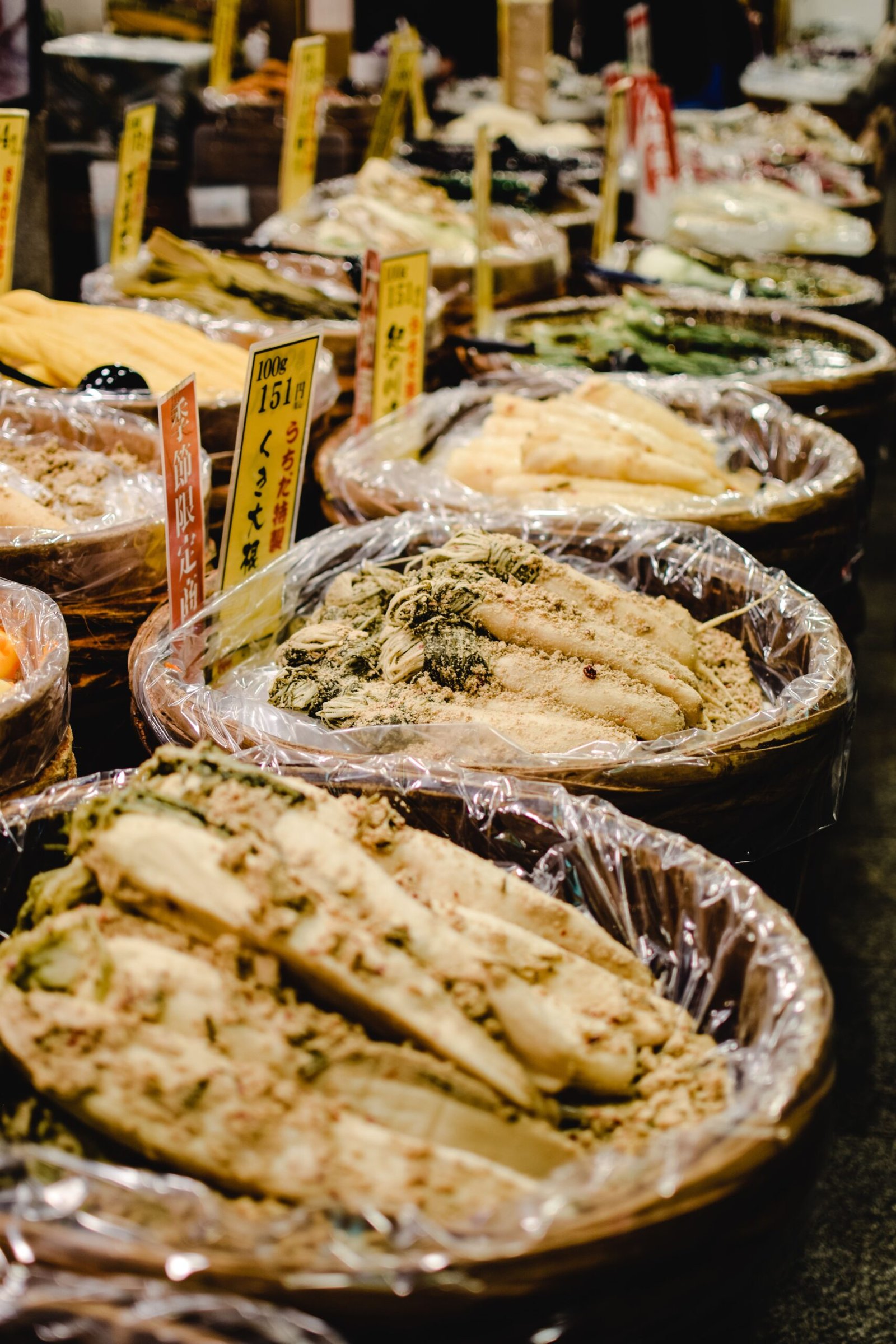
Pickles (tsukemono). Kyoto’s pickled vegetable tradition runs deep, and Nishiki has entire stalls devoted to nothing else — pickled eggplant, daikon, cucumber, and Kyoto’s own heirloom vegetables, usually available as small free samples before you commit to buying a pack.
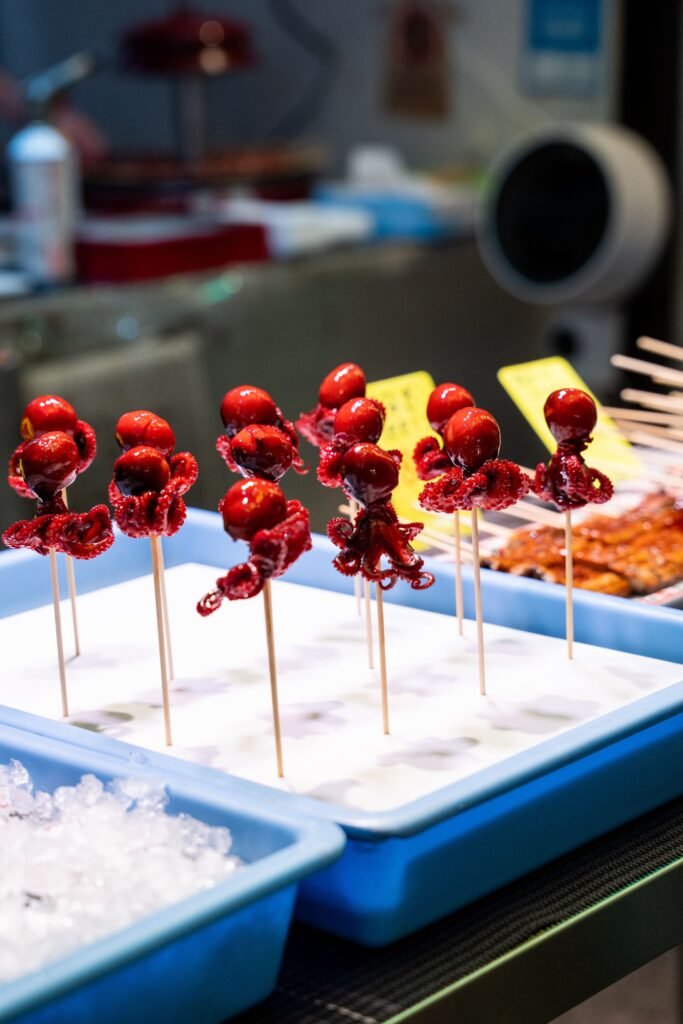
Skewered and grilled seafood. Grilled unagi, octopus skewers with a whole quail egg tucked inside, and scallops cooked to order over open grills are some of the most photographed items in the market, and they taste as good as they look.
Tamagoyaki and dashimaki. Rolled Japanese omelets, some plain and some stuffed, sold in thick slices off a stick — an easy, mild bite if you want something between the stronger-flavored stalls.
Matcha and yuba. Soft-serve matcha ice cream shows up at several stalls, and yuba (fresh tofu skin), a Kyoto specialty, is sold both fresh and as a snack food in a few different forms worth trying if you haven’t had it before.
A Note on Etiquette
Eating while walking through the arcade used to be firmly discouraged, and while enforcement has loosened at plenty of stalls, it hasn’t disappeared. Some shops still expect you to finish what you bought standing in front of their stall rather than carrying it off down the aisle, especially the ones without their own trash bins. When in doubt, look for a small standing area near the stall itself, or ask before you walk off with food in hand.
Nearby, If You Have More Time
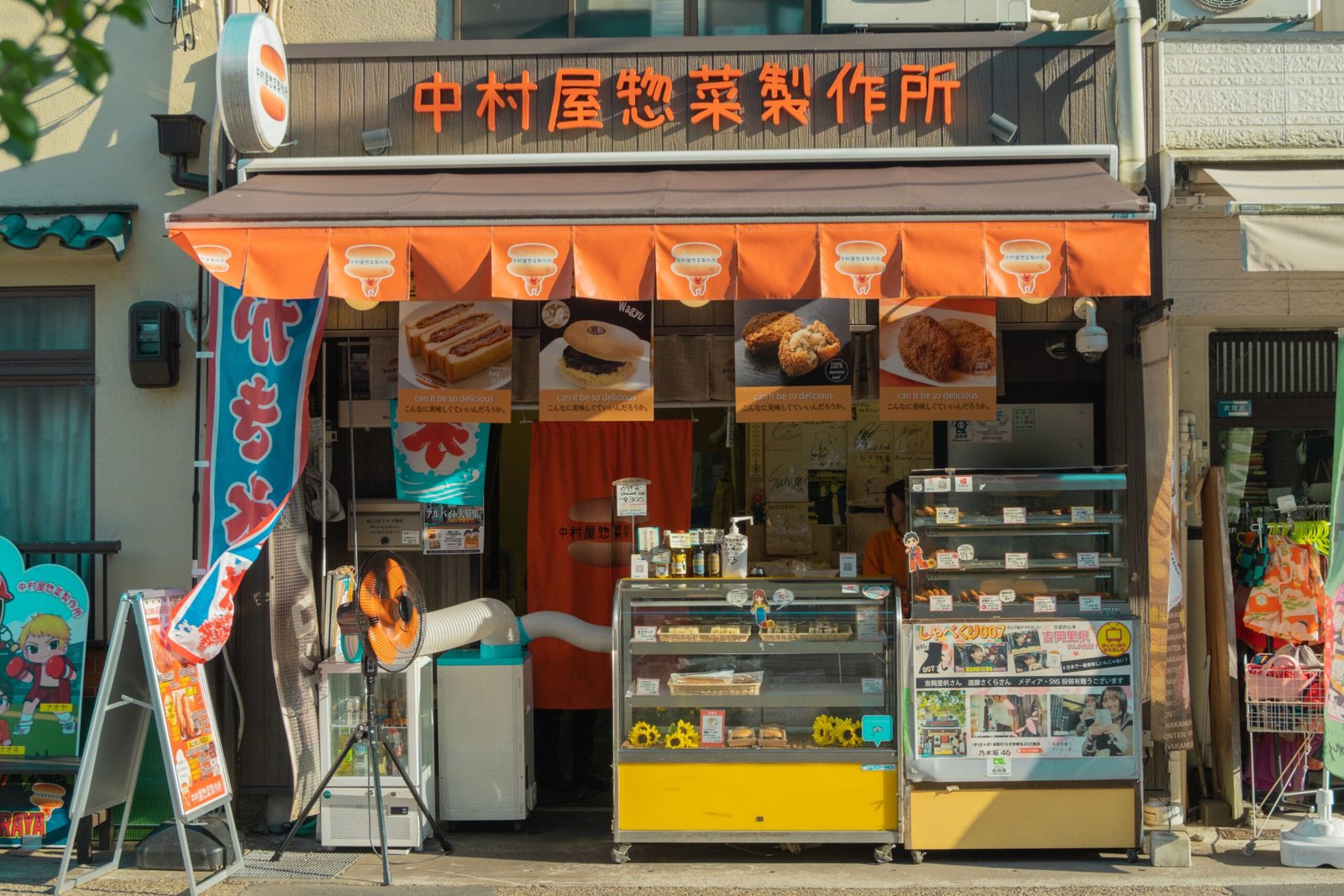
The east end of Nishiki Market feeds directly into Teramachi and Shinkyogoku, two more covered shopping arcades with a completely different character — less food, more clothing, stationery, and souvenir shops, plus a scattering of temples tucked between the storefronts. It’s an easy, seamless continuation if you want to keep walking after the market itself thins out.
Where to Stay Nearby
Nishiki Market sits inside Kyoto’s Kawaramachi and Shijo shopping district, one of the most central and well-connected areas to base yourself in. Our Kyoto neighborhood comparison guide covers this area in more depth alongside the city’s other main districts.
Staying nearby means you can treat the market as a five-minute walk rather than a planned outing, useful if you want to swing back for a snack more than once during your trip. Booking.com has a large concentration of options in this part of the city.
Bottom Line
Nishiki Market rewards grazing over planning. Skip breakfast, show up on a weekday morning, and let yourself get pulled into whichever stall has the longest local line — that’s usually the one worth the wait. Bring small cash, and don’t try to see every shop; picking five or six things to actually try beats a rushed walk past a hundred stalls you didn’t stop at.