Rurikoin: A Practical Guide to Kyoto’s Mirror-Table Maple Reflection
Most of Kyoto’s famous maple views are things you can see any day the temple’s open. Rurikoin isn’t one of them. This small temple in the Yase valley, at the foot of Mount Hiei, keeps its doors shut to the public for most of the year and opens only for a handful of weeks in spring, a few days in summer, and a stretch of autumn that starts in October and runs into early December. What draws people to time a trip around those narrow windows is a single second-floor room, where the maple garden outside reflects onto a black lacquered table like a mirror. It’s one of the more photographed interiors in Japan, and also one of the more logistically fussy temples on this list, so it’s worth knowing what you’re signing up for before you go.
The Essentials at a Glance
| What | Details |
|---|---|
| Admission | ¥2,000 adults; ¥1,000 junior and senior high school students (with ID); one elementary-age child free per paying adult, ¥1,000 for additional children |
| Hours | 10:00 a.m.–5:00 p.m., last entry 4:30 p.m. |
| Open dates | Limited seasonal openings only — spring (roughly mid-April to early June), a short window in summer, and autumn (from October 1 into early-to-mid December in 2026; confirm the exact closing date and any reservation requirement for peak November dates on the temple’s official site before you go) |
| Address | 55 Kamitakano Higashiyama, Sakyo-ku |
| Getting there | Eizan Railway from Demachiyanagi Station to Yase-Hieizanguchi (about 12 minutes’ walk from there), or Kyoto Bus from Kokusaikaikan subway station to the Yase-ekimae stop (about 10 minutes’ walk) |
| Visit length | 30–45 minutes, longer if there’s a queue for the reflection room |
| Good to pair with | Mount Hiei and Enryaku-ji, or a day trip to Kurama and Kifune, both reached from the same Eizan Railway line |
The Reflection That Made It Famous
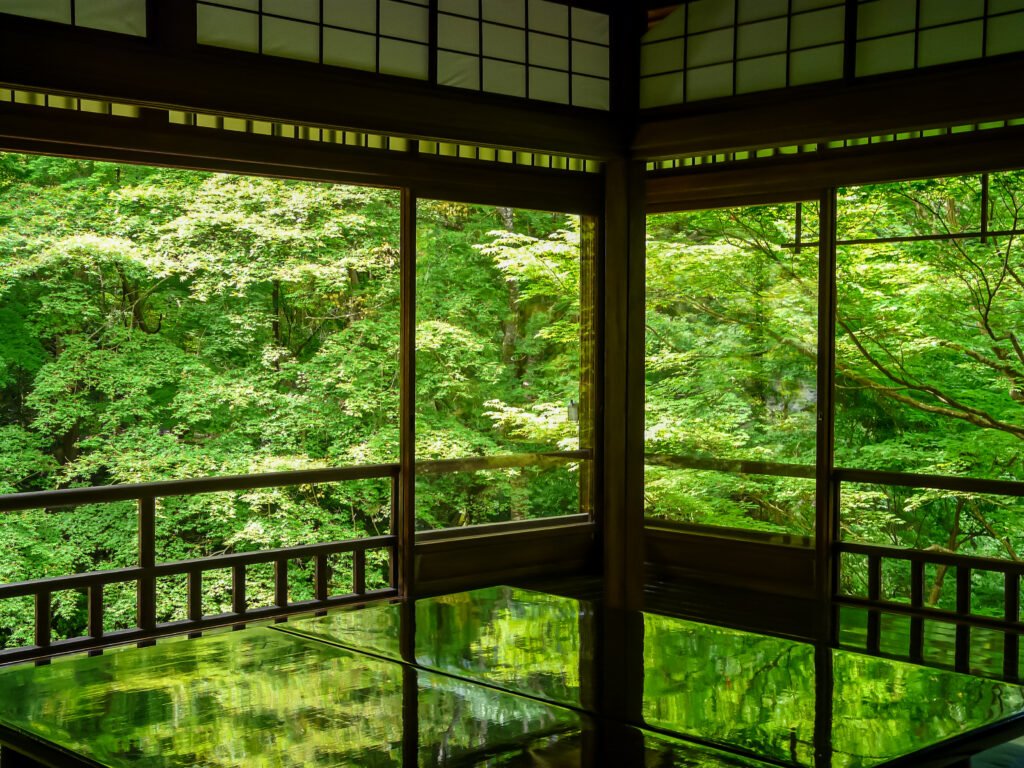
The temple’s signature moment happens in a tatami room on the second floor of the shoin building, where a long, low table finished in black lacquer sits below a wall of glass looking out onto the garden. Sit or kneel at the right angle and the maple canopy outside doubles onto the tabletop, an effect locals call yuka momiji, “floor maple.” In autumn the reflection turns the deep red of the leaves overhead into a second, darker red underfoot; in late spring, when the same trees are fresh green instead, the effect is softer but just as striking, and considerably less crowded. Staff generally keep the line moving during peak color, so a minute or two at the table, rather than an extended sitting, is the realistic expectation on a busy November afternoon. No flash photography, and no touching the table itself, which the temple’s staff enforce more strictly than most Kyoto sites.
A Meiji-Era Villa Turned Temple
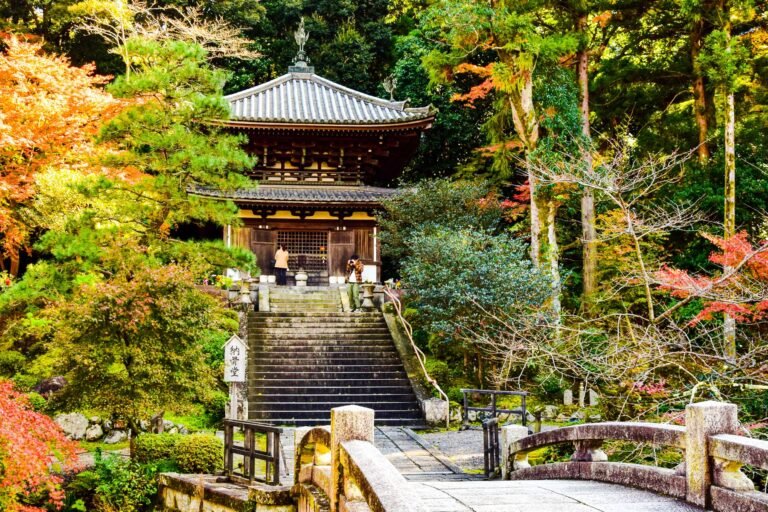
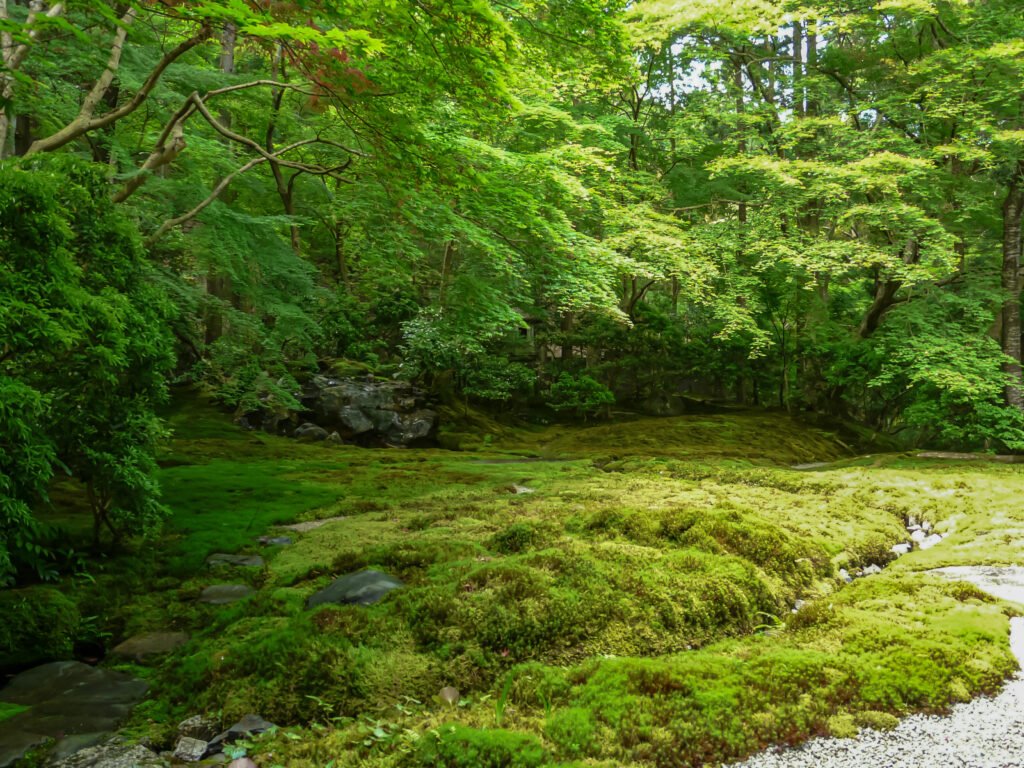
The building started out as a private villa, Kikaku-tei, built in the early Meiji era for Sanjo Sanetomi, one of the most senior court nobles of the new Meiji government and a figure who helped steer the transition out of the shogunate. The site had earlier served travelers along the old road between Kyoto and Lake Biwa, and Sanjo is said to have chosen it for the same reason visitors still come today: the view. In the 1930s the property was renovated by the architect Nakamura Sotoji and its gardens developed further by the noted landscape designer Sano Toemon, and it operated for decades afterward as a restaurant and private retreat before Komyoji, a temple based in Gifu Prefecture, took over the property in 2005 specifically to preserve it and open it to the public as Rurikoin. Today the grounds hold three separate gardens, a tea room, and a small display of Art Deco prints by the French printmaker Louis Icart, a nod to Kyoto’s sister-city relationship with Paris that feels genuinely unexpected inside a Japanese temple.
Getting There
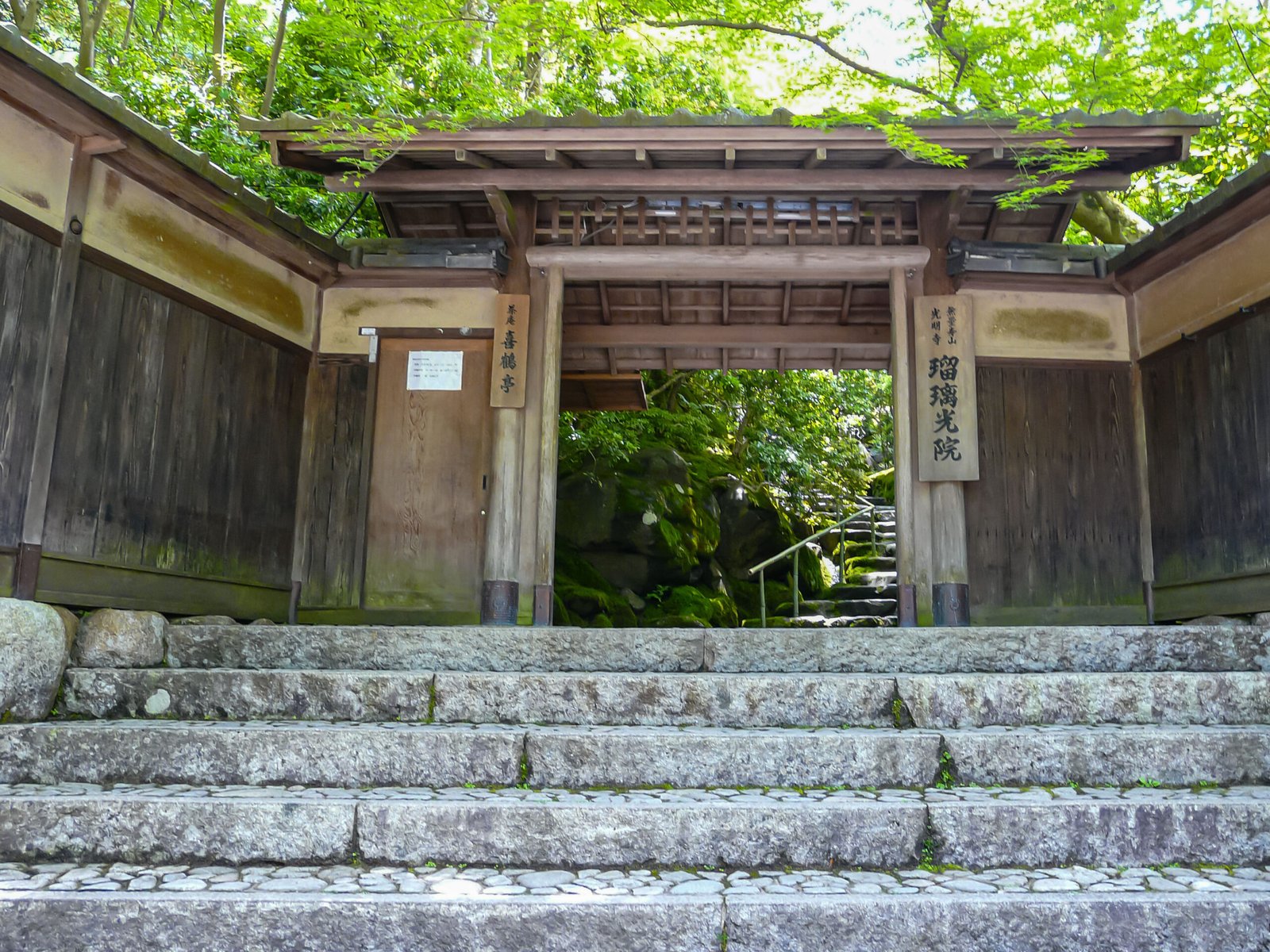
Getting to Rurikoin is most of the experience in itself. The Eizan Railway line out of Demachiyanagi Station runs north along the Takano River and into the hills on small, often single-car trains, past Miyake-Hachiman and on toward Yase, with the foliage along the tracks worth the ride on its own during peak season. From Yase-Hieizanguchi Station it’s a short, well-signed walk to the temple gate. The alternative, a Kyoto Bus from Kokusaikaikan subway station, works fine but skips the train ride, which is arguably the more scenic half of the trip. Either way, an IC card such as ICOCA or Suica covers the fare; there’s no parking at the temple itself, so arriving by car isn’t a practical option.
When to Go and What to Expect
Because Rurikoin only opens for a few weeks a year, timing is less about avoiding crowds and more about hitting the window at all. Peak autumn color usually falls in the second half of November, which is also when the temple is at its busiest and when some dates have required advance reservations in past years; check the official site ahead of your trip rather than assuming same-day entry, especially for a weekend. Admission is cash only, so bring yen rather than relying on a card. Weekday mornings shortly after the 10:00 a.m. opening tend to be calmer than afternoons, and the earlier weeks of the autumn opening, in October, offer a quieter visit with green-to-gold leaves rather than full color, if the crowd matters more to you than peak red.
Pairing It With Yase and Mount Hiei
Yase sits at the base of the cable car and ropeway route up Mount Hiei, so a Rurikoin visit pairs naturally with a half-day at Enryaku-ji, the mountaintop temple complex that anchors Japanese Tendai Buddhism; our guide to Mount Hiei and Enryaku-ji covers the cable car options and what to expect at the summit. The same Eizan Railway line continues north toward Kurama and Kifune, another mountain day trip built around a temple and a shrine rather than a single room, if you have a full day to spend in this corner of Kyoto rather than half of one. And if you’re mapping out when to schedule any of this around the city’s broader foliage season, our Kyoto Autumn Foliage guide lays out how timing varies by neighborhood and elevation.
Bottom Line
Rurikoin asks more of visitors than most Kyoto temples: a narrow open season, a real chance you’ll need to reserve ahead in November, cash at the gate, and a train-then-walk journey that isn’t quite as simple as hopping on the subway. What it gives back is a single room that looks like nothing else in the city, and a quiet valley at the foot of Mount Hiei worth the trip on its own merits. Check the current season’s dates before you build a day around it, and go in October if a shorter line matters more to you than the deepest red.